Japan’s Rare Earth Lesson: De-Risking Beats the Fantasy of Full Decoupling

Working across research, policy, and data-driven analysis, the Editorial Board ensures that published pieces reflect a consistent institutional perspective grounded in quantitative reasoning and long-term structural assessment.
Authored On
Modified
Japan proves China dependence is hard to replace, even after years of effort
The real task is de-risking, not full decoupling
That means coordination, processing capacity, and skilled labor
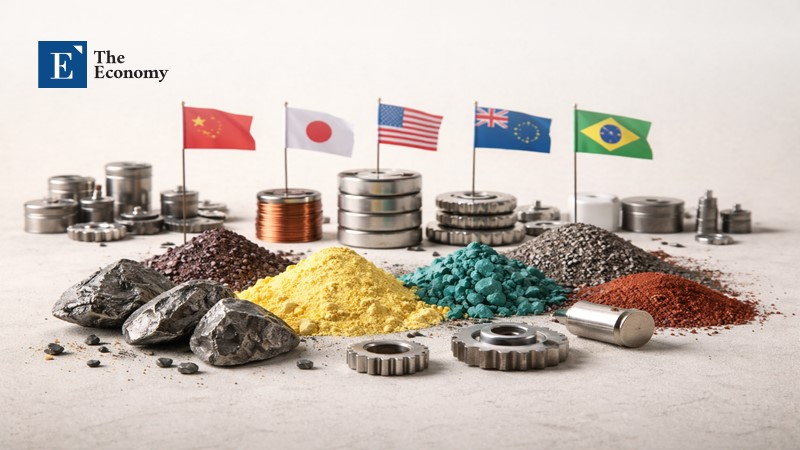
Fifteen years after the 2010 crisis revealed Japan’s vulnerability, the country still relies on China for about 60% of its rare-earth imports. That number should end much of the political talk. Japan isn’t a weak industrial nation. It’s one of the world’s most advanced economies, with strong manufacturing, robust infrastructure, and a highly skilled workforce. It acted early, invested heavily, supported projects overseas, pushed for alternatives, promoted recycling, and built stockpiles. This took years, money, facilities, labs, ports, trained workers, and patience. Japan did many things that Western governments now treat as new ideas. But the result isn’t full independence; it’s partial protection. This is the real lesson for countries that promise to quickly end China's dominance in rare earths. The goal shouldn’t be total escape. It should be building a rare-earth supply chain that can handle risks through managed dependence, cooperation among allies, and much larger investments in the steps between raw ore and final products.
Japan’s Progress: Real but Incomplete
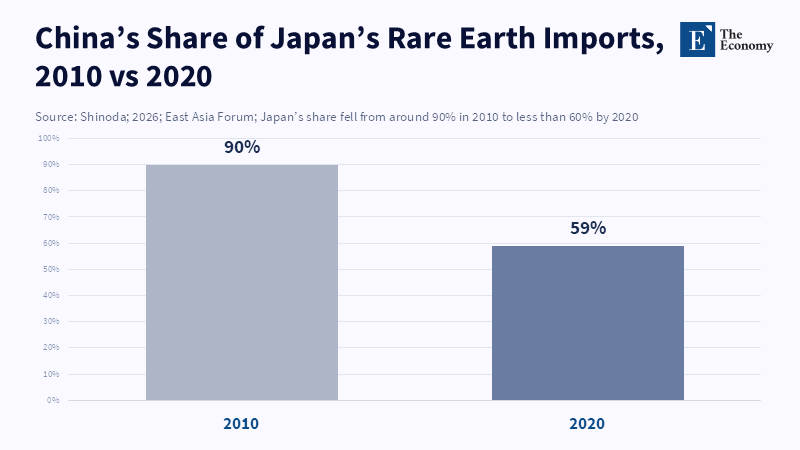
The first point to understand is that Japan didn’t fail because it didn’t do enough. It only failed if the goal was to completely sever ties with China. More realistically, Japan made real progress. It cut its use of Chinese rare earths from about 90% in 2010 to around 60%. Its overall use of rare earths has also dropped by roughly half since the embargo. These aren’t minor improvements—they show that diversification, stockpiling, using materials more efficiently, and steady industrial policies can lower risk. But they also highlight the limits of these tools when one country still dominates the most critical parts of the supply chain. Even today, Japan depends heavily on Chinese sources for certain rare earths used in magnets. Japan’s experience shows that dependence won’t be wiped out quickly. Instead, exposure can be lowered, bargaining power can improve, and vulnerability to crises can drop, while some structural dependence remains.
This nuance matters because debate often overemphasizes mining. Supply chain security requires focus on separation, refining, metalmaking, magnet production, contracts, and skills. Japan advanced in these through partnerships and government support, but progress still took more than 15 years. Full replacement is unrealistic in the near term; effective policy should instead judge whether exposure to risk is shrinking faster than geopolitical threats are increasing.
The Downstream Bottleneck China Controls
The root of this ongoing dependence isn’t merely geology; it’s industrial strength. In 2024, China produced about 270,000 tonnes of rare earth oxides, roughly 69% of the world’s mine output. That’s a dominant share but only part of the picture. The bigger bottleneck is downstream. The International Energy Agency estimates that China accounted for around 60% of global rare-earth magnet mining in 2024, but about 91% of the separation and refining work. In permanent magnets, China accounts for about 94% of production. So, countries can diversify their ore sources, but still remain stuck with most of the value, control, and leverage. The challenge isn’t just the mine; it’s the factories, the processes, industrial clusters, and customer relationships. It’s also about export licenses, quality standards, and trust as a supplier. China’s controls starting in 2025 showed how quickly pressure can shift from raw materials to finished parts containing rare earths.
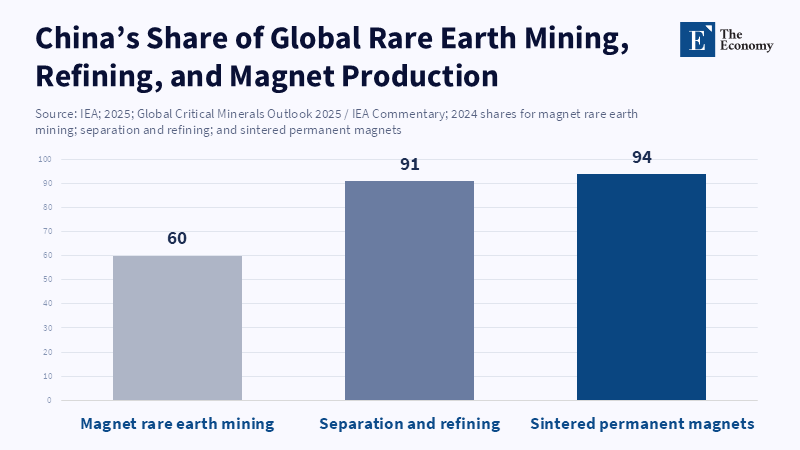
Many current policies don’t fully grasp this problem. Yes, there are reserves in places like Australia, Brazil, Vietnam, and India. But new mining doesn’t automatically create supply chain resilience. The IEA’s 2025 outlook clearly indicates that, even by 2035, China is expected to remain the top supplier of processed rare earths, accounting for about 80% of the rare-earth-refining market for magnets. In a worst-case scenario, excluding China, the rest of the world could cover only about 35-40% of demand. In plain terms, the world isn’t building a quick, China-free backup system, despite official claims. This also explains why stories about deep-sea mining should be viewed with caution. While deep-sea resources could matter in the future, they don’t solve today’s processing bottleneck. They also require years of capital, permits, engineering, and buyer commitments before materials can reach factories.
Rethinking the Goal: Resilience Over Replacement
The real policy lesson is not to give up but to change the focus. Instead of asking how to replace China, governments should ask how to make coercion less effective. These are different goals. The first leads to unrealistic timelines and weak measurements. The second directs attention to stockpiles, long-term buying, minimum price guarantees, shared financing, recycling, alternative materials, and allied capabilities in midstream stages where market failures hit hardest. Japan’s recent moves show this shift. It's newer deals with Australia and Brazil, and its 2026 plan with the U.S. suggests moving away from trying to escape China entirely toward forming market structures. This includes project support, coordinated stockpiling, and price-floor mechanisms that help non-Chinese producers survive when China undercuts prices. The 2026 U.S.-Japan plan also pointed to projects in recycling and processing, not just mining. This is the right path, even if less flashy than language about economic freedom.
Some critics could call this defeatist, arguing that managed dependence accepts Chinese power and locks it in. But the opposite is true. Calling for a complete break too soon can cause governments to underinvest in the tools that really matter now. Japan’s record shows that partial protection isn’t trivial. Cutting dependence from 90 to 60% is significant. Using fewer raw materials and securing supplies of heavy rare earths outside China are important, too. These steps don’t eliminate dependence, but they lower the harm that coercion can cause. Another critique is that stockpiles and price supports are costly and distort markets. That’s true, but market shocks often create even more severe distortions. The rare-earth price spike in 2010 and China’s tightening export controls in 2025 led to production cuts, inflation, loss of competitiveness, and policy panic. Sometimes smart interventions are the price for staying resilient. Empty slogans tend to be far more expensive.
The Human Capital Gap
There’s also an overlooked lesson about people. Rare earth supply chain resilience isn’t just about subsidies and agreements. It depends on having skilled workers. Processing plants, recycling systems, advanced labs, environmental review teams, trade agencies, and finance offices all need specialized expertise. The OECD warned in 2025 of major workforce gaps in mining due to fewer young people entering related education and training programs. This matters because the next phase of strategy requires more knowledge than before. Countries don’t just need miners; they need metallurgists, chemical engineers, geologists, hydrometallurgy specialists, magnet designers, recycling technicians, procurement professionals, and regulators who understand industrial chemistry and economic security. Without these skills, announced projects risk remaining on paper rather than working in practice.
For teachers and policymakers, this means shifting away from vague green transition goals toward practical programs. Technical schools should offer applied courses in mineral processing, materials science, separation chemistry, and industrial maintenance. Community colleges and vocational schools should connect directly with local refining, recycling, and magnet projects rather than being afterthoughts. Universities should also expand training in resource diplomacy, trade law, and ESG verification because contracts, permits, and due diligence matter as much as geology. Policymakers need to fund labs, apprenticeships, and demonstration plants over the long term, even when prices fall, and public attention fades. They also need rules that help new plants find buyers because training isn’t enough if graduates have no place to work. China’s advantage came from a deep ecosystem, not individual projects. Anyone aiming for real resilience must build that depth. Without it, diversification plans will just generate announcements, not actual capacity.
The clearest lesson from Japan isn’t that dependence can be broken by willpower alone. It’s that dependence has many layers, and the hardest ones are in the industrial middle. Japan acted faster and smarter than most would have, diversifying supply, cutting use, supporting overseas production, and building stockpiles. But 15 years later, the system still bends toward China. This isn’t a reason to give up, but to set clearer goals. Governments should stop selling the public simple stories about replacing China and start focusing on reducing vulnerability. That means working with allies on financing, shared stockpiles, midstream processing, recycling, substitutions, and building human capital to support all these efforts. It also means patience. True resilience won’t come in one election cycle or with one flagship mine. Japan has already learned this lesson over many years. Others should learn it sooner rather than later, to avoid overconfidence leading to repeated costly mistakes.
The views expressed in this article are those of the author(s) and do not necessarily reflect the official position of The Economy or its affiliates.
References
AP News (2025) ‘China outlines more controls on exports of rare earths and technology’. Associated Press, 9 October.
Cordier, D.J. (2025) ‘Rare earths’. In Mineral Commodity Summaries 2025. Reston, VA: U.S. Geological Survey.
Daniel (2026) ‘Japan’s Rare Earth Reality Check: Managing China Dependence, Not Escaping It’. Rare Earth Exchanges, 18 March.
Ge, J. (2026) ‘Japan’s bid to build a “de-Chinafied” rare earth supply system – with Australia and Brazil on-board’. The Interpreter, Lowy Institute, 19 March.
International Energy Agency (2024) Global Critical Minerals Outlook 2024. Paris: International Energy Agency.
International Energy Agency (2025) Global Critical Minerals Outlook 2025. Paris: International Energy Agency.
Kim, T.-Y., Dhir, S., Dasgupta, A. and Scanziani, A. (2025) ‘With new export controls on critical minerals, supply concentration risks become reality’. IEA Commentary, 23 October.
Lee, M. (2025) ‘US, Indo-Pacific partners agree to strengthen maritime, critical minerals cooperation’. Associated Press, 1 July.
Meredith, S. and Butts, D. (2025) ‘A lesson for the West? Japan was better prepared than most for China’s rare-earth mineral squeeze’. CNBC, 20 June.
OECD (2025a) Mining for Talent: Addressing Regional Workforce Challenges in a Changing Resources Industry. OECD Local Economic and Employment Development (LEED) Papers, No. 2025/07. Paris: OECD Publishing.
OECD (2025b) OECD Skills Outlook 2025: Building the Skills of the 21st Century for All. Paris: OECD Publishing.
OECD (2025c) ‘Special focus: Critical raw materials supply chains’. In Economic Security in a Changing World. Paris: OECD Publishing.
Reuters (2026a) ‘Japan, US announce energy projects, critical minerals action plan’. Reuters, 19 March.
Reuters (2026b) ‘US, Japan to focus rare earths cooperation on select group of minerals at first’. Reuters, 19 March.
Shinoda, K. (2026) ‘Lessons from Japan’s rare earth shock’. East Asia Forum, 19 March.
Statista Research Department (2025) ‘China: rare earths production 2024’. Statista.
Tani, S. and Shiga, Y. (2026) ‘Inside Japan’s long battle to “de-Chinafy” its rare earth supply chain’. Nikkei Asia, 28 January.
Terazawa, T. (2023) ‘How Japan solved its rare earth minerals dependency issue’. World Economic Forum, 13 October.
Working across research, policy, and data-driven analysis, the Editorial Board ensures that published pieces reflect a consistent institutional perspective grounded in quantitative reasoning and long-term structural assessment.