Personalized Pricing and the End of the Posted Price

Working across research, policy, and data-driven analysis, the Editorial Board ensures that published pieces reflect a consistent institutional perspective grounded in quantitative reasoning and long-term structural assessment.
Authored On
Modified
Digital markets are moving from dynamic pricing to personalized pricing
That shift lets firms charge people based on data, not just supply and demand
Consumer protection now needs a right to a fair, impersonal price
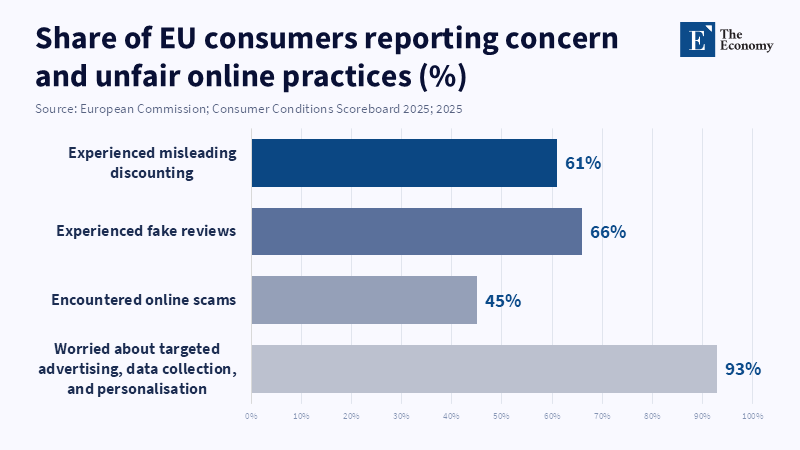
93% of online shoppers in the European Union express concern about targeted advertising, data collection, and personalization practices. This is a significant indicator rather than a minor caution. It signals the emergence of a new dimension in pricing disputes. Previously, debates around pricing centered on whether flight prices varied by day of the week or whether hotel rates fluctuated between seasons. While it has long been accepted that markets modify prices over time, seasonality, and across customer segments, a substantive transformation is now underway: pricing is becoming increasingly individualized. Sellers have moved past traditional visible pricing approaches such as student discounts, loyalty programs, or peak-time surcharges. They are now capable of tailoring offers based on data signals, including geographical location, browsing patterns, device characteristics, and user behavior. In essence, the market is approaching the theoretical ideal of first-degree price discrimination, in which prices are set as closely as possible to each individual buyer’s willingness to pay. As this practice gains prevalence, the conventional concept of a fixed posted price diminishes in relevance. Consequently, consumer protection frameworks have to evolve accordingly.
The Hidden Mechanics of Personalized Pricing
This issue is critical because public discourse frequently reduces personalized pricing to a consumer tactic problem, such as clearing cookies, using private browsing modes, or switching devices to obtain better prices. Although such strategies might offer marginal benefits in some contexts, they overlook the wider concern. The central problem is not whether a single browsing session consistently triggers higher airfare, but that firms now possess both the extensive data and the financial incentives to institutionalize individualized pricing. In 2024, the U.S. Federal Trade Commission issued orders to eight enterprises within the surveillance-pricing ecosystem. Early findings released in 2025 revealed that firms could utilize highly detailed data—such as precise location, browsing history, and even cursor movement—to influence the prices and options presented to different consumers. This phenomenon is not merely anecdotal, as reported on travel forums; it reflects an emerging market structure.
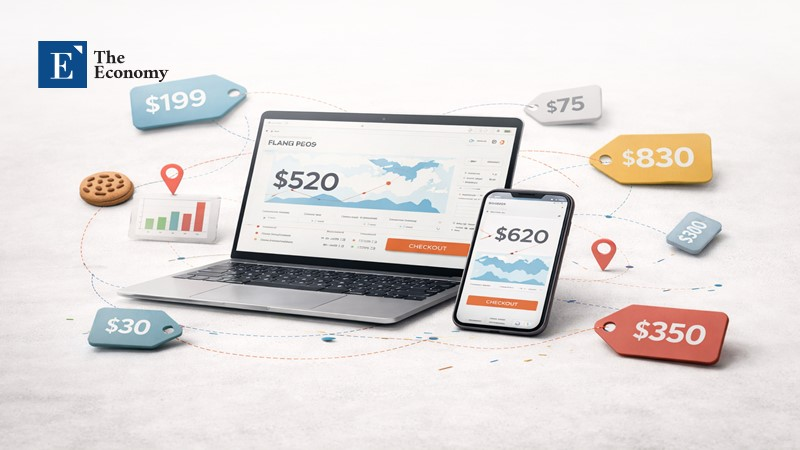
It is important to distinguish personalized pricing from traditional forms of dynamic pricing. Economists should exercise caution, recognizing that not all price variability is equivalent. Much of consumer acceptance relates to second- or third-degree price discrimination, which is often transparent and understandable. For instance, gyms offer memberships with varying benefits, streaming services apply different rates depending on the country, and airlines differentiate prices based on ticket flexibility as well as booking timing relating to traveler type (business versus leisure). These practices segment markets in identifiable ways and offer consumers meaningful choices among alternatives reflecting trade-offs. By contrast, personalized pricing blurs the distinction between market-driven and individual-specific factors. This is the fundamental policy challenge. Price increases justified by observable market conditions, for example, limited seat availability, are relatively straightforward. However, when prices rise because algorithms infer personal characteristics—such as time constraints, device used, socioeconomic status, or prior consumer interest—the pricing logic goes beyond scarcity or timing to incorporate surveillance elements. Empirical studies complicate common assumptions; for example, some investigations found no evidence of price discrimination based on air carriers or browser cookies. These outcomes do not suggest policy irrelevance; rather, they illuminate the complexity of the issue, which involves the fusion of profiling, real-time experimentation, and opaque pricing in markets lacking transparent base prices.
Industry in Practice: The Airline Model
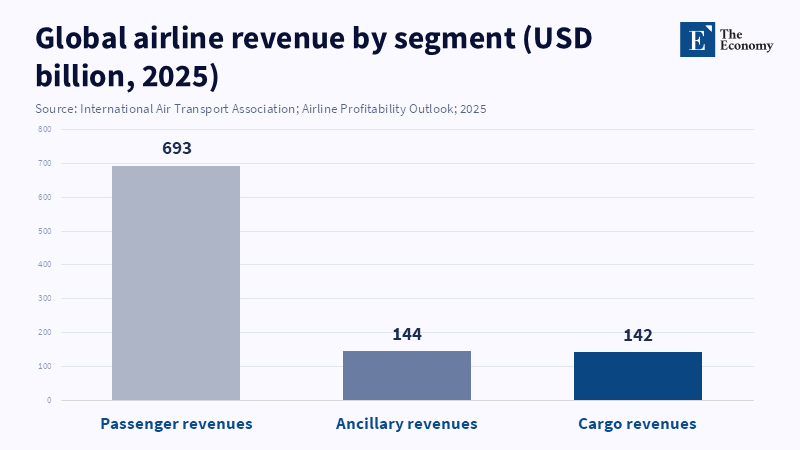
The airline industry illustrates this shift through its longstanding use of price discrimination. Recent research published in the Review of Economic Studies shows the extent of intertemporal and intratemporal discrimination practiced by airlines, segmenting customers based on booking time, cabin class, route, and travel purpose. Concurrently, the industry’s retail model is evolving; programs such as IATA’s Dynamic Offers aim to enable airlines to generate tailored offers grounded in shopping context and consumer patterns. The transition toward more granular retailing, encompassing offers and orders, is intended to increase flexibility. With global passenger revenues projected to reach hundreds of billions of dollars and billions of passenger segments, even marginal improvements in extracting willingness to pay bear considerable economic significance. This development is structural, rather than incidental.
Economic theory supports these observations but also denotes caution. An important 2024 study in the American Economic Review found that the effects of personalized pricing vary with market coverage and competitive conditions. This complexity invalidates simplistic assertions that personalized pricing is inherently detrimental or that market competition will self-correct such concerns. In markets characterized by concentration or limited comparability, opaque personalization may shift surplus from consumers to firms without affording consumers a reasonable opportunity to respond. Accordingly, academic instruction should revise the treatment of price discrimination, recognizing that although traditional categories remain relevant, attention must now focus on discriminatory inference—the system’s perception of the consumer’s identity and circumstances—which can translate into undisclosed price increases.
A common argument in defense of first-degree style personalization is that it may improve efficiency by expanding output, filling unsold capacity, and aligning prices more closely with demand. While this has some validity and prior scholarship has shown that certain forms of discriminatory pricing can enhance total welfare relative to uniform pricing, this rationale does not address current concerns. Efficiency cannot be a blanket justification when pricing mechanisms are opaque and impose burdens on consumers who cannot observe, compare, or contest prices. Markets may achieve narrow efficiency while undermining wider societal trust. When firms infer attributes such as urgency, family status, or information asymmetry from consumer data, the fundamental question shifts from seat sales volume to whether pricing reflects genuine willingness to pay or exploits consumer vulnerabilities. This distinction parallels the difference between a market signal and an imbalance in bargaining power.
Why Disclosure Alone Is Not Enough
Regulatory responses commonly prioritize disclosure, requiring openness about the use of algorithms in pricing, with the expectation that informed consumers will regulate the market. Yet research by OECD and ESRI indicates that even robust and repeated disclosures exert minimal influence on consumer awareness or behavior, and perceptions of unfairness persist. This outcome arises because mere warnings at the point of sale neither restore consumers’ bargaining power nor provide choices or access to benchmark prices devoid of personalization. For example, New York’s Algorithmic Pricing Disclosure Act mandates explicit communication when personal data informs pricing decisions. While this represents progress, disclosure alone does not constitute equitable market conditions.
Within learning settings, this issue is tangible rather than theoretical. Students, families, and institutions engage with data-driven markets, including study-abroad travel, conference participation, accommodations, software subscriptions, tutoring services, testing platforms, and campus food delivery. Therefore, educators should incorporate personalized pricing within economic literacy and digital citizenship curricula, seeing it as more than an industrial organization curiosity. Administrators ought to consider procurement policies, travel regulations, and vendor agreements when prices may vary without transparency. Policymakers have to move beyond an informed-consumer paradigm; without comparison points, information alone offers limited protection. A student informed that a price is personalized, yet unable to discern the non-personalized baseline, is simply made aware that conditions are uneven.
Establishing a right to an impersonal price would be a sensible next step, though it would be hard to implement legally. This does not imply eliminating all forms of dynamic pricing but rather delineating a boundary between price variation driven by objective market factors and that driven by individual profiling. Sellers may continue adjusting prices based on timing, inventory levels, service class, or seasonality, but should not, except under strict regulation, deploy personal or inferred traits to silently raise prices beyond a public baseline. Current European legislation primarily mandates disclosure when automated decision-making influences personalized pricing; however, the European Parliament acknowledges these protections are insufficient for the developing market context. More effective regulations would require visible benchmark pricing, prohibitions on the use of sensitive or vulnerability-linked data, audit trails accessible to regulators, and mechanisms allowing consumers to select impersonal pricing by default.
Toward a Right to Impersonal Pricing
Anticipated objections include claims that such rights would suppress innovation, restrict beneficial discounts, or impede improved product-consumer matching. This illustrates the need to distinguish between personalizing offers and personalizing prices. While tailoring recommendations based on preferences remains acceptable, covertly charging higher prices based on predictive tolerance is fundamentally different. Regulators should preserve space for customization yet tighten rules governing price extraction. Universities can contribute by advocating for clearer procurement conditions, educating stakeholders on digital market profiling, and supporting regulatory systems that ensure price auditability. Although education cannot replace regulation, it can promote more informed regulatory debates.
The essential message for academic discussion is that personalized pricing threatens fundamental civic norms by disconnecting price from product and market factors and instead tying it to concealed buyer characteristics. Given the broad concern among consumers about data-driven personalization, the response cannot be limited to advising smarter browsing habits. Rather, an adjustment of fair exchange rules is necessary. Students must understand the implications of first-degree price discrimination and recognize that the challenge is no longer hypothetical. As posted prices decline, it becomes imperative for regulators, educational institutions, and decision-makers to defend the principle of impersonal pricing; otherwise, markets risk reinforcing a harsher reality in which greater knowledge of individuals results in less neutral pricing.
The views expressed in this article are those of the author(s) and do not necessarily reflect the official position of The Economy or its affiliates.
References
Aryal, G., Murry, C. and Williams, J.W. (2024) ‘Price discrimination in international airline markets’, Review of Economic Studies, 91(2), pp. 641–689.
Azzolina, S., Razza, M., Sartiano, K. and Weitschek, E. (2021) ‘Price discrimination in the online airline market: An empirical study’, Journal of Theoretical and Applied Electronic Commerce Research, 16(6), pp. 2282–2303.
European Commission (2025) Consumer Conditions Scoreboard 2025. Brussels: European Commission.
Esposito, F. (2022) ‘The GDPR enshrines the right to the impersonal price’, Computer Law & Security Review, 45, article 105660.
Federal Trade Commission (2024) ‘FTC issues orders to eight companies seeking information on surveillance pricing’, press release, 23 July.
Federal Trade Commission (2025) ‘FTC surveillance pricing study indicates wide range of personal data used to set individualized consumer prices’, press release, 17 January.
Hamel, Z. (2014) ‘Do browser cookies really affect online airline ticket prices?’, Capstone: The UNC Asheville Journal of Undergraduate Scholarship, 27(1).
International Air Transport Association (2025a) ‘Airline profitability to strengthen slightly in 2025 despite headwinds’, press release, 2 June.
International Air Transport Association (2025b) Dynamic Offers. Montreal/Geneva: International Air Transport Association.
James, L. (2026) ‘Attorney General James demands answers from Instacart about algorithmic pricing’, press release, 8 January. New York: Office of the Attorney General of the State of New York.
Julienne, H., Barjaková, M., Robertson, D. and Lunn, P. (2021a) ‘Online disclosures fail to make consumers aware of personalised pricing’, ESRI Research Bulletin, 2021/06.
Julienne, H., Barjaková, M., Robertson, D. and Lunn, P. (2021b) The effects of online disclosure about personalised pricing on consumers: Results from a lab experiment in Ireland and Chile. OECD Digital Economy Papers, No. 303. Paris: OECD Publishing.
Loader, A. (2025) ‘Price discrimination and the airline industry: Economic effects of tiered pricing models’, Economics Online, 26 February.
Rhodes, A. and Zhou, J. (2024) ‘Personalized pricing and competition’, American Economic Review, 114(7), pp. 2141–2170.
Rott, P., Strycharz, J. and Alleweldt, F. (2022) Personalised pricing. Brussels: European Parliament, Policy Department for Economic, Scientific and Quality of Life Policies.
Vorobeva, Z. (2025) ‘How airlines use price discrimination: Insights from economics and data science’, Medium, 10 September.
West, D.M. (2026) ‘What is dynamic pricing, and why do consumers need better protections?’, Brookings, 18 March.
Working across research, policy, and data-driven analysis, the Editorial Board ensures that published pieces reflect a consistent institutional perspective grounded in quantitative reasoning and long-term structural assessment.