Europe’s Quiet Efficiency Model: Why Labour Costs, Not a Lack of Innovation, Hold Back Growth

Working across research, policy, and data-driven analysis, the Editorial Board ensures that published pieces reflect a consistent institutional perspective grounded in quantitative reasoning and long-term structural assessment.
Authored On
Modified
Europe’s productivity lags mainly because high labour costs push firms to scale elsewhere
Silent process innovations thrive, yet much value escapes when production is off-shored
Cutting the domestic cost of work is the decisive step for renewed European growth
In Europe, discussions of growth often use the wrong approach. People say the continent lacks daring entrepreneurs, creative destruction, spectacle, and a unifying story. But the numbers tell a different story. In 2024, labor productivity per hour worked in the EU increased by just 0.4%, following a 0.6% drop in 2023. At the same time, average hourly labor costs reached €33.5, with non-wage costs making up nearly a quarter of total labor expenses. This isn’t about a lack of ideas but rather about the high costs associated with organized labor, compliance, and domestic production that reduce the benefits of scaling up activities in Europe. The main barrier to European productivity growth isn't a shortage of patents or talent. Instead, it’s the expense involved in turning ideas into large-scale production on European soil. Europe does innovate, but it doesn’t always industrialize that innovation where the work happens.
Europe’s Innovation Is Quiet, Not Absent
The first misunderstanding in Europe’s growth debate is to confuse quiet innovation with weak innovation. Europe is a mature economy, and such economies don’t always highlight their progress with famous founders or media hype. Much of Europe’s strength comes from integration, engineering, strong supplier networks, process control, and the steady adoption of new methods within established companies. This approach might be less visible than the American startup story, but it remains genuine. In 2024, the European Patent Office received nearly 200,000 patent applications, and filings from member states rose marginally despite a weak economy. EU business research and development also remains substantial, reaching 1.49% of GDP in 2024. European inventions are not scarce. Instead, many firms improve, adapt, and refine existing ideas. The issue is that such steady progress is often mistaken for stagnation because it lacks a dramatic narrative.
This difference is important because it affects policy solutions. If Europe truly lacked talent, the answer would be to invest in more labs and incubators and wait for a breakthrough entrepreneur. According to the European Commission, AI talent in the EU has more than doubled between 2016 and 2023, now accounting for 0.41% of the European workforce, highlighting the region’s growing technical skills and research capabilities. Europe is active and quick to adopt new technology. However, adoption must not be confused with ownership, and creating new ideas is not the same as obtaining the value that comes from scaling them. According to the European Patent Office, while Europe is active in improving processes and meeting demand, it struggles to retain the most profitable aspects of scaling and investment, as 57 percent of European patent applications in 2023 were filed by companies and inventors outside Europe. This is a structural issue, not a cultural one.
Because of this, calls for Europe to produce another Elon Musk miss the real point. The continent doesn’t mainly need louder entrepreneurs but rather a lower cost to maintain production and scale nearby. The fixation on symbolic disruption distracts from the more practical question of at which efficiency gains actually occur. Many European firms quietly integrate advances into medium-sized businesses, supply chains, and operations without public attention. Yet when it comes to expanding labor-intensive production, many companies shift that activity abroad. For example, China accounted for over 21% of extra-EU imports in 2024, and the EU had a goods deficit of €304.5 billion with China. This doesn’t mean Europe’s challenges are only about labor costs, but it shows the continent has grown comfortable with a model in which design and premium products remain in Europe, while much of the scalable production value is captured elsewhere.
The Real Barrier: The Cost of Scaling at Home
Once this global setup is clear, the next point comes naturally. Europe’s growth problem is less about generating ideas and more about making it affordable to implement them domestically at scale. Labor costs are a key part of this. In 2024, average hourly labor costs in the EU industry were €33.9, and non-wage costs made up 24.7% of total labor costs, with some countries having even higher rates. These costs aren’t accidental; they reflect decades of social protections, including pensions, insurance, and bargaining systems that preserve social peace. But they still add up. When companies consider sites for production, assembly, and support, these costs influence where investments go. Capital seeks the best return after accounting for expenses, taxes, and risks. Europe cannot ignore this reality by appealing to moral arguments alone.
This is where many European discussions avoid the real issues. They act as if Europe can keep all its labor protections and regulations, rely on imported production, and still expect a big leap in productivity. But such gains often come where production is large-scale, repetitive, and cost-sensitive. According to research by Bernhard Dachs and colleagues, when production is moved outside Europe, European firms tend to retain higher-value functions such as R&D and design, and they frequently introduce new products and invest in cutting-edge technologies more frequently than firms that keep all production local. However, some of the direct learning and innovation linked to factory work may occur elsewhere as a result. According to Eurostat, in 2024 the European Union achieved a goods trade surplus of €147 billion, suggesting that concerns about deeper problems tied to trade deficits may not reflect the current trade situation. It concerns where operational knowledge accumulates over time.
Lowering Production Costs Without Abandoning Labor Rights
Some claim that reducing labor’s share of revenue would hurt Europe’s social model and reduce demand. That worry is real, and Europe should avoid a race to the bottom. But the choice isn’t just between full protection and social collapse. There’s room for plans that reduce hiring and production costs without dismantling labor rights. These could include lower payroll taxes on new hires, stronger incentives for automation at home, faster permitting, cheaper energy, simpler reporting for medium firms, and fairer tax treatment between capital investment and labor compliance. The goal is to lower the effective cost of producing in Europe while maintaining labor protections. The real test is not whether labor rights survive in name, but whether Europe can make output cheap enough to keep more productivity within its borders.
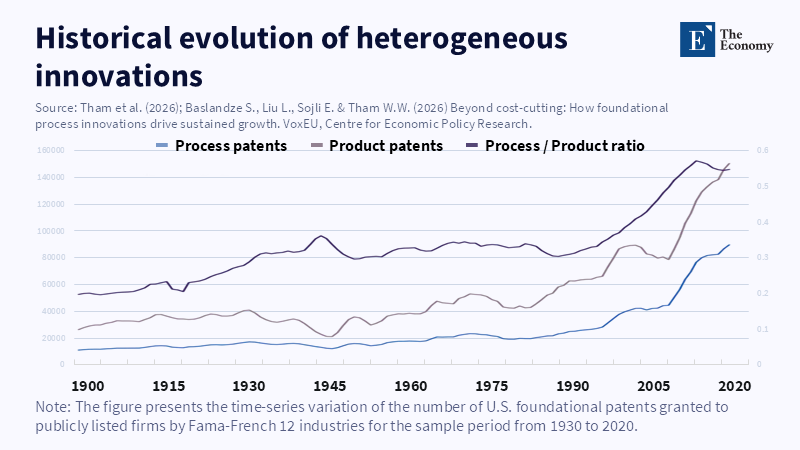
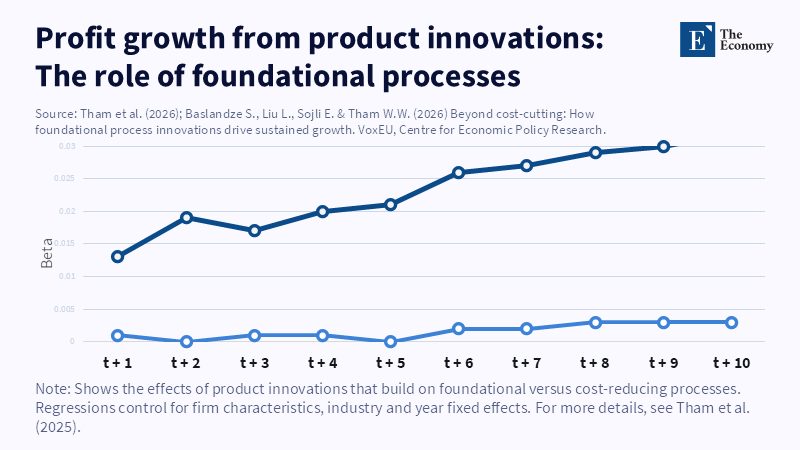
This matters because not all innovation has the same effect. It’s useful to distinguish between flashy product inventions, simple cost-cutting, and deep process innovations that change what firms can build in the future. Research has shown that some process improvements do more than just reduce costs — they create new capabilities that support future growth and help firms expand over time. This fits well with Europe’s strengths. European firms often excel in standards-setting, accurate engineering, workflow redesign, and operational dependability. These don’t make headlines but are important for long-term competitiveness. Europe may be undervaluing the type of foundational innovation it already has. The main weakness isn’t the lack of these gains but that Europe often lets the largest scaling benefits happen elsewhere.
Artificial intelligence highlights this point. Recent studies of over 12,000 European firms found that AI adoption increases labor productivity by around 4% on average, with no evidence of short-term job losses. This suggests a practical path for Europe: improving work efficiency, increasing capital intensity, and raising output per worker. But the same research also shows AI is not enough on its own. Additional investments in software, data, and organizational changes are demanded to unlock bigger benefits. Europe is good at adopting AI but less strong at leading frontier technology, attracting later-stage capital, and handling computational scale. The risk is that Europe remains a skilled user of general technologies, while much of the profits, platform control, and biggest gains accrue elsewhere. A region can be efficient yet still miss out on valuable layers if it fails to control key bottlenecks.
For teachers and decision-makers, this means the lesson isn’t about encouraging more founders with big personalities. It’s about teaching how mature economies grow without noise. Curricula should emphasize operations, industrial software, process engineering, logistics, compliance, machine integration, and adoption within existing firms. Administrators should stop treating productivity as a remote macro concept and see it as a structural issue involving technical training, procurement, data infrastructure, and regional industry partnerships. Policymakers should stop assuming that more patents alone will fix growth. The real challenge is to make it cheaper and easier to apply, scale, and keep capabilities in Europe. This is harder than celebrating disruption, but it’s what really counts.
The Political Reality Europe Rarely Admits
There’s a political reality that Europe rarely admits outright. A mature social democracy can’t and shouldn’t suddenly slash labor protections. But it also can’t pretend that high labor costs, expensive energy, fragmented capital, and complex rules will lead to US-style growth simply if the right visionary entrepreneur appears. The competitiveness debate in Brussels now acknowledges slowing productivity, higher energy costs, and tougher global competition. The productivity gap with the US is striking. Between late 2019 and mid-2024, productivity per hour in the euro area rose only 0.9%, compared to 6.7% in the US. This gap can’t be explained away by cultural reasons related to entrepreneurship. It points to a structural issue. Europe has many strengths and has also built a cost environment that discourages some forms of domestic scaling compared to other places.
Some commentators might say this sounds like a call for labor cuts and social rollback. It’s not. A more accurate view is that Europe should protect labor rights while reducing the tax and compliance costs associated with productive work from home. It should lower penalties for hiring, training, automation, and expansion within Europe. Profit should be allowed without being seen as a moral problem. Europe must accept that capital won’t keep absorbing rising labor costs as a civic duty forever. And relying on Asia for cost-sensitive production means depending on it for much of the future's efficiency gains, too. That’s the real tactical choice. Europe can keep its mature social order, but if it wants stronger productivity growth, it must make domestic production less costly, not just celebrate more innovation stories.
That initial statistic should stick with us. A continent in which productivity barely grows while labor costs rise isn’t mainly short on talent. It faces a mismatch between skill and cost. Europe still has skilled people, strong companies, respected universities, deep industrial knowledge, and the ability to adopt new tools. What it lacks isn’t thought leadership in a showy sense, but a political willingness to admit that growth depends on lowering the cost of work, scale, and execution within Europe. This doesn’t mean breaking the social contract, but modernizing it. If Europe continues to export labor-intensive parts of production while importing the finished products, it will stay clever but slower, inventive but less dynamic, and wealthy but less productive. The challenge now is clear: preserve the quiet intelligence but make it cheaper to turn that intelligence into output. That is how European productivity growth can move from slogan to strategy.
The views expressed in this article are those of the author(s) and do not necessarily reflect the official position of The Economy or its affiliates.
References
Aldasoro, I., Gambacorta, L., Pal, R., Revoltella, D., Weiss, C. & Wolski, M. (2026) AI adoption, productivity and employment: Evidence from European firms. EIB Working Paper 2026/02. Luxembourg: European Investment Bank.
Baslandze, S., Liu, L., Sojli, E. & Tham, W.W. (2026) Beyond cost-cutting: How foundational process innovations drive sustained growth. VoxEU, Centre for Economic Policy Research.
Dachs, B., Ebersberger, B., Kinkel, S. & Som, O. (2015) ‘The effects of production offshoring on R&D and innovation in the home country’, Journal of Industrial and Business Economics, 42(1), pp. 9–31.
European Central Bank (2024) Recent country-specific and sectoral developments in labour productivity in the euro area. Economic Bulletin.
European Commission (n.d.) Shaping and strengthening European AI talent. Brussels: European Commission.
European Commission (2024) The future of European competitiveness. Brussels: European Commission.
European Innovation Council and SMEs Executive Agency (2025) EPO publishes Patent Index 2024: Growth in artificial intelligence and battery technology innovations. Brussels: European Commission.
European Union, Eurostat (2024) Labour cost index – recent trends. Luxembourg: Publications Office of the European Union.
European Union, Eurostat (2025a) EU hourly labour costs ranged from €11 to €55 in 2024. Luxembourg: Publications Office of the European Union.
European Union, Eurostat (2025b) EU trade in goods surplus up to €147 billion in 2024. Luxembourg: Publications Office of the European Union.
European Union, Eurostat (2025c) Slight decline in imports and exports from China in 2024. Luxembourg: Publications Office of the European Union.
European Patent Office (2025) Patent Index 2024. Munich: European Patent Office.
Orsingher (2024) EPO Patent Index 2023: Patent applications on the rise. Milan: Orsingher Ortu – Avvocati Associati.
Steinschaden, J. (2026) ‘Europeans consume AI brilliantly, but train the algorithms owned by others’, Trending Topics.
Working across research, policy, and data-driven analysis, the Editorial Board ensures that published pieces reflect a consistent institutional perspective grounded in quantitative reasoning and long-term structural assessment.