Remote Work Fertility Dividend: Why Education Systems Should Lean In

Working across research, policy, and data-driven analysis, the Editorial Board ensures that published pieces reflect a consistent institutional perspective grounded in quantitative reasoning and long-term structural assessment.
Authored On
Modified
Remote work is driving an 8 percent jump in births
That fertility boost stabilises future school enrolment at virtually no public cost
Governments should embed flexible work as core demographic infrastructure

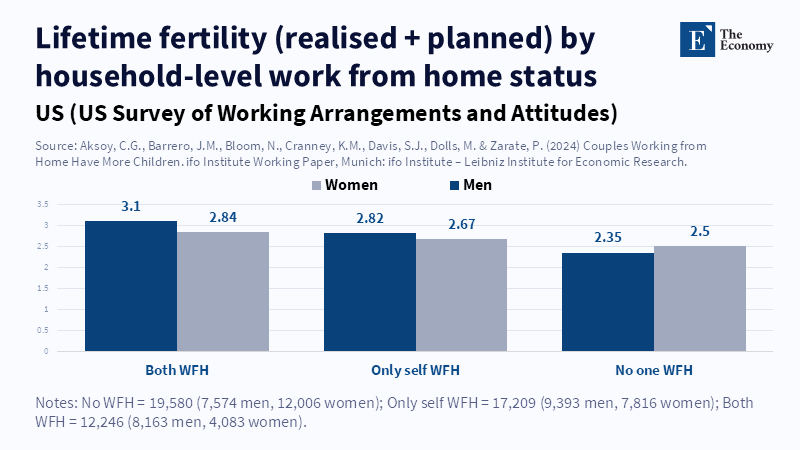
In 2024, approximately 8% of all newborns in the United States—an estimated 291,000 infants—can be linked to a slight yet meaningful shift in work arrangements: the transition of parents from working in traditional office cubicles to performing professional duties remotely, often from their kitchen tables. This single statistic necessitates a review of longstanding discussions of declining birth rates. Historically, governments have adopted several strategies, such as financial incentives (e.g., baby bonuses and tax credits) and high-profile media campaigns, aimed at supporting higher fertility. In spite of these efforts, none have achieved changes on the scale observed recently, let alone within a single fiscal year. Emerging empirical data regarding fertility patterns associated with remote work suggest that flexible work schedules influence family planning decisions in substantive ways beyond only increasing employee satisfaction. Should flexible working arrangements prove capable of incrementally raising birth rates without imposing significant demands on public finances, the ramifications would extend well beyond employment sector trends, directly impacting educational institutions that policymakers currently anticipate may face substantial under-enrollment in the coming decade.
Remote Work and the Fertility Shift
The intersection of remote work and fertility provides an intriguing development within demographic studies. According to research published by Aksoy and colleagues, when both partners work from home one or more days per week, estimated lifetime fertility is higher by an average of 0.32 children per woman compared to households where neither partner works remotely. According to research by Pabilonia and Vernon, fathers’ remote or hybrid work arrangements are closely linked with higher employment among mothers.
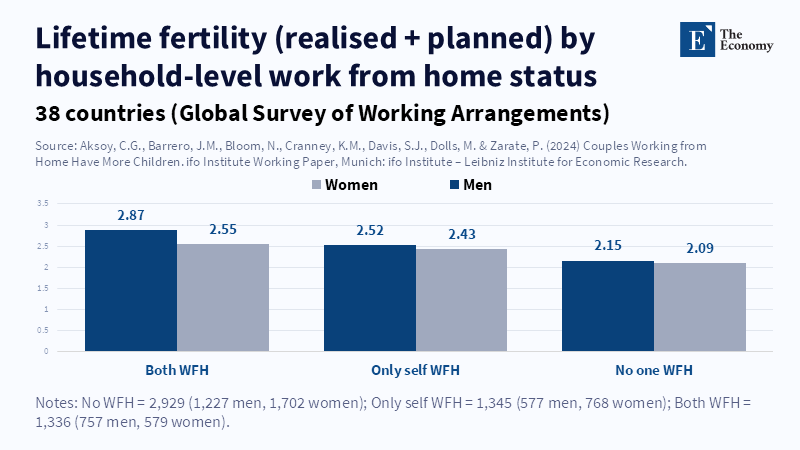
The significance of remote work’s impact on fertility emerges amidst developing demographic issues. Whereas traditional demographic theory projected a near-inevitable trajectory of population aging and decline in developed countries, the introduction of flexible work arrangements coincides temporally with emerging enrollment fluctuations within educational systems. For instance, local governments in England are compelled to merge classrooms due to diminished primary school cohorts, and projections for Japan anticipate the closure of nearly one-third of public schools by 2035. Policies that encourage even a small increase in remote work opportunities could help boost birth rates with little impact on public budgets. According to research by Di Filippo, Escobar, and Facal, women are more likely to be employed when their husbands have more opportunities to work from home, which could in turn affect family planning decisions.
Time, Caregiving, and the Remote Work Effect
At the core of fertility decisions lies the allocation of time rather than economic resources alone. The elimination or reduction of daily travel through remote work effectively reallocates several hours per week, much of which is redirected toward caregiving responsibilities—whether for children, elderly family members, or personal rest. Time-use research estimates that dual-remote households reclaim approximately 5 hours weekly, of which 2 hours are devoted to direct childcare, another hour to unpaid domestic tasks, and the remainder to rest or leisure activities. According to a report by The Atlantic, remote work is encouraging family expansion, particularly among educated, wealthier, and older women, who may find it easier to balance work and family responsibilities.
The linkage between flexible work and educational infrastructures is immediate and varied. Most education funding models assign resources based on enrollment figures, rendering consistent student populations critical for budget forecasting, staff planning, and infrastructure maintenance. Remote work also influences residential mobility patterns; it facilitates family relocations from metropolitan centers with high living costs to suburban or rural areas offering larger homes and often access to extended family networks. According to a 2021 article on family support policy in Europe and Hungary, relationships between grandparents and grandchildren play an important role in family life, suggesting that living near grandparents and having access to informal childcare can help families with young children and may influence patterns in school enrollment and fertility. Districts equipped with early data mapping can adjust attendance boundaries and resource deployment preemptively, thereby reducing possible overcrowding. Collaborative alliances, such as partnerships with internet service providers to ensure reliable broadband access in underutilized catchment areas, may further strengthen school viability more effectively than traditional infrastructure investments designed to attract young families.
Rethinking Pronatalist Policy
Policy approaches to addressing low fertility rates have traditionally prioritized cash incentives, yet these measures have yielded limited success and often imposed considerable fiscal burdens. Singapore allocates nearly 0.3 percent of its GDP toward direct childbirth incentives, yet its total fertility rate hovers near 1.16, well below replacement levels. France’s substantial family allowance expenditures failed to prevent a decline in births below the replacement rate by 2023. Hungary’s notable loan-forgiveness program, originally perceived as an innovative intervention, has produced marginal fertility increases of approximately 0.1 child per woman at considerable public expense. According to a recent article, while financial incentives can help offset some of the expenses associated with raising children, they do not solve the underlying issue of the limited time that parents have. In contrast, fertility enhancements linked to remote work draw primarily on private investments in technological infrastructure, such as laptops, virtual private networks, and cloud computing. However, the article also notes that women working from home may face a significant wage penalty, often because they are assigned or choose less promotable tasks. to workforce preferences. The public sector’s role is thus primarily regulatory and facilitative: enshrining legal rights to flexible work requests, harmonizing tax treatments of home-office expenses, and easing zoning regulations to enable residential coworking spaces.
According to a report in The Atlantic, research indicates that remote work may be supporting family growth, particularly for educated and wealthier women. This suggests that even relatively modest measures that enable remote work, such as micro-grants for ergonomic home offices, could be a cost-effective way to encourage higher birth rates compared with traditional credits. The report also highlights that issues of fairness and access remain important in debates about how remote work influences family planning. Not all occupations can be performed remotely, and disparities in broadband access persist, especially affecting lower-income and rural populations. Comparable limitations are evident in existing pronatalist measures, which frequently fail to reach households facing considerable upfront childcare costs. To reduce these disparities, policy measures might include providing digital skills training vouchers, expanding rural broadband networks, and mandating that public-sector office roles default to blended models when feasible. It is important to conceptualize remote work fertility as a complementary strategy that functions optimally alongside well-established policies such as parental leave provisions and affordable childcare services, rather than a standalone remedy.
Addressing criticisms, three principal concerns merit examination. First, some argue that remote work reduces productivity; however, data from large-scale corporate experiments indicate that, following an adjustment period, productivity remains stable or improves modestly, partly due to reduced turnover among seasoned employees enabled by flexible timetables. Second, the causality of the remote work-fertility relationship is questioned; nonetheless, the persistence of fertility differentials when using pre-pandemic occupational task-based measures as instruments suggests a causal mechanism grounded in time savings rather than mere correlation. Third, concerns regarding the exacerbation of socioeconomic inequalities are legitimate; however, restricting flexibility for knowledge workers is not the appropriate response. Instead, expanding remote work opportunities downward through digital upskilling initiatives and sectoral negotiations that balance hybrid workdays against performance expectations can help address those divides.
Implications for Education and the Path Forward
For educational stakeholders, the implications call for immediate integration of remote work prevalence into enrollment forecasting models, including granular tracking of how remote work adoption varies by postcode. Linking birth registration data to school district mapping will enable projection of cohort sizes several years in advance, facilitating the alignment of teacher training and staffing with future demand—particularly in specialties related to early childhood education. Cooperative efforts among ministries responsible for education, labor, and transportation are key to developing national strategies that promote workforce flexibility, recognizing that shifts in remote-work adoption rates will reverberate in school enrollment figures half a decade later. Local educational authorities might explore converting underutilized schoolrooms into community work hubs, further highlighting the intersection of work flexibility and family-support infrastructure.
The current policy environment yields a limited window of opportunity. The COVID-19 pandemic led to major disruptions in workplace routines, causing continued use of hybrid work models even as some organizations push for a return to fully on-site work. While the pandemic created new challenges—especially for early-career researchers, who experienced significant productivity losses, according to research by Moschella-Smith and Potter—it also presents governments with an opportunity to rethink the work environment and consider policies that could support a stronger domestic talent pipeline.
According to a report from King's College London, around 291,000 additional births in the United States in 2024 can be ascribed to work-from-home arrangements, highlighting that flexible work options play an essential role in supporting family growth. The report suggests that policies promoting remote work could bring about noticeable increases in elementary school enrollment within five years and a stronger workforce in the future. Absent such intervention, gradual demographic contraction appears likely, a trend resistant to reversal by conventional financial incentives alone. Accordingly, the strategic option is clear: develop strong technological and governing frameworks that facilitate flexible working, thereby enabling families to expand and assisting in population stabilization.
The views expressed in this article are those of the author(s) and do not necessarily reflect the official position of The Economy or its affiliates.
References
Aksoy, C.G., Barrero, J.M., Bloom, N., Cranney, K.M., Davis, S.J., Dolls, M. & Zarate, P. (2024) Couples Working from Home Have More Children. ifo Institute Working Paper. Munich: ifo Institute – Leibniz Institute for Economic Research.
Axios (2024) ‘Does working from home boost productivity? We're starting to get answers’. Axios, 23 January.
CEPR VoxEU (2026) Remote Work Can Blunt the Fertility Decline. London: Centre for Economic Policy Research.
CNA (2025) ‘Singapore's total fertility rate remains at historic low of 0.97 in 2024’. CNA, 28 February.
Education Policy Institute (2024) Falling Pupil Numbers and School Funding Outlook. London: Education Policy Institute.
European Commission (2025) Demographics and Investment in Education. Brussels: Directorate-General for Education, Youth, Sport and Culture.
Fodor, E. (2025) ‘Hungary's fertility-rate decline amid policy incentives’. The Washington Post, 13 December.
Gallup (2025) State of Remote Work Survey. Washington, DC: Gallup.
Kurowska, A., Matysiak, A. & Osiewalska, B. (2023) ‘Working from home during the Covid-19 pandemic and changes to fertility intentions among parents’. European Journal of Population, 39.
McCue, D. (2021) The Possible Impacts of Remote Work on Cities, Neighbourhoods and Households. Cambridge, MA: Harvard Joint Center for Housing Studies.
Ministry of Finance Singapore (2023) Budget Statement: Family Support Measures. Singapore: Government of Singapore.
Monarrez, T.E. (2023) ‘School attendance boundaries and the segregation of public schools in the United States’. American Economic Journal: Applied Economics, 15.
National Center for Education Statistics (2024) Projections of Education Statistics to 2033. Washington, DC: U.S. Department of Education.
Nizalova, O.Y. (2017) ‘Motherhood wage penalty may affect pronatalist policies’. IZA World of Labor, 15 May.
OECD (2024) Education at a Glance 2024: On What Resources and Services Is Education Funding Spent? Paris: OECD Publishing.
OECD (n.d.) Implications of Remote-Working Adoption on Place-Based Policies. Paris: OECD Publishing.
Owl Labs (2025) State of Remote Work Report. Boston: Owl Labs.
Reason Magazine (2025) ‘Work from home, have more kids’. Reason, 28 December.
Solaz, A., Toulemon, L. & Pison, G. (2024) ‘Is France still a demographic outlier in Europe?’. Population & Societies, 620, pp. 1–4.
Statistics, U.S. Bureau of Labor Statistics (2024) ‘Time spent caring for household children in 2023’. The Economics Daily, 12 November.
Upwork (2025) Future Workforce Pulse Report. San Francisco: Upwork.
WFA Team (2025) Work From Home and Fertility: Research Summary. Brussels: Work For All.
Yale Institution for Social and Policy Studies (2024) Boosting Fertility with Remote Work: Grant Initiative. New Haven, CT: Yale University.
Working across research, policy, and data-driven analysis, the Editorial Board ensures that published pieces reflect a consistent institutional perspective grounded in quantitative reasoning and long-term structural assessment.