Fixing the EU Labour Shortage Before Politics Breaks It

Working across research, policy, and data-driven analysis, the Editorial Board ensures that published pieces reflect a consistent institutional perspective grounded in quantitative reasoning and long-term structural assessment.
Authored On
Modified
European Union has 4.4 million openings for 12.9 million jobseekers
Skilled-visa fast tracks can ease the crunch
Failing to act now risks stronger populist backlash and deeper economic stagnation

According to a December 2025 report from the UK Office for National Statistics, there were 2.5 unemployed people for every job vacancy in the UK between August and October 2025, showing a persistent gap between job openings and job seekers. This difference is not simply a statistical anomaly yet rather the product of multiple intertwined organizational factors, including demographic shifts toward an ageing workforce, inconsistencies within vocational training systems, and a policy environment characterized by a tension between official endorsements of immigration and rising voter opposition to it. According to Wikipedia, about 26 percent of the new European Parliament will come from hard-right parties, the highest number ever. This change has raised concerns that finding practical solutions to labour-market challenges could become even more difficult, as the main divisions center on the tension between economic needs and political attitudes.
The Persistence of Labour Shortages
The commonly held assertion claims that labour shortages peaked in 2022 and have since diminished. Although vacancy rates have declined from 2.7% during the 2022 summit period to roughly 2.0% in late 2025, this figure remains above the 1.7% benchmark observed a decade prior. According to a report from the European Labour Authority, there are widespread shortages in several sectors, including construction, as well as in occupations such as welding, nursing, cooking, and electrical work. These sector-specific bottlenecks largely drive wage inflation, project delays, and consequently public dissatisfaction, exhibiting greater influence than aggregate vacancy trends suggest.
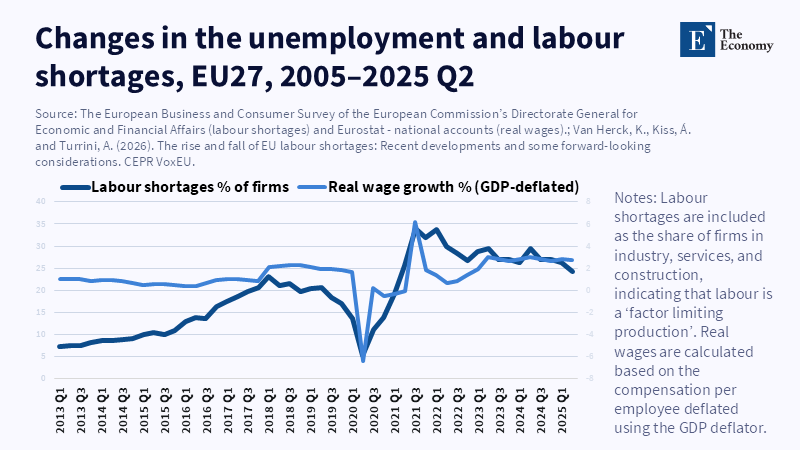
The discourse warrants reframing to focus on these concentrated shortages, particularly as overall slack in the labour market diminishes. According to Eurostat, the share of working-age residents employed in the EU reached an all-time high in 2024, with nearly 76 percent of people aged 20 to 64 in work. While the proportion of working-age residents born outside the EU has risen to 12.6 percent, ongoing retirements from the baby-boom generation continue to reshape the labor market. Without targeted policy measures for sectors with vacancy rates above 3 percent, immigration may fail to address workforce shortages and could result in more new arrivals filling lower-productivity jobs with limited impact.effect on mitigating labour shortages. For education authorities, this implies a planned shift away from broad upskilling initiatives toward more focused dual training programmes that integrate language acquisition with sector-specific qualifications, ideally completed within a year of migrant arrival.
The Retention Problem
Despite apparently robust migration inflows—4.2 million non-EU nationals entering the EU in 2024 alongside 1.5 million intra-bloc movers—retention of skilled workers remains problematic. Germany, traditionally a key destination for skilled migrants, illustrates this issue: despite a federal report indicating 260,000 vacancies across 10 shortage sectors, net intra-EU migration plummeted to 38,735 in 2024, representing a two-thirds decline over 12 months. According to a report by the OECD and the European Commission, nurses are the largest group of health workers in almost all EU countries, playing a vital role, especially highlighted during the COVID-19 pandemic. This points to ongoing workforce shortages in healthcare and suggests that simply attracting more workers is not enough unless efforts are also made to retain them.
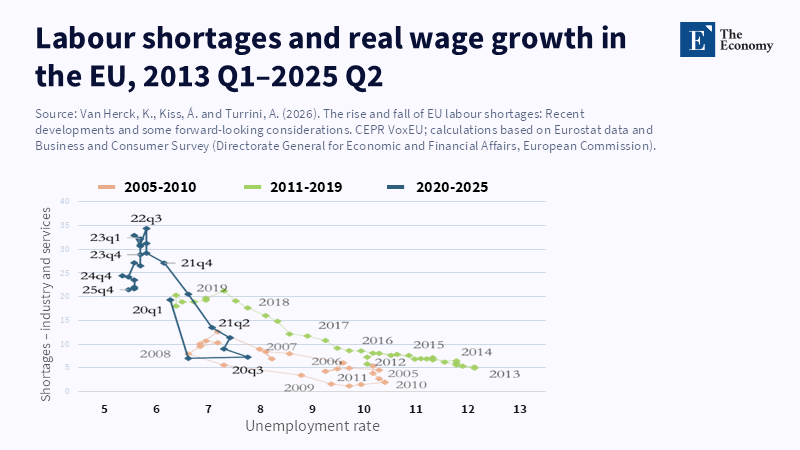
Contrastingly, in Switzerland, which exhibits one of the most acute shortages in the 2024 EURES data, Zurich’s hospitality sector recruits baristas from Mexico, while Spain similarly faces workforce constraints yet retains significant numbers of Latin American staff due to linguistic commonalities and more efficient credential recognition processes. Evidence suggests that retention depends less on wage differentials and more on factors such as recognition of qualifications, affordable housing, and credible pathways to permanent residency. According to EURES, policy reforms in response to labour shortages across Europe should focus on improving the recognition of foreign qualifications and allowing more flexible work permit systems, enabling migrants to move between employers more easily. These recommendations are informed by analyses that combine national job vacancy data with residence permit records spanning multiple years.
Wages, Job Quality, and the Limits of Migration
According to the OECD, there is little evidence that increasing worker mobility leads to wage suppression, and real wage growth has generally aligned with labour market tightness over the past decade. In Switzerland, large companies employ the largest share of workers despite representing a small share of all enterprises, and trade unions facing workforce shortages focus on improving job quality. While ethically compelling, such demands face practical limits. Transitioning all low-quality jobs to median conditions is fiscally burdensome, as demonstrated by the German automotive sector: under competitive pressure from Chinese manufacturers, Volkswagen closed its Dresden facility in 2025, eliminating 35,000 jobs for the first time in its history. When confronted with unavoidable cost increases—whether energy, regulatory, or wage-related—corporations often resort to offshoring or automation, potentially moving critical production capacity and expertise overseas and weakening the domestic value chain.
A feasible compromise involves linking collective bargaining outcomes to quantifiable productivity improvements. Switzerland has recently faced shortages in science, engineering, health, and information and communications technology, while the European Commission warns that only 4.7 percent of bus and coach drivers in the EU are under 30, with more than half expected to retire within the next 15 years—potentially creating a shortage of nearly 400,000 drivers by 2040. Employers adopting advanced scheduling technologies, reducing accident rates, or reducing idle mileage could receive tax incentives that offset wage increases negotiated with unions. Early models suggest that implementing a 1 percent payroll tax credit, combined with a slight increase in the digital-services VAT, could yield a fiscally neutral outcome within three years, though concerns remain that those measures may benefit certain industries over others. Nonetheless, the alternative—an open-ended political call for escalating immigration levels—lacks sustainability. When the electorate perceives a zero-sum trade-off between migrant inflows and job-quality deterioration, support shifts toward parties advocating tough immigration limits.
A Path Forward
The political scene intensifies these problems. According to PolitPro, the 'Patriots for Europe' group has become the third-largest right-wing to far-right sovereigntist political group in the European Parliament. Including the European Conservatives and Reformists (ECR) group, which is set to have 78 Members of the European Parliament at the start of the new term, sceptical voices could make up a significant portion of the legislature. According to the ECR Group website, a clear rise in migrant arrivals risks further strengthening support for anti-immigration policies. Hence, policymakers require an active strategy to address labour shortages expeditiously and preempt their instrumentalisation by populist narratives.
Such a strategy entails three components. Firstly, implementing a skills-based immigration filter giving priority to candidates in occupations where vacancy rates exceed a dynamic 3% threshold. Secondly, financing regional retention initiatives—such as rental guarantees and accelerated family reunification—in locales experiencing net emigration surpassing 2% annually, as observed in parts of eastern Germany. Thirdly, embedding sunset clauses within shortage occupation lists, whereby positions are removed after two years unless renewed based on updated vacancy data, discourages underinvestment in training and prevents temporary shortages from ossifying into permanent recruitment channels.
Acknowledging scepticism regarding arbitrary threshold settings and the potential uncertainty introduced through sunset clauses remains important. Nonetheless, transparent, data-driven, and adaptable frameworks generally foster market confidence more effectively than fixed lists. Moreover, this approach counters the populist critique that EU migration management is ideologically driven rather than responsive to economic conditions by evidencing that migration inflows decrease as shortages subside.
Finally, the speed of data availability is critical. Eurostat statistics typically lag by about 3 months, whereas local employment agencies could reduce this delay to 6 weeks by publishing vacancy data in real time. A consortium including Spain, the Netherlands, and Estonia is currently piloting open-API integration of web-based job board information. If scaled, such infrastructure would empower member states to adjust visa quotas preemptively, lessening the risk of exacerbated shortages. The estimated initial investment of around €50 million is modest compared to the much larger restructuring costs facing German industry, which total approximately €160 billion.
As 2026 began, the EU continued to face major challenges in its labour market. According to the German Federal Employment Agency, unemployment in Germany rose by 177,000 in January, reaching 3,085,000. The government is potentially set to restrict the very migration flows essential to sectors such as healthcare, construction, and information technology. Maintaining an unmodified immigration framework, neglecting issues of retention, job quality, and data responsiveness, risks precipitating policy failure. More promisingly, a calibrated compromise involving targeted visa allocation, time-limited recognition of shortage occupations, and productivity-linked collective bargaining delivers a coherent response to both economic necessities and political constraints. The window for successful intervention is narrowing; should legislators fail to act prior to a further rightward shift in the Parliament, the existing 4.4 million vacancies may soon appear comparatively modest. Thus, the imperative lies in improving the relationship between migration and skills development to prevent the labour shortage from hardening into persistent economic stagnation.
The views expressed in this article are those of the author(s) and do not necessarily reflect the official position of The Economy or its affiliates.
References
Ali, S.N., Mihm, M. & Siga, L. (2024) The Political Economy of Zero-Sum Thinking. arXiv preprint.
Commission, European (2024) Outlook and Major Challenges for the Labour Market – General Labour Market Conditions in the EU and its Member States – LMWD 2024 – DG EMPL.
Commission, European (2025a) Labour Market and Wage Developments in Europe 2025.
Commission, European (2025b) Migration, Mobility and the EU Labour Market.
Contreras, R.R. & Molina, O. (2023) Tackling Rising Inflation in Sectoral Collective Wage Bargaining. Eurofound.
Council of the European Union (2026) Tackling the Skills Shortage: Council Adopts Recommendation on Human Capital.
Digital Services Tax Review Report (n.d.) HM Treasury.
EADaily (2024) They Asked for Half a Trillion Dollars to Save German Industry.
Europe Elects (2025) EU Parliamentary Projection: August 2025.
European Business and Consumer Survey, Directorate-General for Economic and Financial Affairs (2026) Quarterly Dataset.
European Economic Institute (IW) (2025) Skills Shortage in Ten Key Sectors.
European Education Area (2024) Refugee and Migrant Integration into Education and Training.
European Labour Authority (2025a) Gaps on the European Labour Market 2024 Continue to Increase.
European Labour Authority (EURES) (2025b) Labour Shortages and Surpluses Dashboard 2024.
European Migration Network (2024) Meeting Labour Market Needs through Migration Pathways.
European Migration Network (2025) Meeting Labour Market Needs through Migration Pathways.
European Transport Workers’ Federation (2023) Labour Shortage: Quality Jobs and Strong Unions Are Crucial.
Euronews (2026) ‘We Can’t Afford It’: EU Workers Leave Germany Despite Labour Shortage.
EUROMETAL (2025) Volkswagen Is Closing Its First Factory in Germany in Its 88-Year History.
Eurostat (2026a) EU Received 4.2 Million Immigrants in 2024.
Eurostat (2026b) Job Vacancy Statistics, Q4 2025.
Eurostat (2026c) Labour Market Flows, Q4 2025.
Eurostat (2026d) Euro Area Unemployment at 6.2 %, December 2025.
Kiss, Á., Maldonado, J.E., Turrini, A. & Van Herck, K. (2026) Migration, Mobility and the EU Labour Market: Recent Developments. Discussion Paper 241.
Kiss, Á., Morandini, M.C., Turrini, A. & Vandeplas, A. (2022) Slack and Tightness: Making Sense of Post-COVID-19 Labour Market Developments in the EU. European Economy Discussion Paper 178.
Labour Market and Wage Developments in Europe 2024 (n.d.) European Commission.
Labour Migration in Times of Labour Shortages (n.d.) OECD and European Migration Network Study.
Qualification as a Key Criterion? An Analysis of Germany’s Labour Migration Policy (2025) Comparative Migration Studies, 14.
Reshoring, Automation, and Labour Markets under Trade Uncertainty (2025) Journal of International Economics, 156.
Van Herck, K., Kiss, Á. & Turrini, A. (2026) The Rise and Fall of EU Labour Shortages: Recent Developments and Some Forward-Looking Considerations. VoxEU.
UNN (2025) Volkswagen Closes Dresden Plant: Historic Decision after 88 Years of Operation.
Working across research, policy, and data-driven analysis, the Editorial Board ensures that published pieces reflect a consistent institutional perspective grounded in quantitative reasoning and long-term structural assessment.