When Science Policy Becomes Boardroom Strategy

Working across research, policy, and data-driven analysis, the Editorial Board ensures that published pieces reflect a consistent institutional perspective grounded in quantitative reasoning and long-term structural assessment.
Authored On
Modified
Trump’s science council looks more like billionaire influence than real expertise
That risks wasting public money on tech hype instead of sound science
A real science agenda needs scientists with power, not just one for show

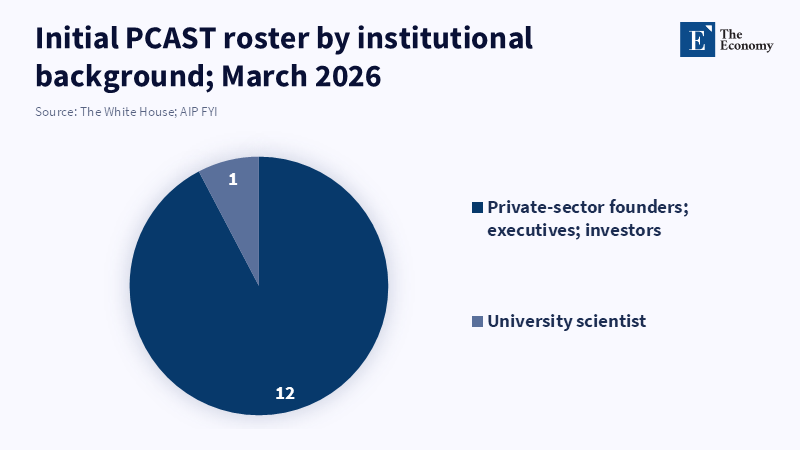
One fact tells the whole story. President Trump’s new science policy council opened with 13 members, and only one is a university scientist. At least nine are billionaires. That is not a broad scientific bench. It is a narrow concentration of money, status, and corporate power. The danger is not only symbolic. Science policy shapes which questions count as urgent, which risks get downplayed, which fields get funded, and what schools and universities are told to produce. Once a White House science council is built like a venture portfolio, public knowledge starts to look like a private asset. That matters now because the same administration has framed the council’s mission around emerging technology, the American worker, and a “Golden Age of Innovation.” In plain terms, the people closest to the boardroom may now help define what counts as scientific progress, what counts as useful education, and what deserves public money. That is not a small staffing choice. It is a governing theory.
Science Policy Is Not a Branding Exercise
The usual reaction to this council is outrage at the optics. That reaction is understandable, but it is not deep enough. The real issue is that science policy is being recast as a prestige exercise run by dealmakers, platform chiefs, and investors. The White House order that revived PCAST says the body is meant to advise on science, technology, education, and innovation policy. It also says the members should bring diverse perspectives and supply the scientific and technical information needed for public policy. That is a serious public function. It is not the same thing as asking a group of famous executives what they would like Washington to buy next. When a science council is stocked with people whose careers were built by scaling products, defending market share, and steering capital, it does not stop being political because it speaks the language of invention. It becomes political in a more hidden way. Its preferences start to look like expertise.
That is why the composition matters more than the press release. A report from the American Institute of Physics explains that after more than two and a half years without a meeting, President Trump reestablished the President’s Council of Advisors on Science and Technology, but the White House had not yet set a date for the new council’s first meeting or outlined its initial tasks. According to a report from Scientific American, the Trump administration is pursuing new efforts to reduce congressional control over the federal budget and halt billions in funding for several government agencies. That gap is not cosmetic. A council cannot broker between public evidence and political power if public evidence barely has a seat at the table. The lone academic becomes a symbol of balance rather than a balance of power. Science advice works when it can test claims, state uncertainty, and push back on hype. It fails when it is asked mainly to ratify a direction already favored by wealth and access.
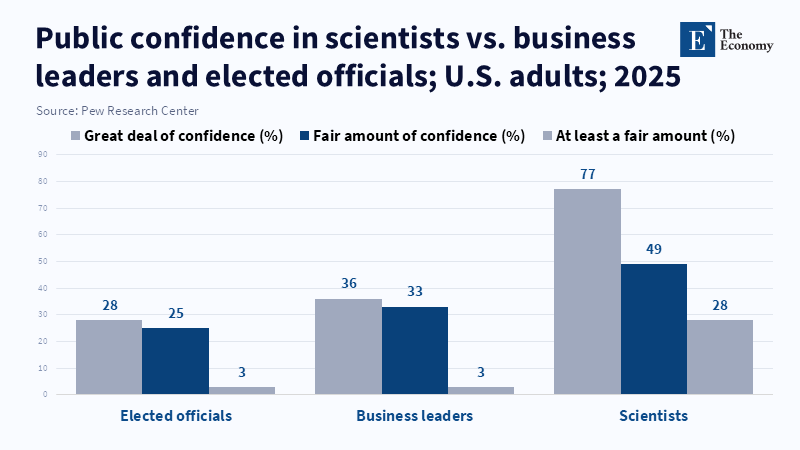
This matters even on its own terms of legitimacy. Pew found in January 2026 that 77 percent of U.S. adults had at least a fair amount of confidence in scientists to act in the public’s best interests. Scientists still rank above business leaders and elected officials on that measure. So the administration is not sidelining a group that the public has already rejected. It is sidelining one who still commands more trust than the people now being elevated over them. That choice tells us something important about the White House's view of expertise. It is not that expertise has lost value. It is that independent expertise has lost convenience. A scientist who studies a problem may slow down a political story. A billionaire who already believes in the story can speed it up.
What Executive-Led Science Policy Gets Wrong About AI
This is where the AI question becomes central. Many of the new council members come from companies or investment networks tied to artificial intelligence, chips, data infrastructure, and platform power. That does not make them uninformed. But it does create a predictable bias. If your business model depends on the idea that larger models, more compute, and faster deployment will solve ever bigger problems, you are likely to see public policy through that lens. The risk is that science policy stops asking hard scientific questions and starts treating scale as proof. That is exactly the kind of mistake governments make when they confuse technical momentum with scientific closure.
The evidence does not support that leap. The 2025 Stanford AI Index showed major gains on hard benchmarks in a single year, indicating that these systems are improving quickly. But the same report also stressed that large language models still face factual errors and hallucinations, even when their best benchmark scores look impressive. A 2025 review in npj Artificial Intelligence went further, arguing that AI has so far been limited in its impact on fundamental science and that large language models are still better understood as tools that may assist discovery than as engines that can replace the scientific process. A 2025 Scientific Reports study found that several leading models performed worse than physicians on a benchmark designed to test flexible clinical reasoning, and exhibited overconfidence and hallucinations. The point is simple. Today’s systems are powerful statistical tools. They are not a settled substitute for scientific judgment.
That does not mean AI is trivial, useless, or doomed. It means the public case for massive AI spending has to be made with scientific discipline rather than venture logic. There is still no sound basis for governing as though current models are on a straight path toward machine intelligence capable of standing in for scientists, teachers, doctors, and researchers. Yet the political sales pitch often moves in exactly that direction. It treats present limits as temporary annoyances that capital will soon wash away. That is bad science policy. It tells policymakers to spend first and ask basic questions later. It invites the state to subsidize a mythology: that correlation will become understanding if we only buy enough chips.
When Science Policy Turns Education into a Talent Pipeline
The education consequences are easy to miss because they arrive dressed as opportunity. The White House says the council will focus on the opportunities and challenges that emerging technologies present to the American workforce. Read that closely. The key noun is not knowledge, citizenship, or inquiry. It is the workforce. Under that frame, education enters science policy less as a public good than as a labor input. Schools become feeder systems. Universities become research vendors and skills factories. Students become future operators of tools built elsewhere. That is a much thinner vision of education than an advanced democracy should accept. That shift also changes what students are taught to admire. They learn that authority belongs to founders, not to methods; to speed, not to replication; to confident forecasts, not to slow correction. A democracy that teaches science that way does not prepare citizens. It prepares followers.
A good science policy for education would ask how to strengthen basic research, how to teach students to judge evidence, how to protect academic freedom, and how to build institutions that can challenge commercial hype. A boardroom view asks a narrower question: how fast can education supply talent to priority sectors? Those are not the same thing. The U.S. still depends on universities for a large share of its public research capacity. NCSES reported that higher education performed about $102 billion in U.S. research and development in 2023. It also found that business funded 75 percent of total U.S. R&D, but the federal government still funded 41 percent of basic research across all sectors. That split matters. Markets are strong at backing development close to profit. Public institutions remain vital where the work is slower, riskier, and less easy to monetize. If public science advice is dominated by executives, the pressure will always run toward what scales quickly and pays visibly.
The budget context makes the danger clearer. In 2025, the administration proposed cutting NIH by 40 percent. It also sought a 57 percent cut to the National Science Foundation, before Congress pushed back. A report from GovTrack.us notes that early Thursday morning, the House passed the One Big Beautiful Bill Act, which includes large cuts to both spending and taxes. The real policy choice before us concerns how these cuts may affect NSF funding and support for scientists, technicians, teachers, and students. Do we want science policy to deepen the public research base that trains people, produces independent knowledge, and serves broad social needs? Or do we want science policy to move public resources toward a few fast-growing technology bets while universities are told to do more with less? Educators and administrators should not treat this as a distant Washington fight. It is a battle over the mission of education itself.
Rebuilding Science Policy Around Public Evidence
Defenders of the new council will say that builders belong in the room. They are right. Industry expertise matters. The problem is not that executives are present. It is that they are close to overwhelming the category of expertise itself. A serious science policy needs scientists, engineers, educators, public-interest researchers, and industry leaders in the same room because each sees different failure modes. Scientists test claims against evidence. Educators see how policy lands in classrooms and labs. Industry leaders understand deployment, cost, and adoption. When one group dominates, the blind spots stop being accidental. They become structural.
Research on science advice makes this point in a calmer language, but the message is firm. A 2025 systematic review in Frontiers in Communication found that dedicated advisory bodies, stronger science-policy links, and institutionalized evidence systems help evidence-informed decision-making, while fragmentation and weak interaction between researchers and policymakers block it. A 2025 study in Science and Public Policy argued that effective science advice at the top of government depends on evidence synthesis, explanation of uncertainty, policy relevance, independence, and trust. None of those qualities is guaranteed by commercial success. In fact, some are in direct tension with it. The task is not to find the richest people who talk about the future. It is to build institutions that can tell powerful people when their picture of the future is wrong.
That is why this council should be contained and corrected now, not merely mocked. The repair is not mysterious. Add independent scientists in numbers large enough to matter. Add university leaders who still do research, not only fundraising. Add educators who understand the difference between scientific literacy and software training. Publish strong conflict-of-interest rules. Make room for experts whose job is to test claims, not sell them. Above all, stop pretending that science policy can be outsourced to the same circles that profit from the most inflated stories in technology. A council with one scientist and at least nine billionaires is not a bridge between knowledge and power. It is power congratulating itself in the language of knowledge. A country that cannot tell the difference will not only waste money but also teach its schools, universities, and public agencies to mistake hype for truth.
The views expressed in this article are those of the author(s) and do not necessarily reflect the official position of The Economy or its affiliates.
References
Aboulenein, A. (2025) ‘Trump budget proposes drastic cuts for US scientific research’. Reuters, 2 May.
Benzatine Infotech (2026) ‘Trump staffs science and technology panel with non-scientists’. Benzatine News Room, 25 March.
Garisto, D. (2026) ‘Trump’s new science advisers include 12 technology chiefs — and one academic’. Nature, 26 March. doi: 10.1038/d41586-026-00977-z.
Garisto, D. and Nature magazine (2026) ‘Trump’s new science panel includes 9 tech billionaires—and just one scientist’. Scientific American, 27 March.
Kennedy, B. and Kikuchi, E. (2026) Do Americans Think the Country Is Losing or Gaining Ground in Science? Washington, DC: Pew Research Center.
Kim, J., Podlasek, A., Shidara, K., Liu, F., Alaa, A. and Bernardo, D. (2025) ‘Limitations of large language models in clinical problem-solving arising from inflexible reasoning’. Scientific Reports, 15, 39426. doi: 10.1038/s41598-025-22940-0.
Maslej, N., Fattorini, L., Perrault, R., Gil, Y., Parli, V., Kariuki, N., Capstick, E., Reuel, A., Brynjolfsson, E., Etchemendy, J., Ligett, K., Lyons, T., Manyika, J., Niebles, J.C., Shoham, Y., Wald, R., Walsh, T., Hamrah, A., Santarlasci, L., Lotufo, J.B., Rome, A., Shi, A. and Oak, S. (2025) Artificial Intelligence Index Report 2025. Stanford, CA: AI Index Steering Committee, Institute for Human-Centered Artificial Intelligence, Stanford University.
National Center for Science and Engineering Statistics (2024) Higher Education Research and Development: Fiscal Year 2023. Alexandria, VA: National Science Foundation.
National Science Board (2025) Discovery: R&D Activity and Research Publications. Science & Engineering Indicators 2025, NSB-2025-7. Alexandria, VA: National Science Foundation, National Center for Science and Engineering Statistics.
Pštross, K., Firestein, S., Almeida, P.V. and Pasternak, N. (2025) ‘Science advice at the top: a global overview of chief science advisor model in governance’. Science and Public Policy, scaf072. doi: 10.1093/scipol/scaf072.
Shepardson, D. (2026) ‘US Senate passes bill to boost federal science spending after White House sought major cuts’. Reuters, 15 January.
Skousen, M. (1999) ‘A One-Armed Economist, Please’. Foundation for Economic Education, 1 February.
Reuters (2026) ‘Trump names Nvidia, Meta CEOs to science and tech council’. Reuters, 25 March.
Suazo-Galdames, I.C., Saracostti, M. and Chaple-Gil, A.M. (2025) ‘Scientific evidence and public policy: a systematic review of barriers and enablers for evidence-informed decision-making’. Frontiers in Communication, 10, 1632305. doi: 10.3389/fcomm.2025.1632305.
Taylor, J. (2026) ‘White House Announces PCAST Members’. FYI, American Institute of Physics, 26 March.
The White House (2025a) ‘President’s Council of Advisors on Science and Technology’. Presidential Actions, 23 January.
The White House (2025b) ‘Fact Sheet: President Donald J. Trump Launches PCAST to Restore American Leadership in Science and Technology’. Fact Sheets, 23 January.
The White House (2026) ‘President Trump Announces Appointments to President’s Council of Advisors on Science and Technology’. Releases, 25 March.
Timmer, J. (2026) ‘Trump staffs science and technology panel with non-scientists’. Ars Technica, 25 March.
Zhang, Y., Khan, S.A., Mahmud, A., Yang, H., Lavin, A., Levin, M., Frey, J., Dunnmon, J., Evans, J., Bundy, A., Dzeroski, S., Tegner, J. and Zenil, H. (2025) ‘Exploring the role of large language models in the scientific method: from hypothesis to discovery’. npj Artificial Intelligence, 1, 14. doi: 10.1038/s44387-025-00019-5.
Working across research, policy, and data-driven analysis, the Editorial Board ensures that published pieces reflect a consistent institutional perspective grounded in quantitative reasoning and long-term structural assessment.