The Chinese Community in Japan and the Myth of Fast Integration

Working across research, policy, and data-driven analysis, the Editorial Board ensures that published pieces reflect a consistent institutional perspective grounded in quantitative reasoning and long-term structural assessment.
Authored On
Modified
Japan needs Chinese workers and students, but not yet true social acceptance
Education policy can reduce exclusion, but it cannot erase deep political and cultural barriers quickly
The real test is whether Japanese institutions stay fair as distrust of China grows

At the end of 2025, more than 930,000 Chinese nationals were living in Japan. That is not a fringe presence. It is one of the largest foreign communities in the country. It sits inside a wider foreign-resident population that now exceeds four million. Chinese workers play an important role in Japan’s labor market, and Chinese students are significant within the country’s education system. However, according to Wikipedia’s entry on the Japanese labor market, simply noting the presence of these groups should not be taken as evidence that social integration is already underway. Numbers show movement across borders. They do not show movement across the social line. In Japan, as in much of East Asia, that line is unusually hard. It is shaped by history, language, memory, status, and politics. It is made harder still when relations between states deteriorate in public view. The real question in education is not whether a few welcoming policies can make the Chinese community in Japan feel fully accepted soon. The question is whether schools and universities can stop a large cross-border population from becoming a permanent internal distance.
The Chinese community in Japan is growing faster than trust
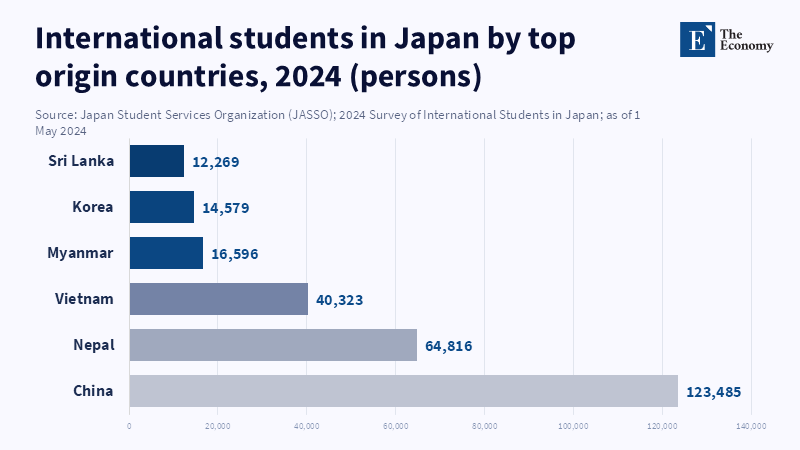
The scale of change is no longer in doubt. Japan had 2.57 million foreign workers by October 2025, the highest figure since records began under the current reporting system, and Chinese workers made up 431,949 of them. In higher education and language institutions, the pattern is just as clear. Japan hosted 336,708 international students in 2024, and 123,485 were from China. These figures matter for one reason above all. They show that the Chinese community in Japan is not a side issue in migration policy. It is now tied to labor supply, campus life, local schools, urban housing, and the future of regional knowledge networks. Any serious education strategy has to start from that institutional fact. A country does not bring in this many workers and students and still treat social inclusion as a secondary question.
But growth in headcount should not be confused with growth in belonging. That is where policy talk goes wrong. The common policy instinct is simple: if labor shortages grow, if universities open up, and if local governments expand support, then acceptance will follow. That view is too neat. It assumes that proximity produces trust. It assumes that contribution softens barriers. It assumes that a foreign student learning Japanese or a worker filling a labor gap will gradually be seen as part of the social whole. In Japan, that path exists, but it is slow. It is also unequal. The deeper problem is that East Asian societies often separate useful inclusion from social inclusion. A person may be useful, visible, law-abiding, and even admired, yet still be marked as outside. Japan’s own integration record suggests as much. The task is not to promise quick acceptance. The task is to prevent hard exclusion from becoming normal.
Security politics is reshaping the Chinese community in Japan
That challenge is sharper because foreign policy and the social climate now move in the same direction. Prime Minister Sanae Takaichi came to office with a historic lower-house landslide. Within weeks, she was warning of Chinese “coercion,” promising a security overhaul, and facing little political resistance in parliament. Japan has also moved to downgrade the language it uses to describe ties with China in its annual foreign policy report. A Chinese sanction on a Japanese lawmaker over Taiwan ties then underlined how quickly the bilateral relationship can harden. These are not abstract signals. They shape media frames, public discussion, and the emotional weather around migration. When national politics casts China as a long-term strategic threat, the Chinese community in Japan cannot be insulated from the effect by good intentions alone. The line between state distrust and social distrust becomes easier to cross.
According to a report from The Genron NPO, the 2024 Japan-China Joint Public Opinion Poll found that Japanese respondents continue to hold overwhelmingly negative views of China. According to a report from Japan's Ministry of Foreign Affairs, only 26.3% of respondents in China considered Japan-China relations important, while 59.6% said they were not, indicating a significant decline in how the relationship is viewed. It is a sharp loss of the middle ground. The broader climate around immigration has also worsened. Stanford reporting on Japan Barometer data shows that opposition to “accepting foreign workers” rose from 35.5% in 2022 and 36.6% in 2023 to 53.1% and 53.4% in two February 2026 surveys. The same research found that fear-based security framing reduces support for immigration, while economic framing can raise it. That matters because the Chinese community in Japan is not entering a neutral public space. It is entering one in which security language now carries unusual force. Education policy cannot pretend that classrooms sit outside that climate.
The Chinese community in Japan is now an education issue
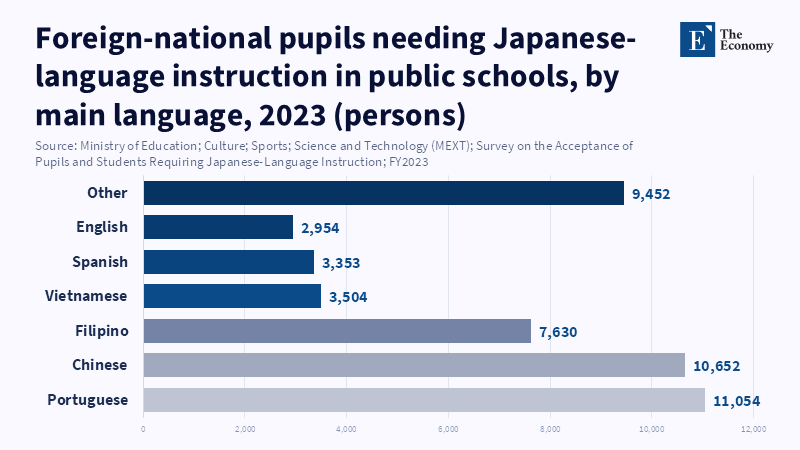
For that reason, the Chinese community in Japan should be treated as an education issue as much as a labor issue. The pressure starts early. According to MEXT, 57,718 foreign-national pupils in public schools needed Japanese-language instruction as of May 2023, and another 11,405 Japanese-national pupils also needed that support. According to the Japan Student Services Organization, 41.5% of foreign-national students enrolled in public schools needed Japanese-language instruction, reflecting a significant and rising demand. It tells us that integration is not only about visas, wages, or border control. It is about classroom access, teacher capacity, curriculum design, and parent-school communication. If children cannot fully enter the language of schooling, they cannot fully enter the social system that schooling organizes. Language support is not an extra service. It is core educational infrastructure.
The school attendance data is just as telling, and it needs to be read with care. A 2021 survey by the Ministry of Education, Culture, Sports, Science, and Technology found that among foreign children in Japan, 1,097 were confirmed not to be attending school and 7,322 had an unknown schooling status. According to the ministry, these numbers should not be combined simply because some children may be enrolled in schools outside the oversight of local authorities, as reported by nippon.com. That caution matters. Even so, the data points to a blind spot. A system that cannot always tell where foreign children are in the education pipeline is already behind. The OECD has made the structural point even more plainly. In its 2024 review of migrant recruitment in Japan, it notes that Japan is the only OECD country where schooling is not compulsory for foreign children. That single fact should have changed the national debate years ago. A state cannot say it wants stable coexistence while leaving the most basic gateway to belonging partly optional for the very children whose futures will shape that shared life.
Schools and universities also cannot solve this on their own, because the problem continues after the classroom. OECD reports that immigrants in Japan experience discrimination in housing, job search, work, and finance, with housing standing out as the area where discrimination is reported most often. That pattern matters because housing often decides whether study, work, and family life can stabilize at all. This matters for educators because students do not leave exclusion at the school gate. A university can recruit internationally, expand Japanese-language support, and promote campus diversity, but if graduates face blocked housing and guarded hiring channels, the lesson they learn is plain: education may open the classroom door, but not the social one. That is why the old belief in easy integration through schooling is too weak. Education helps, but only if the institutions around it stop canceling its effects.
What policy should do for the Chinese community in Japan
A stronger policy response starts by giving up the fantasy of fast emotional convergence. The aim should not be to make Japanese society suddenly feel warm toward the Chinese community in Japan. That is not realistic now. The aim should be to build reliable, low-conflict forms of everyday inclusion that can survive geopolitical tension. In practice, that means long-term Japanese-language support rather than short bursts of remedial help. It means bilingual liaison staff in schools, not just translated pamphlets. It means stronger data sharing between schools, municipalities, and welfare offices so children do not disappear between systems. It means campus policies that treat Chinese students as members of the institution, not only as fee-paying international bodies. It also means sustained, not symbolic, direct-contact programs. The Genron survey offers one useful clue here: Chinese respondents who had visited Japan held much more positive views of Japan than those who had not. Contact does not erase history, but it still matters. Institutions should stop assuming it will happen on its own.
Critics will say this places too much responsibility on education. They will argue that schools cannot reverse nationalism, and they are right. Schools cannot do that. Others will say a hard line toward Beijing can be kept separate from fair treatment of Chinese residents, students, and workers. In principle, that is also right. In practice, it will not happen automatically. It has to be designed. Once security language saturates political life, the burden on domestic institutions rises. Educators, administrators, and policymakers need to act as if the line between external rivalry and internal fairness is fragile, because it is. The right benchmark is not public affection. It is institutional decency under stress. If Japanese schools, colleges, and local governments can create that decency now, they can reduce the risk that the Chinese community in Japan becomes a standing domestic fault line. If they fail, the costs will not stop with Chinese residents. Japan will damage its own labor market, weaken its universities, and teach a generation that contribution does not lead to membership. That lesson, once learned, is very hard to reverse.
The opening statistic matters because it changes the scale of the policy problem. More than 930,000 Chinese nationals in Japan means the country is no longer dealing with a small foreign minority at the edges of national life. It is dealing with a durable social fact at the center of its schools, campuses, workplaces, and neighborhoods. That is why the usual policy language of coexistence is no longer enough. The deeper question is whether Japan can build institutions that remain fair even when public feeling remains cold. Education is where that test begins. Not because education can erase old boundaries, but because it meets people early, shapes daily contact, and can either widen exclusion or slow it down. The Chinese community in Japan does not need rhetoric that promises a rapid embrace. It needs schools and universities that can hold the social line against fear, bureaucracy, and drift. If policymakers want stability, this is the place to start. The alternative is simple: more cross-border flows, more domestic distance, and a harder future for everyone involved.
The views expressed in this article are those of the author(s) and do not necessarily reflect the official position of The Economy or its affiliates.
References
Campbell, J. 2022, ‘History, memory, and politics in postwar Japan’, International Affairs, vol. 98, no. 5, pp. 1837–1838. doi:10.1093/ia/iiac155.
Chen, L. & Huang, F. 2024, ‘Neoliberalism, internationalization, Japanese exclusionism: the integration experiences of international academics at Japanese universities’, Studies in Higher Education, vol. 49, no. 11, pp. 1900–1913. doi:10.1080/03075079.2023.2283094.
Genron NPO 2024, Japan-China Joint Public Opinion Survey 2024.
Immigration Services Agency of Japan 2026, The Status of Immigration and Residency Management Operations in 2025 [in Japanese], Ministry of Justice, Tokyo.
Ishida, K. & Dugar, G. 2025, ‘Upper Secondary Educational Attainment of Japan-Born Immigrants: Mixed-Parentage as a Marker of Social Integration or Family Instability in Japan?’, Journal of International Migration and Integration. doi:10.1007/s12134-025-01306-5.
Japan Student Services Organization 2025, Result of International Student Survey in Japan, 2024, April.
Kawashima, S. 2026, ‘Japan’s growing Chinese community and the future of Japan-China relations’, East Asia Forum, 26 March.
Kelly, T. & Geddie, J. 2026, ‘Japan PM Takaichi warns of China “coercion”, vows security overhaul’, Reuters, 20 February.
Kihara, T. 2026, ‘Japan to drop “most important” tag for China ties’, Reuters, 24 March.
Mercator Institute for China Studies 2026, ‘China-Japan relations + Hacking attack + Clean energy boom’, MERICS China Essentials, 12 February.
Ministry of Education, Culture, Sports, Science and Technology 2024, Results of the Survey on Pupils and Students Requiring Japanese-Language Instruction (FY2023) [in Japanese], 8 August.
Ministry of Education, Culture, Sports, Science and Technology 2025, Results of the Survey on the School Attendance Status of Foreign Children (FY2024) [in Japanese], 2 October.
Ministry of Foreign Affairs of Japan 2023, Japan-China Relations (Basic Data), Ministry of Foreign Affairs of Japan, Tokyo, 6 July.
Ministry of Health, Labour and Welfare 2026, Summary of Notifications on Foreign Employment Status (as of End-October 2025) [in Japanese], 30 January.
Nakagawa, Y. 2020, ‘Coexistence Required in Policies to Promote Japanese Language Education’, Chuo University, 3 September.
Nadaradjane, A. 2026, ‘Japan’s heavy metal rock star PM could wreck Labor’s China strategy’, Australian Financial Review, 8 February.
National Institute for Defense Studies 2025, China Security Report 2026: Imbalanced Partnerships: China, Russia, and North Korea, National Institute for Defense Studies, Tokyo.
Nippon.com 2026, ‘A Landslide for Takaichi’s LDP: House of Representatives Election Results’, Nippon.com, 9 February.
OECD 2018, Education Policy in Japan: Building Bridges towards 2030, OECD Publishing, Paris.
OECD 2021, Education Policy Outlook 2021: Shaping Responsive and Resilient Education in a Changing World, OECD Publishing, Paris.
OECD 2024, Recruiting Immigrant Workers: Japan 2024, OECD Publishing, Paris.
OECD 2025, ‘Japan’, in International Migration Outlook 2025, OECD Publishing, Paris.
Reuters 2026, ‘Japan to drop “one of its most important” tag for China ties’, Japan Today, 24 March.
Ronkin, N. 2026, ‘Japanese Public Sets High Bar for Immigrants’, Freeman Spogli Institute for International Studies, 30 March.
Sugasawa, T. & Harano, K. 2023, ‘A field experiment on discrimination against foreigners in the rental housing market in Japan examining the 23 wards of Tokyo’, Journal of the Japanese and International Economies, vol. 69, article 101273. doi:10.1016/j.jjie.2023.101273.
The Chosun Ilbo Editorial Board 2026, ‘Editorial: Turbulence Ahead After Takaichi’s Strong Japan, Anti-China Victory’, The Chosun Ilbo, 10 February.
Yamane, Y. & Okudera, A. 2024, ‘Survey: Nearly 88% of Chinese view Japan in a negative light’, The Asahi Shimbun, 3 December.
Yamaguchi, M. 2026, ‘China sanctions Japanese lawmaker over his Taiwan ties. Japan calls the step “unacceptable”’, Associated Press, 30 March.
Working across research, policy, and data-driven analysis, the Editorial Board ensures that published pieces reflect a consistent institutional perspective grounded in quantitative reasoning and long-term structural assessment.