War and Human Capital: The Education Cost That Outlasts the Ceasefire

Working across research, policy, and data-driven analysis, the Editorial Board ensures that published pieces reflect a consistent institutional perspective grounded in quantitative reasoning and long-term structural assessment.
Authored On
Modified
War shrinks the future talent base
Britain and Ukraine show the loss lasts for decades
Education recovery is core to national recovery
More than 750,000 British servicemen died in the First World War. Most were young. Many came from the very age groups from which a country expects its future teachers, engineers, scientists, managers, and inventors to emerge. For years, the damage was described in moral, demographic, and military terms. Those descriptions were true, but incomplete. The deeper loss was not only a smaller population. It was a thinner pipeline of ability. When war removes a large share of educated and upwardly mobile young adults, it does not just lower output for a few years. It weakens the transfer of skill, the density of ideas, and the quality of institutions for decades. That is why war and human capital belong at the center of education policy, not at its edge. The lesson from Britain after 1918, and from Ukraine today, is stark. A country can rebuild bridges faster than it can rebuild a generation.
Britain’s lost generation shows what war and human capital really destroy
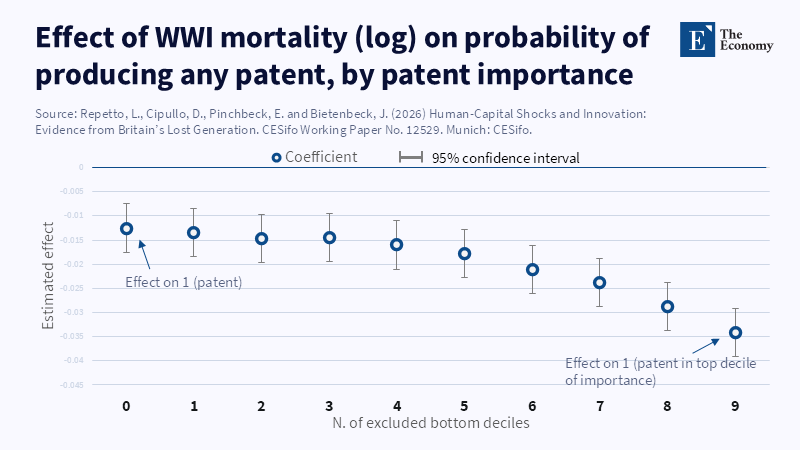
The usual story about Britain after the First World War stresses grief, debt, social change, and a difficult peace. All of that matters. But the sharper policy point is that war did not simply subtract workers from the labor force. It removed a concentrated slice of young male human capital at the very moment when modern industry depended more heavily on technical knowledge, formal training, and local networks of invention. New research linking parish-level military deaths to patent records across Britain shows that places hit harder by wartime mortality produced fewer patents for decades after the war. The effect was not trivial. The referenced study examined infant and early-childhood mortality rates in British parishes during the early 1800s, exploring how higher death rates were associated with community outcomes such as innovation. It means war not only reduced the volume of innovation. It reduced its frontier edge.
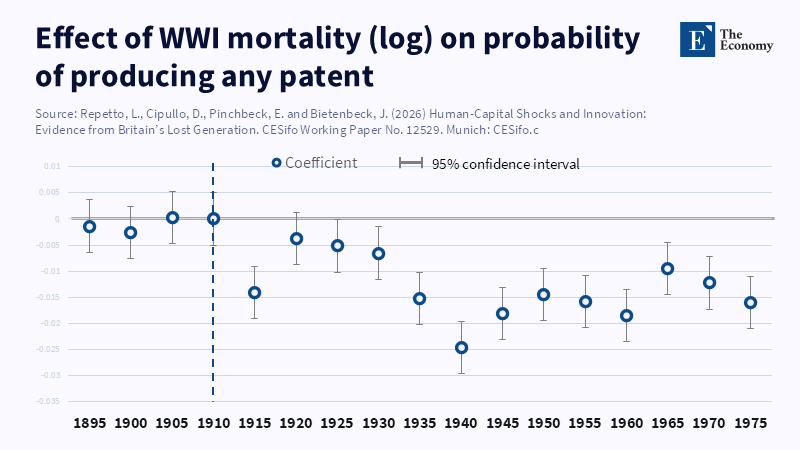
This helps reframe the old phrase “lost generation.” The loss was not mainly poetic. It was economic and scientific. A report from Hugh Rockoff notes that the total cost of World War I to the United States was about $32 billion, which was 52 percent of the nation's gross national product at the time. It tells us that human capital is not stored inside single individuals alone. It also sits in mentorship, collaboration, imitation, and local examples of what a skilled life looks like. When those links break, even survivors become less productive. Earlier historical work on Britain showed why this was plausible. Those who served and died were heavily concentrated among younger men, the very cohorts that would normally move into advanced work, further study, and civic leadership in the interwar years. War and human capital, in other words, are connected through a chain: death changes cohorts, cohort change weakens knowledge networks, and weaker knowledge networks slow national progress.
Ukraine shows that war and human capital damage start in the classroom
Ukraine gives us the modern version of the same mechanism‚ and it starts well before the labor market․ The most useful current estimates do not ask only how many buildings have been destroyed․ They investigate the impact of such an extended disruption on the human capital stocks of a country in the 2030s․ The human capital measure used by Balázs Égert and Christine de La Maisonneuve is based on years of schooling‚ student performance and skills of adults․ If the war lasts two years‚ they estimate‚ human capital alone shrinks total factor productivity by 7 percent by 2035‚ and dies away slowly․ They are particularly concerned with this estimate because it does not assume factories are smashed․ These include disrupted learning‚ lower test scores‚ less developed skills‚ poorer health‚ loss of a home‚ and less work capacity․ The message is simple․ The long-run economy is also being rewritten in real time․
The education data points in the same direction. OECD reporting on PISA 2022 found that in the Ukrainian regions able to participate, students scored below the OECD average in mathematics, reading, and science, and only 58 percent reached minimum proficiency in mathematics, compared with an OECD average of 69 percent. In reading, 59 percent reached minimum proficiency, versus 74 percent across the OECD. These are not abstract indicators. They describe a future shortage of students ready for advanced study, technical training, and innovation-heavy work. Meanwhile, the operating environment remains brutal. UNICEF reported in early 2026 that more than one-third of Ukraine’s children remained displaced, more than 1,700 schools and other education facilities had been damaged or destroyed, and one in three children could not attend in-person schooling full-time. This is what war and human capital look like before they show up in patent counts. They appear first as broken routines, partial attendance, fear, and delayed learning. Years later, they appear as lower productivity and slower scientific renewal.
Why war and human capital loss hurt innovation more than many forecasts admit
A common objection is that war can force adaptation. Labor scarcity can raise wages. Firms can automate. States can push technology forward through necessity. There is truth in that. But it is not the whole story, and it is not the story that education journals should center on. A country can innovate in some sectors while still suffering a broad loss of human capability. Britain after the First World War is a useful case because the war happened abroad. Domestic physical capital was not destroyed on British soil. According to an article by Ellen Munroe and Anastasiia Nosach, recent evidence shows that the decline in local innovation after wartime cannot be explained solely by physical destruction; instead, the aftermath of war has significantly held back innovation in affected countries like Ukraine. The most affected places did not only have fewer men. They had fewer future inventors, fewer skilled peers, fewer role models, and fewer dense circles of technical exchange. The damage was largest in knowledge-intensive and technically complex fields, which is exactly where modern growth tends to depend most on great skill.
The same blind spot appears in present-day reconstruction debates. Public discussion often treats schools as social infrastructure to be restored after the hard work of rebuilding energy, transport, and housing. That order is wrong. Human capital is not a soft issue to be handled later. It is the core growth asset that makes the rest of the reconstruction worth financing. The IMF warned at the start of the full-scale war in Ukraine that advanced economies could face a lasting fiscal squeeze as defense spending rises and public priorities shift. That wider budget pressure matters because education systems rarely win silent fiscal battles. When war expands security spending and shrinks policy room, school repair, teacher support, scholarships, and university research capacity can all be pushed down the list. The danger is clear. A state may save the territory yet still lose the cohort. And when that happens, the loss does not end with lower earnings. It spreads into weaker science, slower business formation, and a smaller capacity to solve the next national crisis.
A war and human capital agenda for education policy
If this diagnosis is right, then education policy in wartime and post-war settings must stop acting as if normal recovery models will be enough. The first task is continuity. Children need sustained contact with school, reliable assessment, safe physical access where possible, and high-quality remote alternatives where that is not possible. But continuity alone is too thin a goal. Systems also need repair at the top of the talent distribution and in the middle of the skills pipeline. That means targeted tutoring for learning loss, accelerated catch-up for adolescents, protected STEM instruction, mental-health support tied to school retention, and active measures to keep teachers in the profession. It also means protecting the transition points where war does the most hidden damage: from school to university, from university to research, and from training into technical work. UNESCO’s recent reporting on Ukraine shows both the scale of disruption and what targeted support can still achieve, from device distribution to teacher training. Those are not side projects. They are growth policies.
The second task is to rebuild knowledge networks, not just classrooms. The British evidence is powerful because it shows that local ecosystems softened the blow when universities, collaboration, and role models were closer at hand. That lesson travels well. Countries hit by war should treat displaced scholars, refugee students, and diaspora professionals as part of a national education system, not as a separate humanitarian file. Credits should transfer across borders. Research fellowships should be designed for return. Universities should build joint labs, remote supervision, and co-authorship networks that keep advanced learners tied to home institutions even when they are abroad. Administrators should map who has left, who remains, and which fields face the greatest long-run shortages. Policymakers should also accept that merit aid alone is not enough. When war and human capital interact, the problem is not just affordability. It is an interruption. The system must make it easier for talent to pause, move, re-enter, and still advance.
A third objection deserves attention. Some argue that digital platforms, AI tools, and remote learning can now protect education systems from the long shadow of war. They can help, and in Ukraine, they already have. But they are a buffer, not a substitute for stable learning conditions. According to UNESCO, the war in Ukraine has disrupted education for over 6.4 million school-aged learners, with many teachers also among those displaced. maintained uneven. Technology can preserve contact. It cannot fully replace regular attendance, peer interaction, lab work, quiet study space, or the social trust that makes teaching stick. This is especially true for younger children and for students on technical or scientific tracks that depend on sequenced instruction. Used well, digital tools can reduce loss. Used as a policy excuse, they can normalize loss. Education systems in war need both emergency technology and a hard push back toward safe, high-quality in-person learning whenever conditions allow.
The final task is political honesty. We should stop saying that children are the future while funding them as an afterthought. War damages many things at once, but its most expensive losses are often the least visible in real time. A destroyed power station is counted quickly. A missing inventor is not. A damaged bridge appears in the budget. A weakened cohort appears twenty years later in lower research output, fewer start-ups, thinner public administration, and slower productivity growth. Britain’s interwar experience and Ukraine’s present struggle point to the same rule. War and human capital are bound together long after the shooting slows. Rebuilding cannot start with concrete alone. It has to start with preserving the generation that would otherwise rebuild everything else.
The views expressed in this article are those of the author(s) and do not necessarily reflect the official position of The Economy or its affiliates.
References
Avvisati, F. and Ilizaliturri, R. (2023) Ukrainian regions (18 of 27). PISA 2022 Results: Factsheets. Paris: OECD.
Égert, B. and de La Maisonneuve, C. (2023) ‘The impact of the war on human capital and productivity in Ukraine’, VoxEU CEPR, 26 October.
Égert, B. and de La Maisonneuve, C. (2024) ‘The impact of the war on human capital and productivity in Ukraine’, Policy Studies, 45(3–4), pp. 282–292.
Engzell, P., Frey, A. and Verhagen, M.D. (2021) ‘Learning loss due to school closures during the COVID-19 pandemic’, Proceedings of the National Academy of Sciences, 118(17), e2022376118.
Gay, V. and Grosjean, P. (2023) ‘Morts Pour la France: A database of French fatalities of the Great War’, Explorations in Economic History, 90, 101550.
Huck, P. (1994) ‘Infant Mortality in Nine Industrial Parishes in Northern England, 1813–1836’, Population Studies, 48(3), pp. 513–526.
Ichino, A. and Winter-Ebmer, R. (2004) ‘The Long-Run Educational Cost of World War II’, Journal of Labor Economics, 22(1), pp. 57–86.
Munroe, E., Nosach, A., Pedrozo, M., Guarnieri, E., Riaño, J.F., Tur-Prats, A. and Valencia Caicedo, F. (2023) ‘The legacies of war for Ukraine’, Economic Policy, 38(114), pp. 201–241.
OECD (2023) PISA 2022 Results (Volume I): The State of Learning and Equity in Education. Paris: OECD Publishing.
Repetto, L., Cipullo, D., Pinchbeck, E. and Bietenbeck, J. (2026a) ‘War and the lost generation of inventors’, VoxEU CEPR, 28 March.
Repetto, L., Cipullo, D., Pinchbeck, E. and Bietenbeck, J. (2026b) Human-Capital Shocks and Innovation: Evidence from Britain’s Lost Generation. CESifo Working Paper No. 12529. Munich: CESifo.
Rockoff, H. (2004) Until it’s Over, Over There: The U.S. Economy in World War I. NBER Working Paper No. 10580. Cambridge, MA: National Bureau of Economic Research.
Rogoff, K. (2022) ‘The long-lasting economic shock of war’, Finance & Development, 59(1), March.
Showalter, D.E. and Britannica Editors (2026) ‘World War I: casualties, armistice, legacy’, Encyclopaedia Britannica, updated 28 March.
UNESCO (2023) Ukraine: UNESCO trains 50,000 teachers on digital pedagogy. Paris: UNESCO, 11 October.
UNESCO (2025) How UNESCO’s Global Education Coalition supports learning continuity in Ukraine. Paris: UNESCO, 26 June.
UNICEF (2025) 4.6 million children in Ukraine face ongoing educational barriers as fourth academic year during war begins. New York: UNICEF, 1 September.
UNICEF (2026) More than a third of Ukraine’s children remain displaced four years into war – UNICEF. New York: UNICEF, 17 February.
Winter, J.M. (1977) ‘Britain’s “Lost Generation” of the First World War’, Population Studies, 31(3), pp. 449–466.
World Bank (2025) Learning and School Reforms Continue in Ukraine Despite War Challenges. Washington, DC: World Bank, 25 March.
Working across research, policy, and data-driven analysis, the Editorial Board ensures that published pieces reflect a consistent institutional perspective grounded in quantitative reasoning and long-term structural assessment.