China Economic Statecraft Has a Credibility Problem

Working across research, policy, and data-driven analysis, the Editorial Board ensures that published pieces reflect a consistent institutional perspective grounded in quantitative reasoning and long-term structural assessment.
Authored On
Modified
China makes deals, but not deep commitments
Partners can profit, but they cannot count on protection
That keeps China’s influence useful, yet conditional
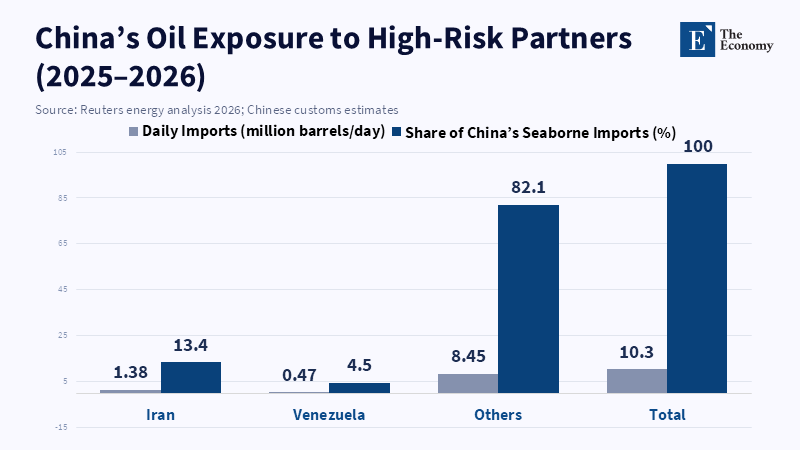
In 2025, China imported roughly 1.38 million barrels of Iranian oil daily, about 13.4% of Chinese seaborne crude imports. According to Cadena SER, Venezuela produces about 3% of OPEC's oil, a much smaller share than that of major producers like Saudi Arabia, Russia, or Iraq, which may affect how attractive the relationship is to Beijing. They also help explain a larger phenomenon. China's relationships with so-called high-risk partners were, in fact, linked to spare capacity, hardware channels for oil, payments, influence, and reach. But when both relationships became too risky to handle, Beijing didn't follow an 'all-in' play for them. Instead, it served as the least-cost supplier of its own influence and resources. That's the key lesson many analysts continue to miss. China's use of economic statecraft isn't weak because it doesn't purposefully form military alliances. It is weaker because each crisis confirms to other states a lesson Beijing is eager for them to learn: that Beijing may buy, lend, build, and train if asked, but it refuses to pay the same price for those services when imminent danger threatens to erupt between it and an ally.
China's economic statecraft only works until the country feels threatened
The strongest case for China’s recent behavior is easy to put forward. Nothing China promised Iran or Venezuela resembles NATO; why should we treat it as if it does? There is some validity here. China originally avowed no interests more fundamental than non-interference, others which would remain flexible, and still others, such as commercial access to the outside world, rather than troops, that would be the price of alliances. Even in Iran, where China entered into a 25-year comprehensive strategic partnership in 2021, USCC notes that China has not engaged in any formal defense arrangements. While it supplied oil to consumers, enabled dual-use trade, and provided technology as diplomatic cover, it did not include a military promise to come to Tehran’s aid. Such behavior allowed China to conduct disciplined economic statecraft by purchasing cheap crude, maintaining relations with Gulf sheikhdoms, and criticizing wars it would not fight. It is also enough to render simplistic Washington claims that Beijing “abandoned” a treaty partner.
The more difficult question is not whether China broke its word. The more difficult question is how much the utility of Chinese economic statecraft is diminished when fellow leaders realize that a "strategic partnership" has a clearly defined limit. Evidence suggests quite a lot. Relationships between states are not simply matters of soft texts and fuzzy labels. Rather, states are judged by what the more powerful will do when costs escalate. If a politician in North Africa, Central Asia, or sub-Saharan Africa is contemplating taking a large Chinese port, mine, telecom, or energy concession, they'll simply have to ask themselves: what will Shanghai want to do if this investment results in sanctions, coercion, and violence from a rival power? Based on Venezuela and Iran, the answer is that "Shanghai will oppose, modify, and keep the liberty to maneuver."(21) That doesn't eliminate the attractiveness of Chinese finance. However, it removes the safety valve that the relationship provides. A collaborator can still reap the benefits of China. However, they can't count on China to endure the hardship for them. Once politicians recognize the limits of China's emotional commitment, the political price of allowing too much in Beijing increases. This is a deduction from the recent behavior of the leadership in Beijing and an analysis of how power dynamics in strategic partnerships are perceived by vulnerable states.
China economic statecraft is attractive, but trust still decides
The case for China should not be discounted. Its commercial appeal remains enormous. One 2025 Belt and Road valuation indicated the highest-ever recorded participation, with around $213.5 billion in infrastructure contracts and investments across many projects in over 60 nations, with Africa outstripping others as the regional accelerator. AidData also argues that China remains the world's largest official creditor and that its global lending scope is substantially larger than past projections indicated. Simply, Xi is not retreating. The 'wall hand' China economy that conducts mega projects, roads, mines, mass infrastructure, industrial zones, telecom companies, and energy facilities is present. Beijing has given the rulers enough: fewer talk-radio (public) forums that happen fast enough, faster agreement, and less questioning in open administration.
Attraction does not necessarily mean trust. This is clear from the latest State of Southeast Asia report, which reveals contradictory sentiments. Though China remains the region's biggest economic, political, and strategic influence, 52.3% of survey takers thought ASEAN should tilt toward the U.S. rather than move into China's orbit if the two powers ever fall into disagreement or back each other's play. According to Afrobarometer, China is seen as a preferred development model by 22% of Africans across 34 countries, trailing the United States at 33%, with South Africa and former colonial powers ranking lower. 60% of African citizens had positive views of China's impact on their continent, exceeding the figures for the U.S. and the EU. So yes, Chinese economic statecraft is clearly effective. But good perceptions aren't necessarily trust, and countries don't just want the upside; they hedge. They can and do embrace the lion, yet keep a backdoor of action and an alternative to trust open if things get hot.
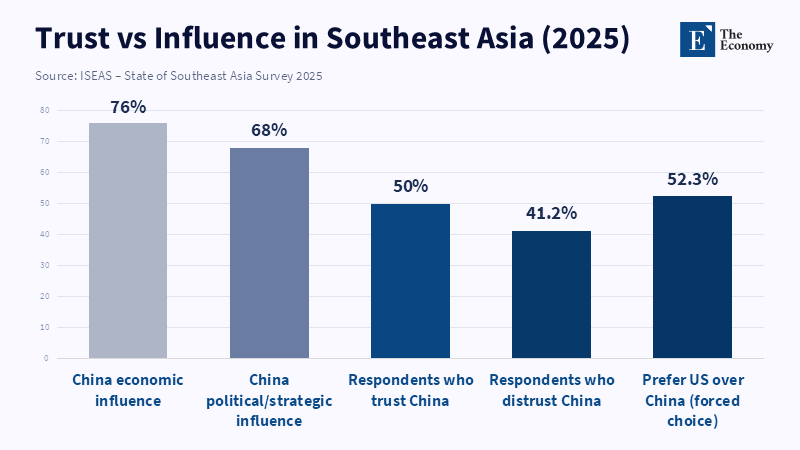
It does not matter more than the headline deals made, true. But it does matter quite a lot. An exposed state can accept all those deals and still remain two steps away from the door. In a nutshell, no matter who turns up, who is offering, a state that fears its exposure also wants to know who fears no measure. Who can not only pour in dollars but also keep shipping lanes open against pirates? Who can cover a balance-of-payments shock? Who can stay helpful when it finally faces a crisis? China generally wins that test in the early rounds. It tends to fall short on the latter ones. That does not prompt countries to abandon China. It does prompt countries to be a little more cautious in their promises, a little quicker to change their agreements into bagfuls of beans, a little quicker to overshoot their conversion into dove-hued citizens. Nothing should collapse, but influence will be harder to get and softer when it is gained than Beijing claims. The broad conclusion hinges on what the survey finds in the gaps inside the dragon's path.
China's economic statecraft provides structure, not security.
Some will also argue that such criticism is still too Western. China does not attempt to mirror US alliances. It chooses yet another path, one defined by order, regime stability, pipelines, police assistance, and trade. And that is true, and it should be given utmost importance. However, in recent studies on China's Global Security Initiative, many elite political, security, and military officials across certain parts of Southeast Asia, East Africa, and the Middle East do perceive Beijing as a 'useful security partner. But the domestic security China traditionally provides still plays a central role: it is about internal order, police cooperation, surveillance technology, and counterinsurgency assistance. That can have profound importance for leaders who are more worried about possible unrest than invasion. It may even accelerate Chinese sway in states seeking tools of control, but not self-governance and human rights processes. In this limited sense, China's economic statecraft is advancing successfully.
Yet that adaptation illustrated the fundamental shortcoming. Internal order is not the same as external security. A government might accept Chinese cameras, training, payment systems, and industrial loans, but still doubt that Beijing would come to its defense in a stand-off with Washington, a blockade, or a strike. That is what will matter, because the next phase of great power competition will be over ports, minerals, data links, power grids, and energy routes in just those vulnerable areas. If leaders believe Chinese support stops where serious coercion begins, they will opt for shorter deals, faster cash, more legal parameters, and greater leeway in decision-making. They may continue to do business with Beijing. They will not want to seem to be in Beijing's camp. That is now the true dilemma facing China's economic statecraft. It may secure continued access. It could also lose the political foundation needed to make many projects a durable empire of influence.
A second rebuttal also merits discussion. A view holds that, despite such issues, Beijing does not require the fervent levels of trust often asked of the West because the U.S. can appear so volatile, expensive, and overbearing. That is true sometimes, and China realizes it. Chatham House reasons that Washington may even derive some immediate diplomatic benefit from implying that Beijing is the more peaceful and restrained great power when Washington uses power. But that is only part of the story. Calm can make headlines, but it does not always produce hard decisions in exposed capitals. It is possible that leaders prefer a risk-taking, assertive power that can show force rather than a laid-back power that might back down when the time comes to lay down cover fire. That is why China's image as the calm great power is helpful but inadequate. China's economic statecraft can benefit from ensuring that it appears different from the United States and prevents doubt about its commitment.
What China's economic statecraft comprises for policymakers and educators:
This is the context to which policymakers and educators need to turn; they must discern the differences between these two variants of a story that frames far more than it explains. To date, too much teaching on China's worldwide role has been caught between these two narratives: that it is transparently commercial and that it is transparently militarized. Neither narrative captures the more difficult reality: that China's capability in economic statecraft stems from its melding of finance, infrastructure, technology, and access to political capitals, without the responsibilities of a binding alliance. This same design paradoxically imposes a well-defined ceiling on the level of trust that can exist. Academia that trains future ambassadors, civil servants, planners, and business people should expose students to the reality of Chinese engagement as a complex system of transactional bargaining, not friendship, not empire in the traditional sense. Projected value, political leverage, regime support, and crisis behavior need to be examined simultaneously. Absent this, future officials will miscalculate and underprepare, or overreact and fall into as-yet-unknown forms of dependence.
Administrators should also think more strategically about institutional exposure. China, oriented financial arrangements, for instance, related to education, scholarships, vocational training, digital platforms, or research infrastructure, may continue to flourish by delivering concrete advantages while imposing relatively few expectations, at least initially. Still, they should be based on a presumption of transactional continuity rather than strategic partnership. Developing-country policymakers should seek to separate four questions that tend to be combined: who will supply funding, assume risk, defend the system during a crisis, and remain afterward. The answer may not always be China. This is not an argument for avoiding Beijing. It is an argument for negotiating with conscious awareness. A commercial superpower can carry quite a load. But if it wants more enduring support, not just an ever-growing share of the marketplace, it will have to demonstrate that partner states are more than pins on a balance sheet.
This means strategy, not slogans, for our education systems. Business schools should stop treating Chinese capital as a means of cheap project finance. Schools of public policy should stop treating non-alignment as a neutral concept when supply chains, payment channels, and security threats are joined at the hip. Education ministries that sign technology, training, or scholarship agreements with Chinese partners should ask China's own finance ministries the same questions they ask about ports and grids: What is the gain, where is the reliance, and what happens if the wider international environment shifts? None of this is anti-China. It is a state capacity analysis. Those who understand what China's economic statecraft is being engineered to do, and where that strategy starts to run into trouble, will be the governments that prosper with China in the next decade.
The lesson from Iran and Venezuela is not that China's model has broken down. It is that its outer edge is more transparent. Beijing can continue to build ports, buy oil, extend credit, and provide a toolbox of influence. It can even project the image of a less aggressive rival at war. But calm is not commitment. And that distinction will resonate with leaders in fragile nations. When the next Chinese delegation arrives with money for a railway, a refinery, a campus, or a data center, officials will listen. They may sign. Yet they will recall who remained on the sidelines as the missiles fell. Such memories are unlikely to deflate China's economic statecraft. They are more likely to condition it, render it more transactional, and be prone to dissolving into no more than expedient efficiency. China need not be America. But if it hopes that its ventures will determine the shape of the coming order, rather than make a financial killing from it, it will have to demonstrate that commodity trade remains an outer edge, rather than the extent of its engagement.
The views expressed in this article are those of the author(s) and do not necessarily reflect the official position of The Economy or its affiliates.
References
AidData (2025) China’s Global Loans and Grants Dataset, Version 1.0. Williamsburg, VA: AidData at William & Mary.
Duchâtel, M., Bräuner, O. and Hang, Z. (2014) Protecting China’s Overseas Interests: The Slow Shift away from Non-interference. SIPRI Policy Paper No. 41. Stockholm: Stockholm International Peace Research Institute.
Fulton, J. (2022) Cooperative Security in the Middle East: A Role for China? London: Chatham House.
Garcia, Z. (2026) ‘The West continues to misread China’s partnerships’, East Asia Forum, 2 April.
García-Herrero, A. (2026) ‘Iran, a bigger headache for China than Venezuela, but with Taiwan as potential silver lining’, EuroAsia and the World, March.
Gelpern, A., Horn, S., Morris, S., Parks, B. and Trebesch, C. (2023) ‘How China lends: A rare look into 100 debt contracts with foreign governments’, Economic Policy, 38(114), pp. 345–416.
Jackson, L. and Li, S. (2026) ‘China’s oil investments in Venezuela’, Reuters, 5 January.
Khan, S. (2026) ‘China’s Dependence on Iranian Oil: Strategic Leverage and Exposure’, Modern Diplomacy, 13 January.
Kynge, J. (2026) ‘China’s economic statecraft has been exposed by US attacks on Iran and Venezuela’, Chatham House, 10 March.
Martín, A. and Fàbrega, J. (2025) ‘El peso del petróleo venezolano: oxígeno para Maduro, insignificante a nivel mundial’, Cadena SER, 17 December.
Nurmamat, M. (2026) ‘China signs record US$213 billion of new “belt and road” deals in 2025: report’, South China Morning Post, 19 January.
Parks, B.C., Escobar, B., Walsh, K., Zhang, S., Fedorochko, R., Vlasto, L., Sickell, J., Miao, S., Bury, E., Zimmerman, J., Custer, S., Dreher, A., Franz, L., Fuchs, A., Horn, S., Malik, A.A., Reinhart, C.M., Strange, A., Tierney, M.J. and Trebesch, C. (2025) Tracking Loans and Grants from China to Low-, Middle-, and High-Income Countries: An Application of AidData’s TUFF 4.0 Methodology. Williamsburg, VA: AidData at William & Mary.
Sanny, J.A. and Selormey, E.E. (2021) ‘AD489: Africans welcome China’s influence but maintain democratic aspirations’, Afrobarometer Dispatch, No. 489.
Seah, S., Lin, J., Martinus, M., Sithanonxay Suvannaphakdy and Pham Thi Phuong Thao (2023) The State of Southeast Asia: 2023 Survey Report. Singapore: ISEAS – Yusof Ishak Institute.
Seah, S., Lin, J., Martinus, M., Fong, K., Pham Thi Phuong Thao and Aridati, I.Z. (2025) The State of Southeast Asia: 2025 Survey Report. Singapore: ISEAS – Yusof Ishak Institute.
U.S.-China Economic and Security Review Commission (2026) China-Iran Fact Sheet: A Short Primer on the Relationship. Washington, DC: U.S.-China Economic and Security Review Commission.
Working across research, policy, and data-driven analysis, the Editorial Board ensures that published pieces reflect a consistent institutional perspective grounded in quantitative reasoning and long-term structural assessment.