AI Research Memo
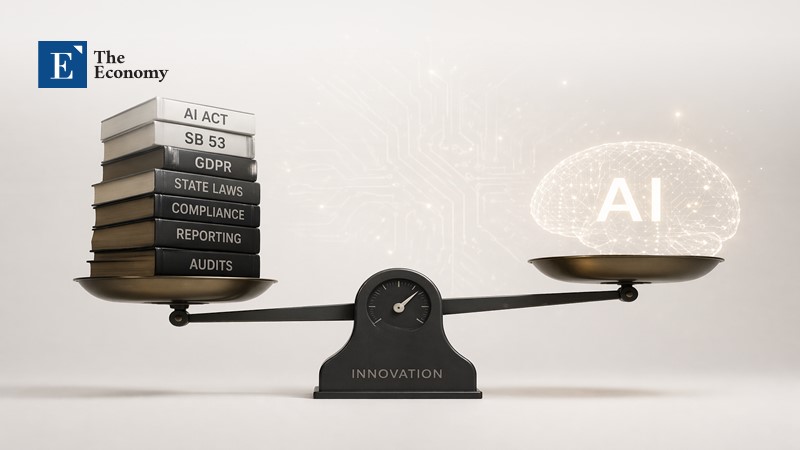
AI regulation is no longer just uncertain; it is becoming too heavy Layered rules now protect large firms and weaken smaller AI challengers The next AI leaders will be those that balance safety with room to build Every one of the 50 U
Read More
Claude Mythos marks a new machine-speed era in cybersecurity It exposes how much weak software still underpins the digital economy The article argues that firms and policymakers must adapt fast In April 2026, the UK AI Security Inst
Read More
Data AI looks powerful, but it is energy-hungry and weak in noisy, causal settings Bio AI offers a more efficient and more adaptive path by using living neural systems Education policy should stop training only for today’s chatbots and prepare for this wider AI future
Read More
AI is raising output while reducing the need for average human labor Mass retraining alone will not solve a labor market that needs fewer workers Education policy must shift from teaching adaptation to protecting human economic relevanc
Read More
AI can raise productivity without creating enough jobs to offset the losses Unlike the China shock, the AI shock may keep production at home while still weakening careers The real policy challenge is not just skills, but who captures the gains from automation
Read More







AI is shifting income from wages to profits and capital That will intensify wealth-tax, capital-tax, and AI-tax debates If governments wait, unemployed growth will weaken fiscal legitimacy According to data compiled by
Read More
AI-driven job losses slash labour income and VAT, straining European Union budgets. Public demand for universal basic income surges just as tax capacity erodes. Digital VAT enforcement, a rent surtax, and automatic income top-ups offer a solvency lifeline.
Read More
AI can raise business output while shrinking labour’s share of income That weakens household demand first in B2C sectors, then spreads across the wider economy Without broader distribution of AI gains, growth may continue, but it will become narrower and more fragile
Read More
AI job loss can reduce consumption fast That can shrink the VAT base and strain budgets Europe may face the pressure first In 2023, value-added tax (VAT) accounted for 20.5% of total tax revenue across OECD countries.
Read More
AI tools let a handful of workers match whole teams’ output. Job-loss forecasts overlook the widening productivity gulf inside occupations. Spreading agentic-design skills and sharing gains can turn the windfall into broad prosperity.
Read More

Current AI labour data hides deeper structural shifts Displacement risks are underestimated by early signals Policy must act before the shock becomes visible One key number should make anyone betting on a smooth transition
Read More
Current research on AI’s job impact is sparse, uneven, and contradictory Official metrics miss rising under-employment, so today’s calm may disguise looming layoffs Governments must invest now in adaptable training and safeguards before clearer data arrive
Read More
Physical AI will erase millions of jobs, making labour redundancy inevitable. A mandatory Universal Basic Adjustment Benefit must be enacted before the shock. AI’s productivity boost widens gaps so sharply that reskilling alone cannot save workers.
Read More
AI will not just augment workers; it will replace many with a few “superhuman” operators The real divide is access to compute and energy, not worker readiness Without new policy, AI will create structural labor redundancy The artifici
Read More
AI lets a select cadre of super-human workers outproduce whole teams. Visa barriers in the United States choke the frontier talent pipeline. Policy must back elite training, open immigration, and an automation-funded safety net.
Read More

Shanghai’s single AI cluster outpaces United States’ scattered hubs. Talent gravity widens innovation and wage gaps. Focus investment, cushion workers. In July 2025, Shanghai caught the attention of global policymakers when the
Read More
Federal AI spending alone no longer secures United States dominance after decades of relative decline. China is sprinting ahead as AI-driven “super-human” productivity makes vast swathes of labour redundant. Research budgets must be tied to strong worker protections to win the tech race without fracturing society.
Read More
AI can produce theses that look credible but contain flawed or fabricated research Traditional plagiarism tools cannot detect this new form of AI-assisted fraud Universities must redesign assessment to protect academic integrity I
Read More
The Anthropic–OpenAI shift exposes flaws in Pentagon AI procurement Replacing an AI model triggers deep operational and institutional disruption Procurement reform is needed to balance speed, ethics, and security The pivot
Read More
AI errors often come from bad input data, not the model itself Weak information pipelines allow false claims to spread through chatbots Strong data governance and source verification are essential When a simple blog po
Read More