“Data Centers Powered by Brain Cells” — Bio-Computing Commercialization Gains Momentum as Technological Rivalry Intensifies, Though Skepticism Persists

As one of the youngest members of the team, Tyler Hansbrough is a rising star in financial journalism. His fresh perspective and analytical approach bring a modern edge to business reporting. Whether he’s covering stock market trends or dissecting corporate earnings, his sharp insights resonate with the new generation of investors.
Authored On
Modified
Cortical Labs to build commercial data centers in Australia and Singapore using ‘CL1’
Bio-computing emerges as an alternative to AI-driven power shortages, demonstrating potential for intelligent information processing
Experts caution the technology remains in an early stage despite intensifying development race

As the surge in artificial intelligence (AI) accelerates power shortages linked to data centers, “bio-computing,” which processes information using living cells instead of silicon-based semiconductor chips, is emerging as a potential alternative. The technology has begun attracting market attention due to its ability to perform learning and information processing with significantly lower power consumption than conventional AI semiconductors. While competition to develop the technology is intensifying among startups and university researchers, some experts warn that commercialization discussions may be premature given the field’s early developmental stage.
Cortical Labs Attempts Commercialization of ‘Bio Data Centers’
According to a report by Tom’s Hardware on the 11th (local time), Australian biotechnology firm Cortical Labs recently announced plans to establish the world’s first commercial data centers in Australia and Singapore using its bio-computer “CL1,” which cultivates 200,000 human brain cells on a silicon chip. CL1 operates by converting human blood cells into neurons through induced pluripotent stem cell (iPSC) technology and placing them on a semiconductor substrate. Electrical stimuli are delivered to the neurons via electrodes, and the electrical activity generated by the neural cells is read to process information.
Cortical Labs plans to collaborate with data center operator DayOne to gradually deploy 120 CL1 units in Melbourne and a total of 1,000 units in Singapore. The Yong Loo Lin School of Medicine at the National University of Singapore (NUS) will operate 20 units during the initial validation phase to conduct pilot demonstrations. Each unit is priced at approximately $35,000 (about $38,000), a figure that includes the specialized life-support systems required to maintain brain cells in optimal condition. The replacement cycle for the cells is approximately six months due to their biological lifespan.
One of CL1’s greatest advantages is its power efficiency. Each unit consumes about 30 watts of electricity, far lower than the thousands of watts required by the latest AI semiconductors. Cortical Labs Chief Executive Officer Hon Weng Chong recently stated in an interview with Bloomberg that “CL1 consumes less power than a handheld calculator.” In this regard, Professor Paul Roach of Loughborough University in the United Kingdom noted that “if CL1 were scaled to data center levels, the potential power-saving effects could be substantial,” adding that energy consumption for cooling may also be significantly lower than in conventional computing systems.
Information Processing Capabilities of Bio-Computers
CL1 has also demonstrated the ability to perform intelligent information processing beyond simple computation. Cortical Labs recently explained that CL1 learned to play the first-person shooter game Doom after approximately one week of training. The game features a relatively complex structure requiring movement through a 3D environment while searching for and attacking enemies.
To overcome this challenge, researchers developed a new neural network system known as Cortical Cloud. Visual information from the game screen is converted into patterns of electrical stimulation that activate specific neural regions, allowing neurons to respond accordingly. Through repeated stimulation, researchers encouraged the neurons to learn commands associated with movement and attack.
Earlier, in 2022, Cortical Labs successfully enabled the classic table tennis video game Pong to be played using its DishBrain system, which was created by differentiating human neurons from induced pluripotent stem cells (iPS). The DishBrain system was designed as a closed-loop structure connected in real time with a computer simulation environment. Information from the game screen was transmitted to neurons as electrical stimuli, while the electrical activity of the neurons controlled movements within the game.
In this interactive framework, Pong served as a task designed to verify the learning capability of the neurons. During the experiment, regular electrical signals were delivered as reward stimuli when the paddle successfully hit the ball, while irregular noise signals were provided when it failed. As a result, the neural cell network learned the game pattern within approximately five minutes and gradually improved the paddle’s movement. The experiment is widely regarded as an early proof-of-concept study that laid the foundation for the development of CL1.
Global Efforts to Advance Bio-Computing Technology
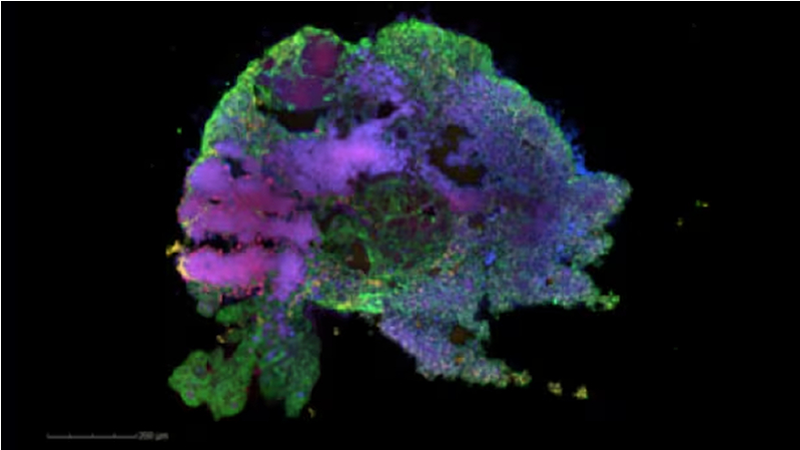
Bio-computing development is emerging as a central research objective for numerous companies and institutions beyond Cortical Labs. Researchers at Johns Hopkins University in the United States are studying the information processing and learning capabilities of “mini brains,” or brain organoids, created from human stem cells. In 2023, the research team introduced the concept of “organoid intelligence,” proposing the use of laboratory-grown clusters of neural cells as a new form of bio-computing platform.
Subsequent studies have succeeded in producing multi-region organoids by combining different brain regions, enabling neural activity and connectivity structures that resemble those of an actual brain. Through this approach, researchers have experimentally observed fundamental neural mechanisms associated with learning and memory formation. Such research is expected to extend beyond bio-computing and contribute to studies of neurological diseases and new drug development.
Swiss startup FinalSpark is another leading company conducting bio-computing research using human neural cells. Founded in 2014, the company has been developing bio-processors based on brain organoids. The processor operates by cultivating miniature brain organoids derived from stem cells originating from human skin cells and connecting them to a multi-electrode array (MEA) to input and output signals.
In 2024, FinalSpark unveiled “Neuroplatform,” a research platform utilizing such neural tissues, allowing researchers worldwide to remotely access experiments through the internet. The platform’s 16 brain organoids demonstrate how biological neural networks learn and process signals.
Despite growing enthusiasm for bio-computing across the industry, some experts continue to stress that the technology remains in its infancy. The learning and computational mechanisms of neural cells are still not fully understood, and training methods for performing tasks such as machine learning remain unclear. Methods for storing neural learning outcomes in long-term memory have yet to be established, and the learned information may disappear once cell cultures are terminated, highlighting additional challenges that must be resolved.
As one of the youngest members of the team, Tyler Hansbrough is a rising star in financial journalism. His fresh perspective and analytical approach bring a modern edge to business reporting. Whether he’s covering stock market trends or dissecting corporate earnings, his sharp insights resonate with the new generation of investors.
Similar Post