[U.S.-Iran War] “$2 Million Per Passage”: Iran Turns Pirate in the Strait of Hormuz, Lays Mines and Extorts Transit Fees

Matthew Reuter is a senior economic correspondent at The Economy, where he covers global financial markets, emerging technologies, and cross-border trade dynamics. With over a decade of experience reporting from major financial hubs—including London, New York, and Hong Kong—Matthew has developed a reputation for breaking complex economic stories into sharp, accessible narratives. Before joining The Economy, he worked at a leading European financial daily, where his investigative reporting on post-crisis banking reforms earned him recognition from the European Press Association. A graduate of the London School of Economics, Matthew holds dual degrees in economics and international relations. He is particularly interested in how data science and AI are reshaping market analysis and policymaking, often blending quantitative insights into his articles. Outside journalism, Matthew frequently moderates panels at global finance summits and guest lectures on financial journalism at top universities.
Authored On
Modified
Iran locks down the Strait of Hormuz and escalates
Draft bill prepared to levy $2 million in transit fees per vessel
Targeting a 24-mile chokepoint in a strait just 24 miles wide
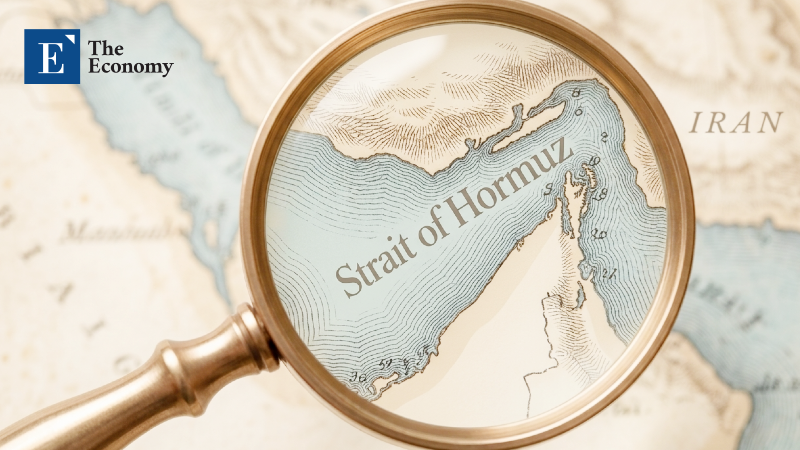
Iran has moved to collect transit fees in the Strait of Hormuz, which it has effectively sealed off, much like the Suez Canal. The plan reflects Tehran’s intention to use the strait as both a core bargaining chip in negotiations and a strategic asset capable of generating revenue even after the war ends. As one of the world’s most critical energy shipping arteries begins to fall under the logic of geopolitical retaliation rather than the principle of freedom of navigation, Middle Eastern waters are rapidly being transformed into a high-risk zone where military tension and logistics disruption overlap.
Formalizing Selective Passage
According to the Financial Times on March 25, Iran’s Foreign Ministry recently sent a letter to the 176 member states of the International Maritime Organization (IMO), formally notifying them that “only non-hostile vessels that coordinate in advance with Iranian authorities will be permitted to pass through the Strait of Hormuz.” Since the outbreak of war last month on Feb. 28 between the United States, Israel and Iran, Tehran has made increasingly explicit its intent to wield control over this strategic chokepoint as an instrument of international legal leverage.
The core of the letter Iran delivered to the IMO is a “discriminatory right of passage.” Iran made clear that vessels from the United States and Israel, as well as ships belonging to countries that joined their aggression, would not qualify for transit. Iran’s Foreign Ministry described the move as a “proportionate measure designed to prevent aggressors and their accomplices from using the strait to conduct hostile operations against Iran.” In particular, vessels linked to the United States and Israel were categorically excluded from the scope of “innocent passage” under international maritime law, a right allowing ships to pass freely so long as they do not threaten the peace and security of the coastal state.
The current situation in the Strait of Hormuz is grave. Since the conflict began, 22 vessels have come under attack by Iran’s Islamic Revolutionary Guard Corps (IRGC), leaving roughly 3,200 ships stranded inside the Persian Gulf. The IMO, a United Nations agency, convened an emergency meeting last week and is discussing the establishment of a “humanitarian corridor” for vessels running out of supplies, but without Iranian cooperation its implementation remains uncertain.
Snowballing Transit Fees in Defiance of International Law
Iran is also extracting enormous economic gains under the pretext of granting passage. According to Lloyd’s List Intelligence and the shipping industry, some vessels are believed to have paid Tehran as much as $2 million in exchange for guaranteed safe passage. The IRGC has reportedly deployed at least 12 high-performance naval mines across the strait and then demanded hefty transit payments from ships seeking to avoid mined zones and pass safely through Hormuz. If all 3,200 vessels currently trapped in Gulf waters were to exit the strait, Iran would reap $6.4 billion.
More troubling is the possibility that Iran is seeking to use the current crisis as an opening to reorder the maritime order itself. In an interview with Iran’s semi-official Mehr News Agency, Iranian lawmaker Mansour Alimardani said Tehran was preparing new legislation centered on tighter controls over passage through the Strait of Hormuz and the de-dollarization of settlement currency, adding that “even after the war ends, the situation will not return to the kind of free passage seen in the past.” Iran has previously used the Strait of Hormuz as a hostage asset. In 2019, a similar bill authorizing transit fees was submitted to parliament in response to the “maximum pressure” policy of the first Donald Trump administration, though it failed to clear the threshold for a vote.
Yet Iran’s collection of transit fees runs counter to international law. Under Articles 26 and 44 of the United Nations Convention on the Law of the Sea (UNCLOS), all ships are guaranteed the right of transit passage through straits used for international navigation, and even within territorial waters, no fees may be imposed simply for passage itself; charges may be levied only for specific services rendered to foreign vessels. Iran, however, has signed the convention without ratifying it. In other words, Tehran is not legally bound by the treaty and retains a possible escape hatch. If Iran does move to impose transit fees, it will likely attempt to frame them as payment for “security services” provided in connection with passage through the Strait of Hormuz.
The Isolation Path Triggered by Piracy
Still, Iran’s move is, in substance, little different from piracy. Forcing ships transiting a particular body of water to pay money and deriving economic gain from that coercion mirrors the core structure of pirate activity. Compared with the Somali pirate operations once seen around the Bab el-Mandeb Strait and the Gulf of Aden, the only real difference is that a state is the actor; the operating mechanism remains the same.
Like Somali pirates, Iran also has the capability to attack civilian oil tankers using small, fast boats. At the narrowest point of the Strait of Hormuz, the width is just over 19 miles, while thousands of kilometers of Iranian coastline effectively envelop the strait in its entirety. In such a constricted waterway, vessels are left directly exposed to Iranian drone and missile attacks.
Because bombardment comes from such close range, effective interception is virtually impossible. Hossein Kanaani Moghadam, a former IRGC commander, said, “If U.S. forces enter the Persian Gulf, Iran can easily destroy them from its 2,000-kilometer coastline.” If dozens of ships become entangled in attacks within a narrow zone fully visible from shore, they are, quite literally, defenseless. That is why the U.S. Navy refers to the Strait of Hormuz as a “kill box.”
Yet over the longer term, Iran’s attempt to extract transit fees is likely to prove a self-defeating move that invites hostile forces into its own backyard. The Somali piracy precedent offers a stark illustration of how maritime threats backed by force tend to end. At the time, the international community dispatched multinational naval forces, including South Korea’s Cheonghae Unit, and built a physical framework for coordinated anti-piracy operations. In that process, Djibouti, near Somalia, was transformed into a strategic hub hosting military bases from countries around the world.
Iran’s actions likewise furnish a justification for international military coordination. The more severely freedom of navigation through the strait is impaired, the stronger the rationale becomes for the deployment of naval forces from the United States, NATO, and East Asian countries facing disruptions to energy supply into the surrounding waters. That outcome would stand in direct contradiction to Iran’s stated slogan of “independently safeguarding regional security,” and instead would likely produce the paradoxical result of constraining its own maritime control. In other words, Iran’s latest measure is unlikely to secure lasting viability as a long-term strategy. One military security expert said, “Weaponizing sea lanes may strengthen bargaining power in the short term, but if sustained, it invites international isolation and military intervention, ultimately culminating in enormous costs for the state as a whole.”
Matthew Reuter is a senior economic correspondent at The Economy, where he covers global financial markets, emerging technologies, and cross-border trade dynamics. With over a decade of experience reporting from major financial hubs—including London, New York, and Hong Kong—Matthew has developed a reputation for breaking complex economic stories into sharp, accessible narratives. Before joining The Economy, he worked at a leading European financial daily, where his investigative reporting on post-crisis banking reforms earned him recognition from the European Press Association. A graduate of the London School of Economics, Matthew holds dual degrees in economics and international relations. He is particularly interested in how data science and AI are reshaping market analysis and policymaking, often blending quantitative insights into his articles. Outside journalism, Matthew frequently moderates panels at global finance summits and guest lectures on financial journalism at top universities.
Similar Post