“AI-Driven Power Crisis Reshapes Market Landscape” NextEra Pursues Dominion Acquisition as M&A and Capital Spending Surge Across U.S. Power Sector

Aoife Brennan is a contributing writer for The Economy, with a focus on education, youth, and societal change. Based in Limerick, she holds a degree in political communication from Queen’s University Belfast. Aoife’s work draws connections between cultural narratives and public discourse in Europe and Asia.
Authored On
Modified
NextEra Energy seeks to acquire Dominion Energy in $67 billion deal
Soaring AI-driven electricity demand sends data-center-region power prices skyrocketing
Utilities and power companies ramp up capital expenditure, with industry-wide M&A activity expected to accelerate
NextEra Energy, the largest renewable energy company in the United States, is moving to acquire rival Dominion Energy. With the U.S. electricity market overheating amid explosive growth in artificial intelligence (AI) data centers, the company is seeking to bolster its competitiveness through large-scale mergers and acquisitions (M&A). The broader trend of aggressive investment is also spreading rapidly across the U.S. utility and power sector.
Mega-Scale Consolidation Across the U.S. Power Industry
On May 18, NextEra announced that it had agreed to acquire Dominion Energy in a $67 billion transaction. The deal will primarily be structured as a stock swap, with shareholders of both companies set to receive a one-time cash payment totaling $360 million upon completion. NextEra and Dominion currently hold market capitalizations of approximately $200 billion and $50 billion, respectively, while the combined company’s total enterprise value, including debt, is projected to approach $420 billion. The transaction would create the world’s largest power company.
Headquartered in Florida, NextEra has long dominated the solar- and wind-focused clean energy market, while recently expanding into natural gas generation as part of a broader diversification strategy. Upon completion of the merger, NextEra would secure Dominion’s extensive portfolio of nuclear reactors, gas-fired power plants, and transmission infrastructure. The company would also inherit Dominion’s major customer base — including Alphabet, Amazon, Microsoft (MS), Meta, Equinix, CoreWeave, and CyrusOne — along with substantial electricity demand from Virginia, where Dominion is headquartered. The acquisition would significantly strengthen NextEra’s position in the increasingly competitive U.S. power market.
Still, the transaction’s successful completion remains uncertain. Given the scale of the merger, regulatory scrutiny is expected to intensify considerably. The largest hurdle will come from federal antitrust authorities, alongside approvals from the Federal Energy Regulatory Commission (FERC) and the Nuclear Regulatory Commission (NRC). Regulatory bodies across the states served by Dominion are also expected to closely review the terms of the merger agreement. Assuming the approval process proceeds without major obstacles, the deal is expected to close within 12 to 18 months.
Power Market Volatility Driven by AI Demand
NextEra’s aggressive M&A push reflects the rapid transformation underway in the U.S. electricity market. The industry has entered an overheated phase as AI-driven data-center demand surges nationwide. Massive facilities operating around the clock are consuming enormous volumes of electricity, triggering a sharp rise in power prices. According to PJM Interconnection, the largest grid operator in the United States, average wholesale electricity prices in the first quarter rose 76% year-over-year to $136.53 per megawatt-hour (MWh), compared with $77.78 a year earlier.
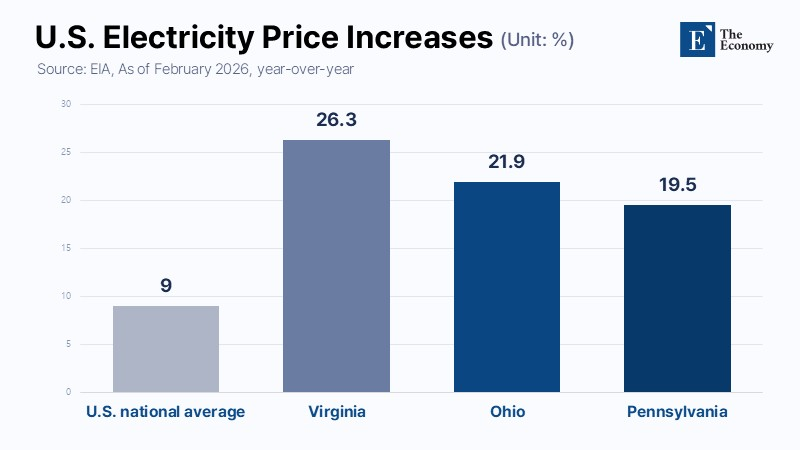
The problem has become particularly acute in regions densely packed with data centers. According to the U.S. Energy Information Administration (EIA), average nationwide electricity prices rose 9% year-over-year in February. In contrast, electricity rates surged 26.3% in Virginia and 21.9% in Ohio during the same period, far outpacing the national average. Analysts point to rapidly escalating costs tied to expanding transmission networks and generation capacity in Virginia — the largest data-center hub in the United States — which have sharply increased utilities’ power procurement expenses. Those costs are ultimately being passed on directly to households. PJM’s capacity procurement cost for the 2025–2026 delivery year reached $269.92 per megawatt, nearly ten times higher than the previous year’s $28.92 per megawatt.
The rise in electricity costs is increasingly shaping public sentiment across the United States. President Donald Trump has publicly addressed the issue as November’s midterm elections approach. In January, Trump wrote on his social media platform Truth Social that, “I never want Americans paying high electricity prices because of data centers,” adding that “Big Tech companies building data centers should bear the costs themselves.” The White House subsequently introduced the “Ratepayer Protection Pledge,” calling on major technology firms to directly shoulder the cost of generation and grid expansion required for new data-center development. Amazon, Google, Meta, Microsoft, OpenAI, Oracle, and xAI have all joined the initiative. However, the measure remains a voluntary agreement rather than a federally mandated regulation.
Wave of Large-Scale Industry Investment
Against this backdrop, enormous amounts of capital are flowing into the U.S. electricity market. According to S&P Global, capital expenditures by 47 major U.S. power companies climbed 22% from $173 billion in 2024 to more than $212 billion last year. Duke Energy currently stands out as one of the industry’s most aggressive investors. The company has unveiled plans to invest a total of $103 billion in capital projects through 2030, with approximately 65% allocated toward transmission grid expansion and new power generation facilities. The company is particularly focused on expanding ultra-high-voltage transmission infrastructure and gas- and battery-based power systems across North and South Carolina.
Southern Company has also raised its planned five-year capital expenditure budget from $76 billion to $81 billion. Its subsidiary Georgia Power is investing as much as $15 billion into dedicated power infrastructure for new data centers while accelerating power plant and transmission network expansion through long-term electricity supply agreements. American Electric Power (AEP) is likewise ramping up investment to meet rising electricity demand from AI data centers. The company recently expanded its five-year investment plan to approximately $78 billion, allocating roughly 42% of total spending toward ultra-high-voltage transmission infrastructure.
M&A activity is also expected to accelerate following NextEra’s move to acquire Dominion. Large-scale consolidation has become increasingly essential for utilities seeking economies of scale. Building transmission networks, power plants, and energy storage systems (ESS) requires astronomical capital expenditure, while larger operators gain advantages in grid efficiency, electricity procurement costs, and long-term power purchase agreement (PPA) negotiations. Expanding through M&A also allows utilities to offset cost pressures during periods of rising electricity prices while maximizing profitability. In addition, data-center operators increasingly prefer massive multi-state utility providers capable of ensuring stable power supply across broader geographic regions rather than relying on smaller single-state operators.
Aoife Brennan is a contributing writer for The Economy, with a focus on education, youth, and societal change. Based in Limerick, she holds a degree in political communication from Queen’s University Belfast. Aoife’s work draws connections between cultural narratives and public discourse in Europe and Asia.
- Previous “The Smartphone’s Two-Decade Reign Is Ending” — Smart Glasses Emerge as the Core Device of the AI Agent Era, With Technological Maturity and Trust Becoming Decisive Factors
- Next “Time for Tightening?” Middle East-Driven Inflation Shock Sends U.S. Long-Term Treasury Yields Surging, Complicating Prospects for Rate Cuts Under a Warsh-Led Fed
Similar Post