Building Better Neighbourhoods, Building Better Futures

Anna Keller’s background spans biomedical sciences and data-driven health research. Her interests include biological data analysis, translational health technologies, and the methodological limits of applying AI to complex biological systems. At SIAI Science Review, she covers bio, health, and life-science topics with an emphasis on scientific validity and cautious interpretation.
Authored On
Modified
Better neighbourhoods create better long-term outcomes for children
Housing design and social mixing shape educational success and adult earnings
Urban policy must align with education policy to reduce intergenerational poverty
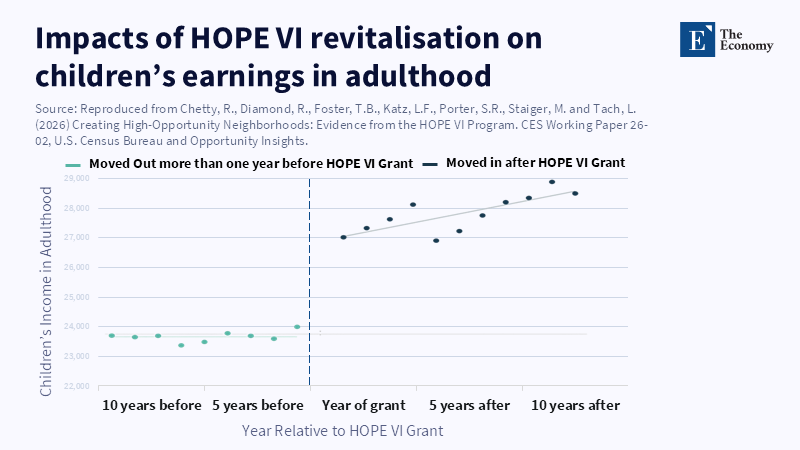
Across the United States, children raised in newly renovated public housing units earned roughly 16% more by their late twenties than peers who grew up in unchanged projects. This sharp number comes from large-scale administrative data studies and highlights a simple claim: the place where a child grows up shapes long-term life chances. Safe streets, shared yards, and more mixed-income contact change routines. They change who children meet and what paths they imagine. When areas are rebuilt to connect to the wider city, schools gain students who can learn with more focus and time. For readers focused on schools, this matters. Classroom work is vital. But it will not erase the drag that an isolated, unsafe area creates for young learners. Call this aim creating high-opportunity neighbourhoods. We argue that schools and planners must act together. We outline how cities and districts can start pilots, blend funds, and protect residents.
High-opportunity neighbourhoods reshape childhood opportunity
When we see housing and urban design as part of school policy, the list of partners changes immediately. District leaders should sit on planning tables with housing authorities and transport planners. Funders should ask for plans that protect existing households. Measures of success must widen: test results matter, but so do safe routes to school, park quality, and the degree to which students from different backgrounds mix in daily life. Small changes to the built form — front porches, visible yards, lower-rise blocks, and streets which invite walking — change routine interactions. Over a childhood, those slight interactions add up. According to a 2011 article on teacher wellbeing, teachers’ day-to-day communications and relationships with students play a key role in affecting their affective reactions and long-term wellbeing, which may affect the overall durability and efficacy of instruction. To pursue this idea as policy, districts must ensure their interests are represented early in planning and insist on tenant protections that prevent renewals from simply pushing people out.
The data point to two linked takeaways. According to the Harvard Gazette, when public housing renewal focuses on creating genuine social mixing rather than just rebuilding, children who move into these revitalized units tend to earn about 16 percent more as adults. Violent events dropped sharply in many sites. Children who spent formative years in renewed units were about 6 percentage points more likely to go to college and saw median adult pay rise by a figure near 16%. These are not tiny ripples. They compare to the sorts of gains that districts fund when they take major curricular reform seriously. Reading these numbers this way reframes housing renewal as a lever for long-run school success.
What the data say — and how to read it
Three clear patterns recur across careful studies. One, children exposed for longer to well-designed, mixed-income places show larger gains later in life. Two, those gains are not limited to schooling metrics: reductions in youth justice contact appear alongside higher college entry and higher adult pay. Three, the strongest benefits appear when renewal increases social mixing and access to nearby resources, not simply when new market-rate households raise the area average. In short, the social links children form matter, and time spent in a caring place matters more than small, one-off upgrades.
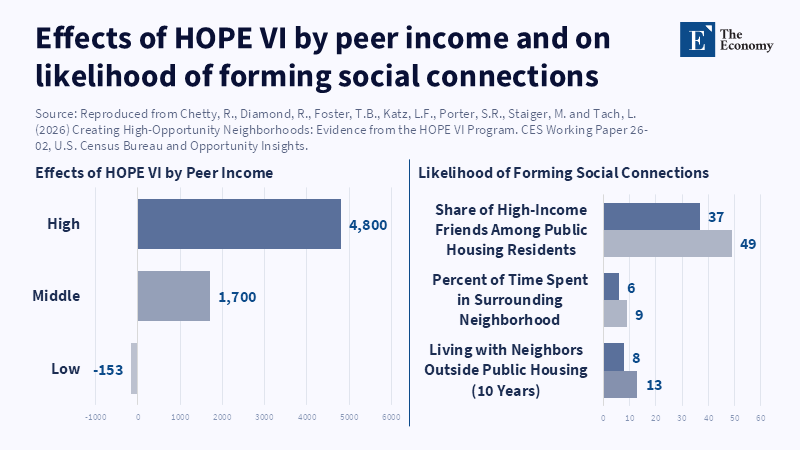
Method details matter because policy choices depend on whether these patterns reflect true causal links or selection effects. The strongest analyses compare renewed sites to closely matched control sites, use sibling comparisons to hold family traits constant, and track movers to link exposure duration to outcomes. They also run sensitivity checks for alternative control groups and for concurrent changes in local schools. Those combined methods do not prove every detail beyond doubt. But they do make a credible causal case that social exposure, safer places, and enhanced access change children’s prospects in ways that schools alone cannot completely replicate.
From design to finance: practical pathways for schools and cities
If place matters for learning, policy has three practical levers. First, design: rebuild isolated towers into human-scaled blocks with active edges, front porches, safe courtyards, and pedestrian routes which invite neighborly contact. Second, integration: site new or renewed housing near transit, jobs, and better schools so proximity translates into real access. Third, programs: align after-school hubs, magnet classes, and peer-mentoring so children from neighboring blocks meet in structured and informal ways. School leaders can act now by demanding that catchment planning, bus routes, and after-school slots be coordinated with housing plans. They can also run low-cost pilots — such as shared sports, joint arts programs, and inter-school study groups — to increase mixing before large capital projects.
The finance puzzle is solvable if policymakers adopt a long view. Deep rebuilds have high upfront costs — historical programs show meaningful per-unit spending. But when analysts value the life gains for children and factor in lower crime and higher local tax receipts, the case improves. One conservative projection values a single child’s long-run pay rise at a sum that offsets a large portion of capital expense when aggregated across cohorts. That does not mean projects should be rushed or done without protections. On the contrary, any finance deal must include enforceable anti-push-out rules, clear return rights, adequate relocation help, and legal aid for tenants.
According to a report from the Urban Institute, blended finance models such as federal seed funds, municipal bonds, philanthropy, and deals with developers aimed at delivering local benefits can be effective if contracts clearly require developers to achieve specific social outcomes and if auditsare available to the public. The report also notes that one of the main concerns is the risk of displacing current residents. Past programs sometimes returned fewer than one in three original households to finished sites. That history matters and requires a firm policy fix. According to research by Chetty and colleagues, providing families with the opportunity to move from high-poverty public housing to lower-poverty neighborhoods can have significant benefits, especially for children. Ensuring that previous residents have legally guaranteed return rights and reserving a portion of new housing units at affordable rents could help maintain access for these families during public housing renewal. Fund relocation supports and tenant legal aid. Require public audits and a tenant advisory board with real decision power over timelines and local benefits. These steps make renewal an investment in people, not a transfer of value to new arrivals.
A second critique questions generalizability: not every poor area abuts a stronger area to draw on. Where a site is a deeply isolated region, the right package combines local early-childhood centers, better transit links, and school partnerships that improve access rather than rely on immediate neighbors. According to research by Chetty and colleagues, there is no direct mention that the scaling strategy is pilot-driven or that it specifically begins in metro areas where poor and wealthy tracts are adjacent. Phase rollouts to create natural control groups. Insist on short-run KPIs — fewer violent events near school routes, higher park use, more cross-neighborhood student contact — and long-run KPIs such as college entry, adult pay, and youth justice contact. Require data sharing that safeguards privacy while enabling cohort tracking. Make school districts formal partners from design through evaluation. Fund an independent panel of tenant advocates, teachers, and researchers to review results and publish findings so other places can learn.
Return to the opening insight: a roughly sixteen percent life-pay advantage for children raised in renewed public housing. This figure does not mean housing alone fixes inequality. It shows that place and school are complements. Treating areas as part of the school policy toolkit widens the set of tools available to educators and leaders. The steps are concrete: bind anti-push-out rules to any renewal; align catchments, transit, and after-school programs with new housing; fund phased pilots that build in strong evaluation; and blend funds in ways that respect residents. Districts should insist on a seat at planning tables now. That work is generational. But when done with rights, finance, and measurement in mind, it can yield gains that last for decades.
The views expressed in this article are those of the author(s) and do not necessarily reflect the official position of The Economy or its affiliates.
References
Chetty, R., Diamond, R., Foster, T.B., Katz, L.F., Porter, S.R., Staiger, M. & Tach, L., 2026. Creating High-Opportunity Neighborhoods: Evidence from the HOPE VI Program. CES Working Paper 26-02, U.S. Census Bureau and Opportunity Insights.
Chetty, R., Diamond, R., Foster, T.B., Katz, L.F., Porter, S.R., Staiger, M. & Tach, L., 2026. Creating high-opportunity neighbourhoods: Evidence from the HOPE VI programme. VoxEU column, 21 February 2026.
Chetty, R., Hendren, N. & Katz, L.F., 2016. The Effects of Exposure to Better Neighborhoods on Children: New Evidence from the Moving to Opportunity Experiment. American Economic Review, 106(4), pp.855–902.
DeSmith, C., 2026. How design of public housing can lift future prospects of children. Harvard Gazette, 29 January 2026.
Gálvez-Gamboa, F.A. & García, L.Y., 2025. Analysis of the Neighborhood Effect in School Performance and Impact on Inequality. Education Sciences, 15(10), p.1391.
Joint Research Centre, 2023. Early–life conditions greatly influence educational success. Joint Research Centre, European Commission, 30 November 2023.
Steuteville, R., 2026. HOPE VI reduced intergenerational poverty. Public Square, Congress for the New Urbanism, 29 January 2026.
Anna Keller’s background spans biomedical sciences and data-driven health research. Her interests include biological data analysis, translational health technologies, and the methodological limits of applying AI to complex biological systems. At SIAI Science Review, she covers bio, health, and life-science topics with an emphasis on scientific validity and cautious interpretation.