The Quiet Trade-Off: How workplace flexibility Explains the ‘Firm’ Factor in the Gender Wage Gap

Erik Van der Meer examines how scientific knowledge is produced, validated, and institutionalized across disciplines. His writing explores the structure of modern science, the evolution of research norms, and the interaction between technology and scientific epistemology. He contributes reflective essays on science itself—bridging hard research and meta-level analysis.
Authored On
Modified
Workplace flexibility is a central driver of the between-firm gender wage gap
Sorting into flexible but lower-premium firms explains a significant share of persistent pay differences
Policy must decouple workplace flexibility from lower earnings to close the gap sustainably

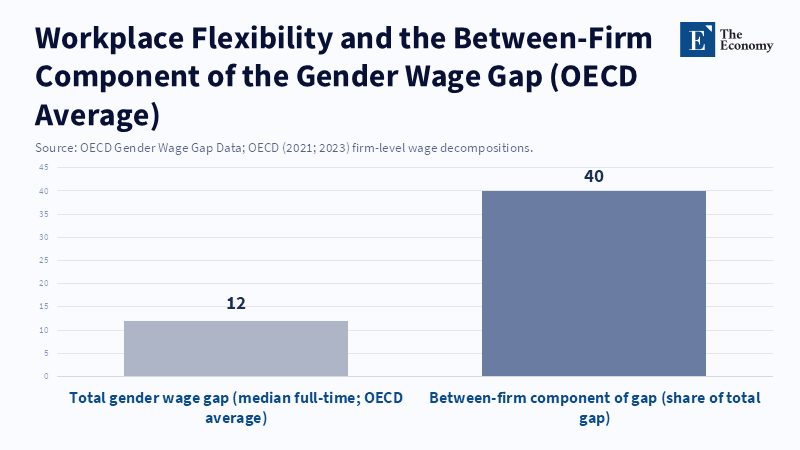
Across OECD countries, the median full-time woman still earns about 12% less than the median full-time man. That blunt number masks something more subtle: a large slice of this gap is not about unequal skills, nor only about bias inside pay negotiations. It is about where people choose to work and the trade-offs they accept. According to the OECD, in 2023, the median full-time working woman earned 89 cents for every dollar or euro earned by her male counterpart. When women cluster in firms that prize schedule control, and men cluster in firms that prize face time and escalation potential, a between-firm pay gap emerges. Read as a behavioral sorting story, the oft-invoked “firm” factor becomes less an indictment of employers alone and more a challenge for policy: how do we preserve dignity, choice, and flexibility without locking whole groups into systematically lower pay? This piece reframes the debate and points to practical levers for educators, administrators and policy makers to break the link between flexibility and low pay.
Workplace flexibility and the firm factor
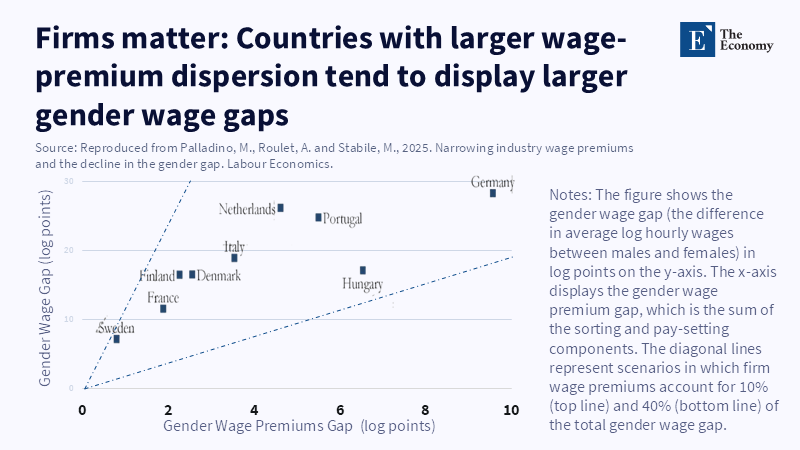
The firm-level component of the gender wage gap is substantial. Cross-country decompositions show that roughly a quarter of the gap between similarly skilled men and women comes from differences across firms: women are more likely to work in firms that pay lower wage premia overall. This is not a marginal technicality. It means that, even when men and women have comparable education and potential experience, their employer choices — and the firms’ pay practices — create persistent pay differences. Why does this happen? The simplest, evidence-backed story is sorting. Some firms offer rigid, high-intensity schedules and steep promotion ladders. Others trade pay for flexibility: part-time options, compressed weeks, remote work, or de-emphasized presenteeism. For many workers balancing care, health, or non-work commitments, flexible workplaces are essential. But those same arrangements frequently coincide with weaker wage growth, fewer promotion signals, or pay structures that compress salaries downward. The result is structural: whole cohorts of women are overrepresented in low-premium firms and underrepresented in firms that seize the gains from aggressive wage trajectories.
This rephrasing matters because it changes the policy question. If the problem were purely discriminatory pay within firms, remedies would focus narrowly on pay transparency, auditing, litigation and in-firm promotion practices. Those are important. But if sorting driven by preferences for flexibility accounts for a large share of the between-firm gap, then policies must bridge two goals at once: expand high-wage opportunities that offer flexibility and make high-reward firms less antagonistic to schedules outside a rigid 9–5 model. Concretely, that means redesigning career ladders, performance measures, and workplace cultures so that contributions can be assessed without relying on visible hours. It also means strengthening mobility across firms and creating portable signals (skills, credentials, project portfolios) that reward achievements rather than presence.
How job-choice preferences determine sorting (and therefore pay)
Behavioral and experimental evidence support the idea that, on average, men and women value different job attributes. Stated-preference experiments and field trials repeatedly find that women are, on average, willing to trade some salary for greater schedule control and job stability. This is not about capability; it is about revealed preference under real constraints. The implication is clear: preferences influence career decisions early and compound across decades. People who choose jobs that allow schedule control accumulate different kinds of experience, networks and promotion signals than those who choose firms that value long hours and constant availability. Over time, these differences multiply into distinct career pathways. Recent labor-market analyses confirm that a large portion of observed pay gaps traces to differences in career shape — both in total time worked and in the types of mobility and role changes individuals undertake.
That said, “preference” is not an exoneration for policy inaction. Preferences are formed by social norms, caregiving burdens, public services, and institutional incentives. Women are more likely to shoulder unpaid caregiving. That reality makes flexibility essential for participation and well-being. Yet when flexibility is mostly available in lower-paid segments, policy creates a trade-off: choose health, balance, and control—or choose income and promotion. The right policy response ought thus to expand high-quality flexible roles within better-paying firms. This requires rethinking job design, performance assessment, and the production of promotion signals. It also requires investment in public infrastructure — especially affordable, high-quality childcare and eldercare — so that workers are not forced to choose between earning and caring. Finally, stronger, portable mechanisms for skill and contribution recognition can make lateral moves between firm types less risky, thereby reducing the penalty of opting for flexibility at some career stages.
Second, firms must redesign how they measure value. Performance evaluation should privilege outcomes over face time. That can be implemented through clearer deliverables, regular structured feedback, anonymized outcome assessments, and promotion criteria that incorporate cross-project leadership. Firms that institutionalize flexible but accountable ways of working reduce the attractiveness gap between low-pay flexible firms and high-pay rigid ones. A report from the OECD highlights that pay openness measures are an important tool for ensuring fairness for women and men in the workplace. Pay transparency rules have demonstrated potential to nudge firms toward fairer pay practices, but they are blunt instruments on their own. Combine transparency with incentives for high-wage firms to adopt flexible schedules (tax credits for verified flexible senior roles, public recognition programs, and subsidies for flexible apprenticeship pathways). Crucially, invest in public care infrastructure. When childcare and eldercare are affordable and reliable, workers are less forced into low-pay compromises. Finally, strengthen the portability of social benefits and pension accrual for part-time or intermittent workers so that choosing flexibility does not automatically mean sacrificing long-term security.
Anticipating critiques and rebuttals: one critique will be that emphasizing preference risks blaming women for the gap. The opposite is true: identifying preferences exposes the organizational constraints that shape them. Another critique points to discrimination within firms; the evidence shows substantial within-firm gaps as well. The policy architecture I propose addresses both: in-firm reforms and cross-firm mobility measures attack the within- and between-firm components together. Critics could also argue that productivity models require long hours. But modern productivity science shows that sustained long hours produce diminishing returns and higher burnout. Firms that learn to measure value precisely can capture high returns without demanding constant hours.
The 12% headline difference between men’s and women’s median full-time pay is a blunt—and persistent—indicator. But the anatomy of that gap points to a solvable structural problem: when flexibility sits mostly in low-premium corners of the labor market, choice becomes a trap. We can have both dignity and decent pay. That requires a new compact among teachers, employers and policymakers. Teachers must broaden the career menu and certify outcomes; employers must measure value by contribution, not by hours logged; government officials must remove the financial and care constraints that make flexibility a costly choice. These actions will not erase every unfairness overnight. But they will break the mechanical link between seeking a less stressful, flexible job and settling for a life of lower earnings. If we want real gender equality in pay, we must realize that freedom to choose includes the freedom to choose flexibility without penalty. It is time to design labour markets around that principle.
The views expressed in this article are those of the author(s) and do not necessarily reflect the official position of The Economy or its affiliates.
References
Bennedsen, M., Kongsted, H. C., & Pérez-González, F., 2019. Do Firms Respond to Gender Pay Gap Transparency? Working Paper. National Bureau of Economic Research.
Bustelo, M., 2020. What Is the Price of Freedom? Estimating Women's Willingness to Pay for Job Schedule Flexibility. Inter-American Development Bank.
Ghorpade, Y., 2023. The Valuation of Flexible Work Arrangements: Insights from Malaysia. World Bank Policy Research Working Paper.
Mas, A. & Pallais, A., 2017. Valuing Alternative Work Arrangements. American Economic Review Papers and Proceedings.
McKinsey Global Institute (Madgavkar, A., Ellingrud, K., Smit, S., Bradley, C., White, O., & Chockalingam, K.), 2025. Tough trade-offs: How time and career choices shape the gender pay gap. McKinsey Global Institute Report.
OECD, 2021. The Role of Firms in Wage Inequality. Organisation for Economic Co-operation and Development.
OECD, 2023. Reporting Gender Wage Gaps in OECD Countries: Guidance for Pay Transparency Implementation, Monitoring and Reform. Organisation for Economic Co-operation and Development.
Palladino, M., Roulet, A., & Stabile, M., 2025. Narrowing industry wage premiums and the decline in the gender gap. Labour Economics.
Wiswall, M. & Zafar, B., 2018. Preference for the Workplace, Investment in Human Capital, and Gender. Quarterly Journal of Economics.
World Bank / Ghorpade, Y., 2023.
VoxEU / OECD LinkEED 2.0 team, 2026. The gender wage gap and what firms have to do with it. CEPR / VoxEU column.
Erik Van der Meer examines how scientific knowledge is produced, validated, and institutionalized across disciplines. His writing explores the structure of modern science, the evolution of research norms, and the interaction between technology and scientific epistemology. He contributes reflective essays on science itself—bridging hard research and meta-level analysis.