Will Russian economic pressure bend the Kremlin? Rethinking Russian economic constraints as a lever for peace

Working across research, policy, and data-driven analysis, the Editorial Board ensures that published pieces reflect a consistent institutional perspective grounded in quantitative reasoning and long-term structural assessment.
Authored On
Modified
Russia’s economy is under strain, not collapse
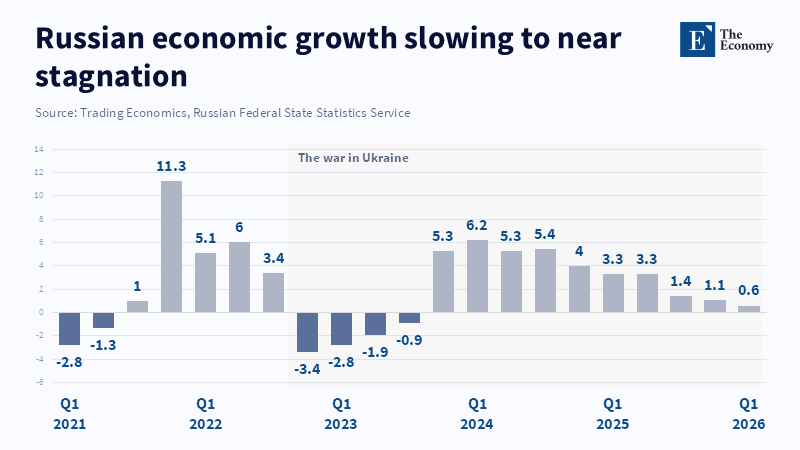
High rates and fading growth reveal deep structural limits behind wartime output
Only calibrated economic pressure paired with credible exit paths can alter the Kremlin’s incentives
The most apparent truth of the last three years is clear: running the Kremlin's war effort now demands more resources than the peacetime government can provide. Russia's defense spending has risen to a level as a percentage of its Gross Domestic Product (GDP) not seen since the Cold War, while income from energy sales, which once supported the nation's economic security, has declined sharply (SIPRI, 2025; CREA, 2026). This situation, which we can call Russia's economic limitations, changes the political situation of any possible resolution. Moscow can continue fighting, but its capacity to maintain intense military operations without causing significant hardship at home is decreasing (Bruegel – Hilgenstock, 2025). This reduction is important for educators and government officials because it influences how we account for the timing and details of incentives, penalties, and offers of assistance for recovery (CREA, 2026; Bruegel – Hilgenstock, 2025). If Western strategies treat penalties and motivations as separate paths, they overlook a basic calculation: declining oil profits, rising defense costs, and a growing strain on economic security create predictable areas of pressure. If these areas are addressed thoughtfully, they could change how the elite in the Kremlin make decisions. The crucial question is identifying which actions will truly change behavior and which will only spread suffering.
Russia's Monetary Constraints and the Battlefield Situation
To better understand the situation, we should change our way of thinking. Instead of wondering if the Russian economy will collapse, we should assess how the government's financial decisions are changing political motivations in the medium term. The situation does not point to complete collapse, but rather a consistent shift of national resources toward the military, which deprives the civilian sector of investment (SIPRI, 2025; CASE-Center, 2025). Both official and independent analyses show that military expenses consume a considerable share of the government's funds. Moscow has focused on the military campaign, increasing defense spending even as other sectors stagnate. This means that the Kremlin faces an ongoing dilemma: supporting the war effort reduces funds for social programs, investments, and public-sector salaries, which in turn increases the domestic political cost of prolonging the war (CASE-Center, 2025). The logic is simple: high defense spending increases the current demand for military supplies but limits the private sector's ability to grow and the government's ability to provide public services. Over time, this creates political tension.
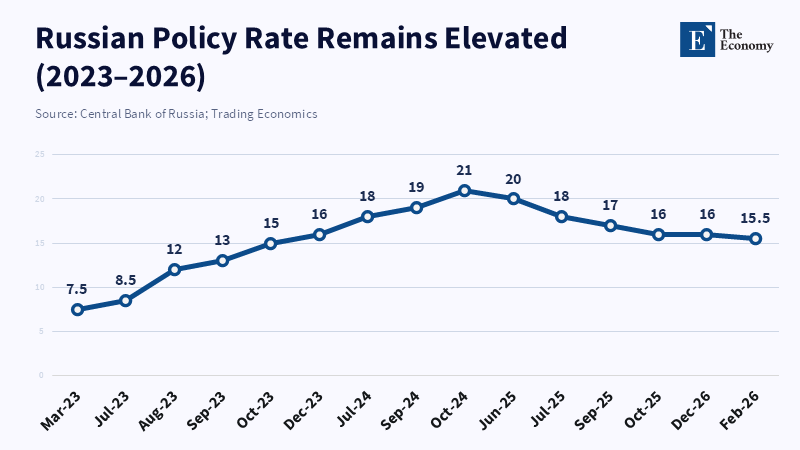
This situation is evident not just in financial statements but also in everyday life. Rising prices and high interest rates have reduced household purchasing power, while particular financial actions, such as using reserves and accounting adjustments, are being employed to keep the government financially stable. The central bank has modified its policies to control inflation and preserve stability, and official predictions indicate only slow growth in the future (Bank of Russia, 2026). These adjustments are not just superficial; they affect who feels the most pressure. City professionals and business leaders face difficulties with supply shortages and rising costs, while retirees and public-sector employees experience declines in their earnings. Political scientists know that when economic difficulties spread from specific sectors (such as exporters affected by penalties) to larger social groups, the risk to the government increases (Itskhoki & Ribakova, 2024). This does not ensure political collapse, but it makes the elite's decisions about the war more fragile.
Energy, Trade Shifts, and Why Penalties Alone Are Not Enough
Another important consideration is that energy exports continue to provide income, but the conditions and methods of these exports have changed. Russia continues to export significant amounts of oil and gas, but the revenue earned per barrel and the market structure have shifted. Since the invasion, Moscow has redirected much of its oil transported by sea toward buyers outside the West, depending on price discounts and non-standard shipping methods to maintain sales (Reuters – Abnett, 2026; CREA, 2026). This sustains sales volumes and jobs in the resource extraction industries but reduces financial gains, as exports receive lower prices and face higher transportation costs (CREA, 2026). In short, energy has become a means of survival rather than a source of growth. This difference explains why viewing penalties as simply effective or ineffective misses the bigger picture: penalties can change profit margins, not just sales volumes, and these profit margins are important for budget decisions (Itskhoki & Ribakova, 2024).
Third, the shift toward Asian buyers weakens some strategies yet opens up others. Trade data indicate stronger trade with key eastern partners, such as higher oil sales to major Asian markets (MERICS, 2025). This shift reduces Western countries' ability to completely stop exports, but it also increases the Kremlin's reliance on a smaller group of buyers and on less secure transit networks. When only a few channels keep finances stable, focused actions that increase the cost of these channels, or coordinated restrictions on insurance, shipping, and banking, can disproportionately reduce revenue. In addition, revenue is less stable when markets depend on fewer customers and non-standard shipping. The result is a government budget that is more at risk and more sensitive to specific policy changes.
Turning Limitations into Policy Actions
If we accept the idea that Russia is damaged but not destroyed, limited but capable of improvement, then the policy implication is evident: combine carefully applied pressure with reliable, step-by-step incentives that lower the political cost of negotiation for the Kremlin's inner circle. This is stated in a very objective way. The purpose is not to buy surrender but to alter the evaluations of elites, who are now balancing the welfare of their associates against the expenses of continued mobilization. In reality, three actions are important:
First, focus on the income sources that are most important to the budget. This does not mean implementing total embargos that worsen humanitarian suffering. It means implementing focused actions that increase the effective discount on oil transported by sea, raise the transportation costs of unofficial shipping, and limit the number of dependable intermediaries. Recent reports have shown how unknown corporate networks, as well as shadow fleets, maintain sales; breaking these networks at key points changes the budget situation more drastically than drastically reducing sales volumes. These actions reduce the net income available for military purchases and force difficult choices at home (CREA, 2026; Reuters – Bryanski & Korsunskaya, 2026).
Second, combine financial pressure with credible relief programs that can be presented as practical and non-political. If public services and wages can be kept stable without signaling weakness on international goals, elites have room to change direction. Such support can include aid for pension funds, healthcare, and key industrial suppliers whose failure would cause uncontrollable domestic crises. The idea is not to protect the regime but to make a negotiated settlement less politically costly by reducing the domestic consequences for groups that are important to the Kremlin. According to Brookings, oil exports play a vital role in funding the Russian government, so fluctuations in energy income can alter which elite groups in Russia benefit most from rising or falling conflict (Aydıntaşbaş et al., 2026). Evidence from studying sanctions shows that carefully calibrated combinations are more likely to change the preferences of the elite than strategies that rely solely on sanctions (Itskhoki & Ribakova, 2024).
Third, broaden the diplomatic approach beyond a single negotiation. Moscow's ability to resist pressure is enhanced by its precautions, including a diverse range of buyers, political support from key partners, and a sense of survival (MERICS, 2025). Western and allied policies must therefore combine financial actions with international frameworks for phased reintegration—not complete normalization, but gradual, verifiable steps linked to clear goals. This means planning early and publicly for aid to rebuild Ukraine, providing guarantees for European security structures, and creating a transparent process for partial economic normalization based on verifiable troop reductions and withdrawals. The message here is structural: if elites can see a politically safe, phased exit, the advantage of prolonged attrition decreases. The dependability of such offers is increased when supported by concrete financial commitments and enforceable verification procedures.
Handling Concerns and Limitations
Several criticisms are likely and valid. One is that sanctions and focused pressure will simply accelerate authoritarian adjustment, leading to more shadow networks, more domestic production, and greater repression. This is partly true; the government will adapt. But adjustment is costly and rarely complete. Domestic production often results in lower productivity and long-term technological disadvantages (Bruegel – Hilgenstock, 2025). According to the Brookings Institution, many of the tankers in Russia's shadow fleet were acquired from Western companies, particularly Greek operators, complicating oversight and regulation. This expansion of shadow networks can raise transportation costs and make it harder for Russia to efficiently collect revenue from its energy exports, eventually increasing the cost of maintaining widespread, ongoing operations that rely on specialized imports and external shipping. Another criticism is that elites will increase repression rather than negotiate. That response depends on the unity of the elite and on how evident the domestic suffering becomes within elite circles. When elites face direct asset losses, budget deficits for patronage, and reputational damage among important groups, their desire to prolong the conflict may decrease (Itskhoki & Ribakova, 2024). History shows that wars sustained at very high financial cost often end not with collapse but with negotiated withdrawal once domestic politics and elite networks become sufficiently strained.
A final concern involves morals and strategy: offering incentives risks rewarding aggression. This is a valid ethical point, and one reason why any offer must be conditional, phased, and reversible. The credibility of penalties must be clear. At the same time, history shows that absolute, maximalist strategies, such as demanding unconditional surrender, have prolonged conflict and suffering. A strategy that combines pressure with a clear, enforceable exit path reduces overall harm while continuing deterrent standards through strict conditionality. The challenge is organizational: building the international coordination capacity to both increase pressure and reliably manage phased reintegration. This is difficult but politically achievable with sustained allied commitment.
What Educators, Administrators, and Policymakers Need to Do Now
For educators and administrators in higher education and policy schools, the lesson is to teach strategy as a combination of calculations—budgets and incentives—not just moral clarity. Curricula should add modules that connect international strategy to financial flows, trade networks, and elite-level patronage calculations (Itskhoki & Ribakova, 2024). This prepares future decision-makers to design combinations of actions that change behavior without inflicting unnecessary suffering for civilians.
Administrators and planners should also model scenarios using realistic revenue assumptions and consider the effects of decreased export prices and higher defense spending (CREA, 2026; SIPRI, 2025). Universities with policy centers can gather experts in energy transportation, finance, and verification technology to develop practical ways to disrupt illegal shipping and payment channels. These practical solutions, which are technical rather than just rhetorical, increase the effectiveness of penalties and raise the negotiating costs of continued war.
Officials must adopt a step-by-step approach. First, identify income points where coordinated actions will raise costs. Second, design low-profile, high-integrity mitigation measures that reduce domestic reaction from those actions. Third, support those steps with public, phased offers for phased normalization linked to specific, verifiable steps on troop posture and security arrangements. The combination of pressure, protection for civilians, and a reliable exit strategy is the only plan likely to meaningfully change how the elite assess costs and benefits in a reasonable time (Aydıntaşbaş et al., 2026).
The main point is simple and practical: Russia's economic limitations do not guarantee a quick end to the conflict, but they do change the possible outcomes of any negotiation. Russia still exports energy, and its government is not collapsing. Yet the profit margin is smaller, and profit margins influence politics (CREA, 2026). A smart policy combines focused pressure on the income channels that support military operations with reliable, conditional relief that reduces the domestic political cost of negotiating. This is a difficult, long-term policy. It requires allied countries not just to punish, but to create a verifiable route to de-escalate the war. For educators, administrators, and policymakers, the task is to turn calculations into strategy—to assess the real trade-offs and propose offers that address them. If the West can do this well, the coming year could be one in which practical incentives, not just battlefield attrition, help make peace achievable.
References
Aydıntaşbaş, A., Baev, P.K., Budjeryn, M., Gordon, P.H., Grzymała-Busse, A., Hamilton, D.S., Karlin, M., Pifer, S., Sisson, M.W., Stelzenmüller, C. and Wright, T., 2026. What price for peace in Ukraine? Brookings Institution.
Abnett, K., 2026. Four years into war, Russia's energy revenues drop but oil keeps flowing. Reuters.
Bryanski, G. and Korsunskaya, D., 2026. Russia plans to divert more oil revenues to budget reserve fund and cut spending. Reuters.
Bruegel (Hilgenstock, B.), 2025. Why Russia's economic model no longer delivers. Bruegel.
CREA (Centre for Research on Energy and Clean Air), 2026. Analysis of Russia's fossil fuel export revenues. CREA.
Itskhoki, O. and Ribakova, E., 2024. The economics of sanctions: From theory into practice. Brookings/Project Paper.
MERICS, 2025. China-Russia dashboard: Facts and figures on a special relationship. MERICS.
SIPRI, 2025. Trends in World Military Expenditure, 2024. Stockholm International Peace Research Institute (SIPRI).
World/Bank of Russia, 2026. Bank of Russia: Key rate decision and inflation summary. Bank of Russia.
CASE-Center, 2025. Situation in the Russian economy and impact of sanctions. Centre for Analysis of Strategies and Economics (CASE).
Working across research, policy, and data-driven analysis, the Editorial Board ensures that published pieces reflect a consistent institutional perspective grounded in quantitative reasoning and long-term structural assessment.