Airlines Reduce Economy Seats as Premium Expansion Accelerates Amid Profit Models and Consumer Polarization

Niamh O’Sullivan is an Irish editor at The Economy, covering global policy and institutional reform. She studied sociology and European studies at Trinity College Dublin, and brings experience in translating academic and policy content for wider audiences. Her editorial work supports multilingual accessibility and contextual reporting.
Authored On
Modified
Expansion of premium seating reshapes in-flight experience
Efficiency concerns give way to revenue maximization strategies
Luxury consumption trend spreads across travel and leisure markets
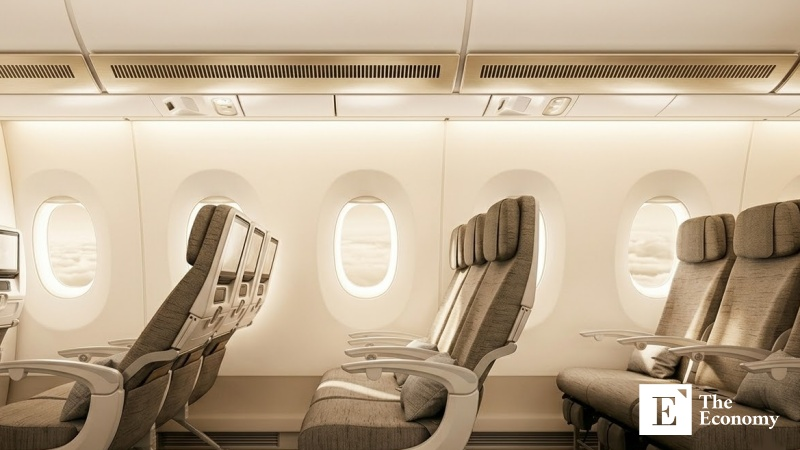
Airlines worldwide are actively reconfiguring cabin layouts. Not only major carriers but also low-cost airlines are increasing premium seating while reducing the share of economy seats, rapidly changing the in-flight experience for passengers. As airlines adopt new approaches to revenue generation, the broader travel and leisure industry is also moving to adapt. The market is already seeing growing consumer interest in high-priced offerings, with a premium consumption structure spreading across the travel sector.
Shifting cabin layouts alter passenger experience
On the 23rd, The Wall Street Journal (WSJ), citing aviation data firm Visual Approach Analytics, reported that “since January 2020, the number of business- and first-class seats on U.S. domestic flights has increased by 27%, while economy seating has grown by only 10%.” Major airlines such as Delta Air Lines and United Airlines have steadily expanded premium seating since the mid-2010s, and more recently, low-cost carriers including Southwest Airlines, Spirit Airlines, and Frontier Airlines have increasingly introduced wider seats for additional fees.
This expansion of premium seating is a global trend. South Korea’s Air Premia has strengthened its presence on long-haul routes with its “wide premium” seating, offering a seat pitch of 106 centimeters. Japan’s ZIPAIR has differentiated its cabin configuration by offering fully flat seats while charging separately for all additional services. Emirates has also launched a $2 billion retrofit program covering more than 120 aircraft, removing 88 economy seats from the front section of the lower deck on A380 aircraft and replacing them with 56 premium economy seats.
In the process, density in economy cabins has risen sharply. For the Boeing 777, a mainstay of long-haul fleets, the standard seating configuration has shifted from nine seats per row (3-3-3) to ten seats per row (3-4-3), effectively redefining industry norms. Cathay Pacific reduced seat width from 47 centimeters to 44 centimeters under this configuration change, adding roughly 40 seats per aircraft. Air France has also introduced a high-density configuration of 472 seats on Boeing 777 aircraft deployed on leisure-heavy routes. Even within the same aircraft model, differences in seating arrangements and space allocation have significantly altered cabin environments.
These internal changes have had a direct impact on passenger experience. Canada’s WestJet, after reconfiguring seating on 21 Boeing 737 aircraft, reduced seat pitch in economy class from 96 centimeters to 71 centimeters and added an extra row. The airline also introduced fixed seatbacks, eliminating recline functionality. The changes triggered widespread consumer backlash. Images circulated on online forums showed passengers’ knees pressed against the seat in front, prompting comments such as “How is this different from standing?” and “It’s more cramped than a poultry cage.”
Seat allocation driven by revenue contribution
Despite the criticism, airlines are accelerating the expansion of premium seating as part of a broader effort to maximize profitability. As it becomes increasingly clear that financial performance depends on how cabin space is allocated and priced, many airlines are restructuring seat configurations accordingly. Savanthi Syth, an analyst at U.S. investment bank Raymond James, noted that “airlines have moved away from the perception that all seats are the same product,” adding that “seats are now being redefined not as a means of transportation but as individual revenue units.”
The International Air Transport Association (IATA) also pointed to premium seating as a key factor supporting industry profitability, reporting that global airline net income reached $36.6 billion last year despite high fuel prices and rising labor costs. In practice, 57% of Delta Air Lines’ revenue last year came from premium seating and loyalty programs, with premium seat revenue rising 8% year-over-year while economy revenue remained flat. United Airlines reported a similar pattern, with premium seat revenue growth outpacing that of basic economy.
Premium economy, a mid-tier cabin class that gained prominence in the 2020s, has become central to this strategy. These seats can command higher prices without requiring expensive lounge access or premium onboard services, resulting in lower operating expenses while generating higher per-seat revenue. Lufthansa, for example, invested $2.9 billion in the first half of 2024 to advance its “Allegris” project, positioning premium economy with a seat pitch of 99 centimeters as a core offering. The result was that premium economy delivered 33% higher revenue per square meter than standard economy and even 6% more than business class.
Following Lufthansa’s initiative, airlines are increasingly segmenting mid-range and premium seating to redesign their revenue structures. Korean Air announced plans in August last year to introduce a premium class positioned between economy and prestige class, offering approximately 1.5 times more space than standard economy. While passengers gain access to dedicated check-in and baggage services, lounge access is not included. T’way Air has introduced a higher-tier “super premium” economy class on certain aircraft, while Parata Air has launched a flat-seat “business smart” option with a seat width of 53 centimeters.
Expansion of the luxury travel market
A similar trend is emerging across the broader travel and leisure market. Travel discount platform Going, in its “2026 Outlook Report” released late last year, projected that “a K-shaped polarization in the travel market will become more pronounced.” Citing Bank of America data, Going noted that spending among high-income households in the United States increased by 2.6% last year, compared with just 0.6% for low-income households, adding that “as inflation and economic uncertainty persist, disparities in purchasing power across income groups are likely to be reflected in travel spending.”
Reflecting this shift, travel products are increasingly being positioned at the high end. Lotte Tour Development has launched a southern France tour package using a dedicated Korean Air charter flight, combining visits to Nice, Cassis, and Marseille with winery tastings and dining at restaurants overlooking the Mediterranean, with prices starting at $5,300 per person. Hana Tour has introduced packages combining Formula 1 race viewing with Michelin-star dining and luxury hotel stays, while Mode Tour has included business-class flights and ocean-view cruise accommodations in its Northern Europe packages.
Industry participants expect competition in luxury travel to intensify further as demand increasingly prioritizes the depth of experience over price. A travel industry official noted that “in the past, premium status was defined by tangible indicators such as airline seats or hotel class,” adding that “today, the overall design of the journey—including convenience of movement, local experiences, and content quality—has become the key competitive factor.” The official added that “as travel is increasingly viewed as an investment in experience, demand for premium offerings continues to rise.”
Niamh O’Sullivan is an Irish editor at The Economy, covering global policy and institutional reform. She studied sociology and European studies at Trinity College Dublin, and brings experience in translating academic and policy content for wider audiences. Her editorial work supports multilingual accessibility and contextual reporting.
Similar Post