The Rules of War Rewritten by Kamikaze Drones and Game-Like Remote Strikes

Authored On
Modified
An Unmanned Warfare Era Defined by Airborne Advanced Weapons
Performing Tactical Missions, Reconnaissance, Strikes, and Psychological Warfare
Economic Sustainability Emerging as the Measure of National Security
The face of war is changing. The era in which tanks, fighter jets and missiles dominated warfare is fading, giving way to one in which unmanned aerial vehicles, or drones, are reshaping the battlefield. The essence of drones lies in one fact: machines are taking the place of human lives. For democratic nations long constrained by the political cost of troop casualties, the mass deployment of unmanned systems constitutes a breakthrough that sharply reduces that burden. The ability to preserve war-fighting capacity while minimizing battlefield deaths is set to become a decisive factor in determining the sustainability of future warfare.
Low-Cost Drones Threaten High-End Weapons
According to U.S. military and security outlet War on the Rocks on March 23 local time, the large-scale deployment of low-cost autonomous drones is dramatically altering the character of the battlefield. Once used as auxiliary reconnaissance tools, drones have now become core strike assets. The most emblematic case is the war in Ukraine, which began with Russia’s invasion on Feb. 24, 2022. Scenes of multi-million-dollar tanks being obliterated by drones costing only tens of thousands of dollars have been witnessed countless times. Even now, both sides are using drones to strike rear-area strategic assets, including fuel storage facilities, refining infrastructure and logistics hubs, thereby eroding each other’s capacity to sustain the war.
The recent Iran war has made even clearer that drones have become a pivotal variable changing the balance of modern warfare. In Operation Epic Fury, carried out on Feb. 27 last month under orders from President Donald Trump, the U.S. military deployed B-2 stealth bombers in tandem with drones. It was a composite operation in which electronic warfare was used to disrupt air defenses, bunker busters destroyed underground facilities, and drone swarms were simultaneously used to strike wide areas. The operation was seen as a case that demonstrated the seamless integration of conventional airpower and next-generation drone forces.
Yet the shift in paradigm was laid bare in Iran’s retaliation. In its broad offensive targeting Gulf states, Iran repeatedly launched Shahed drones priced at $30,000 apiece, while the United States burned through Patriot PAC-3 interceptor missiles costing $4 million to $6 million each in an effort to stop them. It is difficult to call this anything other than a cost dilemma. Missile stockpiles were depleted after only a few days of fighting, underscored by Trump’s subsequent request for additional budget allocations to purchase more missiles. Although interception rates reportedly exceeded 90%, analysts say Iran effectively secured a lopsided victory in terms of cost-effectiveness.
U.S. Deploys a ‘Kamikaze Drone’ Modeled on Iranian Systems
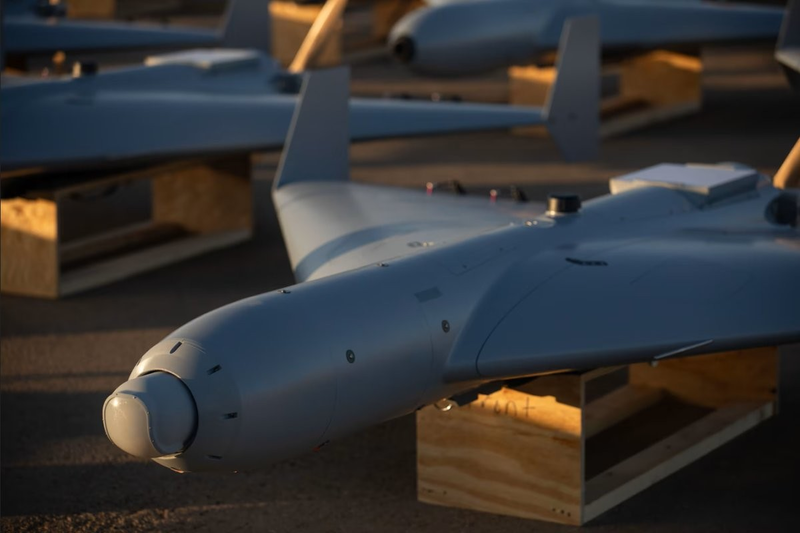
Confronted with those limits, the United States is accelerating mass production of LUCAS, a kamikaze drone reverse-engineered from Iran’s Shahed platform. The move is aimed at countering Iran’s asymmetric war of attrition. Emil Michael, the Pentagon’s undersecretary for research and engineering, said, “The core concept is to mass-produce LUCAS drones in the United States and build the capability to ramp up production dramatically when needed,” adding, “So far, it has been performing very well.”
LUCAS takes its name from the initials of Low-cost Unmanned Combat Attack System. After dismantling a captured Shahed-136 several years ago, the U.S. military preserved the structural concept while applying advanced American technology to internal components in building LUCAS. LUCAS and the Shahed share a similar triangular profile, but the U.S. version has been reduced somewhat in size and designed in modular form to increase versatility. Everything from the fuselage and engine to the navigation system relies on commercial off-the-shelf components. As a result, despite being produced only in limited quantities in the United States, the initial batch price was brought down to $35,000 per unit. That is roughly one-114th the price of the latest Tomahawk Block Va, which costs $4 million.
The United States is also planning to introduce Merops, a counter-drone interception system whose performance has already been proven on the Russia-Ukraine battlefield. Counter-drone systems are weapons that use drones to destroy other drones. Small enough to fit in the bed of a pickup truck, Merops can identify and approach hostile drones, and when satellite and electronic communications are jammed, it relies on artificial intelligence to fly autonomously. It marks the first time since the Cold War that the United States has examined a weapon developed by an adversary, judged it necessary, and built its own version largely as is. As the logic of warfare changes, a paradoxical situation has emerged in which the world’s most powerful military is learning from a hostile state.
The Balance of Power Determined by Drone Stockpiles
Drones are, in this way, transforming modern warfare itself. Human troops concealed in trenches, along with tanks that once drove ground offensives, are rendered ineffective in the face of drones. A NATO exercise conducted in May last year with more than 16,000 troops laid bare the central status drones have assumed in contemporary warfare. NATO forces at the time failed to adapt to the fully altered form of modern combat. In the simulation, thousands of troops were wiped out by drone strikes, while 17 armored vehicles were destroyed in just half a day.
Drones have also reshaped military compensation systems. Since 2024, the Ukrainian military has been awarding points to troops who submit video footage of enemy strikes carried out with FPV drones. Killing a Russian infantry soldier or drone operator earns 12 points and 25 points, respectively, while capturing a prisoner yields 120 points. The points can be spent like cash at an online weapons store reserved for the military. Mykhailo Samus, head of the international military think tank New Geopolitics Research Network, said the purpose was “to motivate soldiers by making them compete as if in a video game, while also securing verified video data of strikes on enemy forces.”
As drone usage expands, the ability to sustain war is also being reorganized. High-cost missiles take time to produce, whereas low-cost drones can be mass-manufactured in a short period. In other words, stockpiles of drone power now determine a country’s ability to keep fighting. At the same time, drone capabilities are evolving rapidly. Equipped with first-person-view cameras that provide real-time visual feeds and connected to satellite internet, drones are now hunting lives almost as if in a game. An executive at a Ukrainian drone manufacturer said, “They can aim at targets from hundreds of meters away, and even if the operator takes their hands off the remote control, they can still hit the target.”
Historically, warfare has always evolved alongside technological change. Gunpowder overturned the methods of combat, aircraft expanded the spatial reach of the battlefield, and missiles became the central axis of strategic strike capability. Now drones have taken that place. Cheap weapons capable of mass production are shaking the balance of the battlefield.
Similar Post