"Prolonged Turbulence Expected" Global Economy Shaken Amid Middle East Conflict, Markets Reel as Stagflation Pressures Mount

As one of the youngest members of the team, Tyler Hansbrough is a rising star in financial journalism. His fresh perspective and analytical approach bring a modern edge to business reporting. Whether he’s covering stock market trends or dissecting corporate earnings, his sharp insights resonate with the new generation of investors.
Authored On
Modified
Prolonged Global Economic Shock Expected from U.S.-Iran War
Industrial sectors and financial markets across nations show acute disruption, households also ‘crying out’
Major economies face stagflation crisis; prolonged conflict could extend impact to China
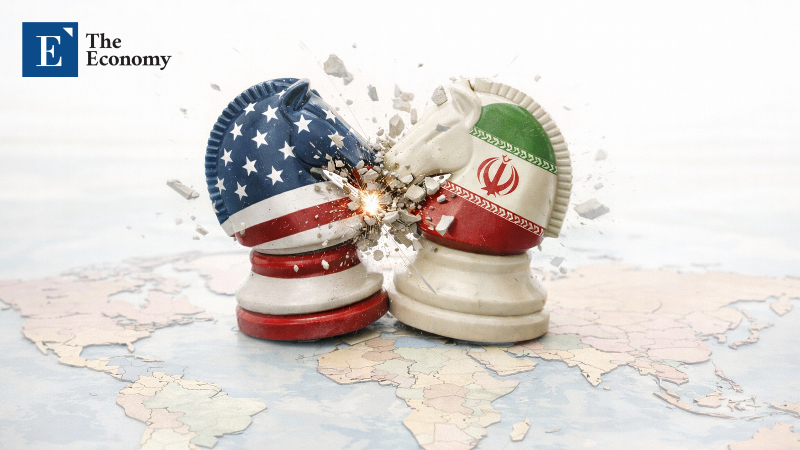
The war between the United States and Iran has dealt a severe blow to the global economy. As industries and households across countries struggle under Middle East-origin risks, global financial markets are also fluctuating under mounting inflationary pressures. Many major economies are now confronting a stagflation crisis—where rising prices and economic stagnation occur simultaneously—while even China, which boasts relatively robust energy security, is being weighed down by various latent risks.
Middle East Conflict Emerging as a ‘Long-Term Risk’
On the 25th, Anne Krueger, a senior fellow at Stanford University, stated at a breakfast lecture hosted by the Institute for Global Economics at Lotte Hotel in Jung-gu, Seoul, “In addition to U.S.-China trade tensions and the tariff policies of the Donald Trump administration, the recent unexpected shock of the U.S.-Iran war has pushed global economic uncertainty to unprecedented levels,” diagnosing it as “a profound threat to countries like South Korea that rely heavily on energy imports.” She continued, “This war has demonstrated the possibility that Iran could weaponize its energy resources,” adding, “Even if the conflict ends, it is difficult to be optimistic that the era of low oil prices will persist.”
Such pessimistic outlooks are being consistently raised across the international community. According to Reuters, Mike Wirth, CEO of U.S. oil company Chevron, said at the CERAWeek energy conference in Houston on the 23rd (local time), “It will take time to move past this situation (the shock of the Middle East conflict),” noting that “concerns over supply shortages due to a potential closure of the Strait of Hormuz have not yet been fully reflected in oil futures prices.” Sultan Al Jaber, CEO of Abu Dhabi National Oil Company (ADNOC), stated, “This (surge in oil prices) is increasing the cost of living for those with the least economic resilience and slowing economic growth everywhere,” adding, “Human costs are rising daily across factories, farms, and households worldwide.” Ben Marshall, CEO of U.S. trading firm Vitol Americas, also warned that if international oil prices reach $120 per barrel, severe “demand destruction” could occur.
Concerns over the conflict are also mounting within financial markets. Noshad Shah, head of EMEA rates sales at Citadel Securities, noted in a recent report, “Investors have become accustomed over recent years to geopolitical shocks dissipating quickly, and they are viewing the impact of the Iran war with relative complacency.” He added, “This belief is based on the assumption that President Trump could end the war at any time and withdraw, but this is a misjudgment,” emphasizing that “the Iran war should not be treated as a simple geopolitical shock.” Even if President Trump steps back from the conflict, its impact on the global economy is unlikely to fade easily.
Global Repercussions of War Intensify
The economic aftershocks of the Middle East conflict are already becoming visible worldwide. In India’s film market, the release of the anticipated blockbuster “Toxic: A Fairy Tale for Adults,” with a budget of approximately $72 million, has been postponed from March to June. As Gulf countries—a key target market for Indian cinema—become embroiled in military conflict, producers have altered their strategy out of concern for box office failure. The film industry estimates that box office revenues in the Gulf region could contract by 20–25% due to the war, with combined losses in the UAE and Gulf Cooperation Council (GCC) markets projected to approach $15 million.
In the United States, the effects of the Trump administration’s consumer stimulus policy—expanded tax refunds—are at risk of being offset. Anna Wong, chief U.S. economist at Bloomberg Economics, analyzed that if oil prices remain above $83 per barrel throughout the year, most of the average household gains from tax refunds could be wiped out. This year’s total tax refunds in the U.S. increased by about $20 billion compared to the previous year, but even if gasoline prices remain elevated for just three to four months, this surplus could be quickly exhausted. According to Citi economist Gisela Young, a 20% increase in fuel costs would impose an additional monthly burden of approximately $6 billion in gasoline expenses on Americans.
Financial markets have also been thrown into significant turmoil. Rising oil prices have intensified global inflationary pressures, driving up government bond yields in major economies. On the 20th, the yield on the UK’s two-year gilt surged by 0.3 percentage points from the previous session to the 4.6% range. This followed the Bank of England’s decision on the 19th to hold rates steady and withdraw its prior guidance on rate cuts. The yield on the U.S. 10-year Treasury also spiked to the 4.3–4.4% range during trading on the 20th, while the policy-sensitive two-year Treasury yield climbed by 0.5 percentage points over roughly three weeks since the outbreak of the war, reaching the 3.9% range. Although the upward momentum eased on the 23rd–24th after President Trump hinted at the possibility of negotiations and a ceasefire, there remains a risk of renewed volatility if hostilities between the two nations escalate again.
Mounting Global Stagflation Concerns
Another concern is that the economies of major countries are beginning to cool under sharply intensifying inflationary pressures. A global stagflation crisis is now taking shape. According to Bloomberg, purchasing managers’ indices (PMIs) for March compiled by global credit rating agency S&P Global generally showed a downward trend across major economies. S&P Global’s PMI is based on surveys of corporate purchasing managers, making this month’s results a comprehensive indicator of the Middle East conflict’s impact on the global economy. In the eurozone, the flash composite PMI—combining manufacturing and services—came in at 50.5, marking a 10-month low and falling short of market expectations. Input and output price indices in eurozone manufacturing both rose sharply.
In the United States, the March flash PMI also slipped to 51.4—its lowest level since April last year—due to weakness in the services sector. In the United Kingdom, business activity growth fell to its lowest level in six months, while manufacturing input costs recorded their steepest increase since 1992. Japan’s March flash composite PMI stood at 52.5, with the pace of growth slowing to its lowest in three months. This trend was also evident in countries outside the G7. For example, in India, which depends on imports for more than half of its energy needs, private sector growth last month slowed to its weakest level in three years.
China has somewhat diverged from these global trends. With an energy self-sufficiency rate of approximately 85% and substantial strategic oil reserves, it has been relatively effective in offsetting the energy shock from the Middle East. However, if the closure of the Strait of Hormuz persists over an extended period, China’s energy security framework is expected to face eventual limitations. U.S. defense publication War on the Rocks projected that China’s energy security could reach a critical juncture after about 90 days. Additionally, there are analyses suggesting that weakening global demand due to an economic downturn could corner China’s manufacturing sector. Alicia Garcia-Herrero, chief economist at French investment bank Natixis, warned, “If an oil shock pushes the global economy into a severe recession, China’s export orders will collapse,” adding, “Structural vulnerabilities hidden beneath apparent strength will surface, potentially leading to job losses.”
As one of the youngest members of the team, Tyler Hansbrough is a rising star in financial journalism. His fresh perspective and analytical approach bring a modern edge to business reporting. Whether he’s covering stock market trends or dissecting corporate earnings, his sharp insights resonate with the new generation of investors.
Similar Post