"Securing Additional Growth Momentum Through IPO" SpaceX Accelerates Space Infrastructure Buildout as Intensifying U.S.-China Rivalry Looms

Authored On
Modified
IPO Acceleration and Valuation Target of $1.75 Trillion
Expansion of Satellite Communications and Space Data Center Infrastructure
China’s Aggressive Catch-Up Amid SpaceX’s Low-Cost Launch Dominance

Elon Musk’s aerospace company SpaceX is moving forward in earnest with its listing process. Through the initial public offering (IPO), the company aims to secure massive funding exceeding $1 trillion and deploy it into core operations, including large-scale satellite launches. Market observers note that, as Chinese firms accelerate the construction of extensive satellite networks backed by government support, this IPO could mark a turning point not merely in capital raising but in the broader contest for dominance over space infrastructure between the United States and China.
IPO Roadmap Taking Shape
On the 26th (local time), the Financial Times (FT) reported that SpaceX may submit its prospectus to U.S. regulators within days. The filing represents the first step in the IPO process. The company will subsequently undergo regulatory review and revisions, conduct a roadshow, and finalize its offering price before listing on the stock exchange. The underwriting syndicate for the IPO includes Bank of America (BofA), Goldman Sachs, JPMorgan Chase, and Morgan Stanley. Funds raised through the listing are expected to be allocated toward launch vehicle development, construction of space-based artificial intelligence (AI) data centers, and lunar base initiatives.
SpaceX is reportedly targeting $75 billion in proceeds through the IPO while seeking a valuation of $1.75 trillion. The company had initially considered raising $50 billion but recently revised its target upward following discussions with investors. This would significantly surpass the $29 billion raised in Saudi Aramco’s record-setting IPO in 2019.
Internally, SpaceX is also said to be considering allowing existing shareholders to sell their holdings on the first day of trading. This would effectively ease the conventional “lock-up” restriction, which typically limits insider sales for 180 days post-listing, and could have substantial market implications. Some analysts suggest the company may adopt a staggered lock-up structure, allowing shares to be released gradually over time to mitigate potential market disruption from a sudden influx of supply, given the sheer scale of the IPO.
Satellite Launch Strategy Expansion
If successfully completed, the IPO is expected to accelerate satellite launches, which form the backbone of SpaceX’s aerospace operations. The company currently commands over 80% of the global commercial satellite launch market. Since its founding, it has launched more than 11,600 satellites into space, with approximately 10,000 believed to remain in low Earth orbit. Last year alone, SpaceX launched rockets at an average interval of once every 2.2 days, accounting for over 70% of total global launches.
The primary objective of these satellites is to establish a low Earth orbit communication network. This infrastructure enables high-speed, low-latency connectivity even in regions lacking terrestrial infrastructure or during disaster scenarios. More recently, functionalities have expanded beyond basic internet provision to include direct-to-cell services, military and government communications (Starshield), and space-based data processing. In effect, SpaceX is constructing a global-scale “space infrastructure” with far-reaching implications.
The company’s large-scale satellite deployment is expected to continue. In January, SpaceX submitted an application to the U.S. Federal Communications Commission (FCC) seeking approval to build space-based data centers. The proposal outlines plans to deploy a solar-powered network capable of handling surging data demand driven by AI. The vision includes launching a constellation of up to one million satellites to function as orbital data centers, harnessing solar energy on an unprecedented scale.
However, SpaceX is currently requesting exemptions from the FCC’s phased deployment requirements. Typically, the FCC mandates that half of an approved satellite constellation be deployed within six years and the full system within nine years, with failure resulting in automatic forfeiture of remaining rights. These rules are designed to prevent companies lacking launch capacity from preemptively securing orbital slots and spectrum. SpaceX argues that, given the unprecedented scale and futuristic nature of the project, applying the conventional six- and nine-year framework is impractical.
Cost Reduction Through Reusability
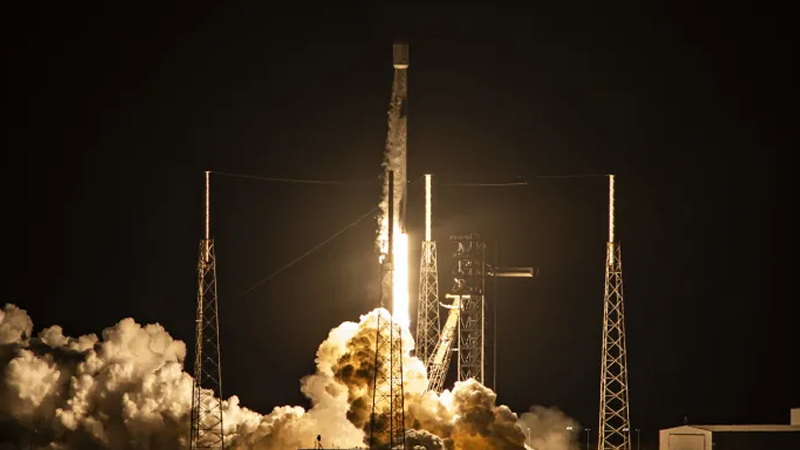
SpaceX’s ability to aggressively pursue large-scale satellite deployment is underpinned by meaningful cost reductions in launch operations. Central to this efficiency is its rocket reusability technology. The company has implemented a system in its Falcon 9 launch vehicle that allows recovery and reuse of the first-stage booster after launch. The booster returns to Earth via retro-propulsion and controlled descent, undergoes inspection and refurbishment, and is then redeployed for subsequent missions. One Falcon 9 booster, designated B1067, set a record last month by completing its 33rd reuse during a launch from Cape Canaveral Space Force Station in Florida.
Building on this foundation, SpaceX is advancing the Starship project, which aims to extend reusability to the entire launch system. The ultimate objective is full recovery and reuse of both first- and second-stage components. If realized, this would theoretically eliminate most of the manufacturing costs that currently dominate rocket launch expenses, effectively transforming the private launch industry from a manufacturing-driven model into a service-oriented one.
The critical question moving forward is whether SpaceX’s competitive edge can be sustained. Chinese aerospace firms are rapidly closing the gap, leveraging substantial state support. In October last year, the Chinese government designated the aerospace sector as one of four strategic emerging industries in its draft 15th Five-Year Plan (2026–2030). In November, it unveiled the “Action Plan for High-Quality Development of Commercial Space (2025–2027),” targeting the establishment of at least three globally competitive commercial space clusters by 2027. To facilitate this, China has eased listing requirements on the STAR Market (Science and Technology Innovation Board), allowing leading firms with core technologies to go public despite ongoing losses, while also establishing national and regional aerospace development funds to strengthen investment capacity.
Supported by this policy framework, China’s large-scale satellite launch initiatives are gaining momentum. According to the South China Morning Post (SCMP), Chinese satellite operators submitted more than ten launch applications to the International Telecommunication Union (ITU) late last year. The “Institute for Radio Frequency Utilization and Technological Innovation,” jointly established by seven Chinese entities, plans to launch 96,714 satellites under its CTC-1 and CTC-2 projects. Private companies such as Guodian Gaoke (1,132 satellites), Mposat (106), and Shanghai Spacecom (1,296), along with the state-owned telecom giant China Mobile (2,960), have also unveiled ambitious deployment plans. In parallel, government-backed initiatives including the Guowang network (approximately 13,000 satellites) and the Qianfan network (approximately 15,000 satellites) are advancing large-scale internet constellation projects.
Similar Post