“Overwhelming Power Efficiency” Arm’s Bet on In-House Chip Production Takes Aim at AI Agent-Driven CPU Demand

As one of the youngest members of the team, Tyler Hansbrough is a rising star in financial journalism. His fresh perspective and analytical approach bring a modern edge to business reporting. Whether he’s covering stock market trends or dissecting corporate earnings, his sharp insights resonate with the new generation of investors.
Authored On
Modified
Arm moves into in-house CPU production, seeking to maximize returns amid the “chipflation” wave
Power efficiency stands as its overwhelming advantage, delivering twice the performance of Intel and AMD’s x86 architecture
CPUs gain prominence alongside AI agents, intensifying competition across the market
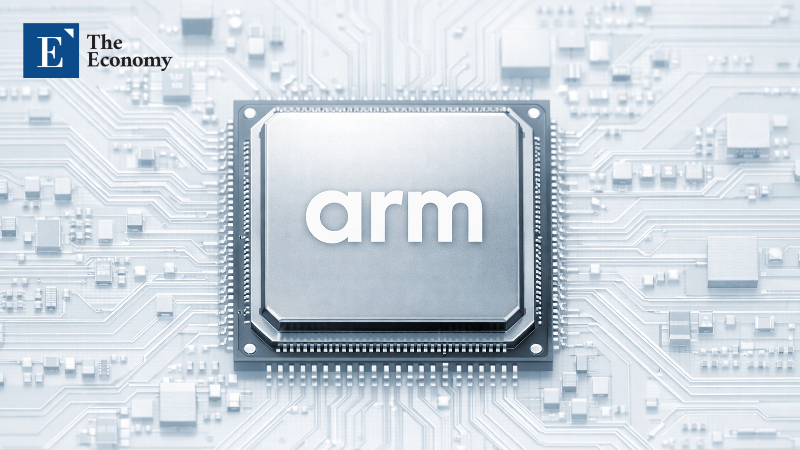
Arm, the British company long focused on semiconductor design IP licensing, has embarked on in-house chip production for the first time in its history. As the AI data center market expands at a blistering pace and semiconductor prices continue to soar, the company is moving to broaden its business in earnest by leading with the central processing unit, the core component underpinning agentic AI operations. Arm’s internally produced CPU is expected to press its offensive into the market by wielding overwhelming power efficiency as its primary competitive weapon.
Arm’s ‘AGI CPU’ Emerges From Stealth
On March 24 local time, Arm unveiled its self-developed data center AI processor, the “AGI (Artificial General Intelligence) CPU,” at an event held in San Francisco, and said it would take direct responsibility for not only the chip’s design but also its production. It marks the first time since the company’s founding that Arm has entered chip manufacturing. Until now, Arm’s principal business model had been to provide foundational chip design technologies to major big tech and fabless clients including Apple, Nvidia, and Qualcomm, in return for licensing fees and royalties.
The backdrop to Arm’s business expansion lies in the so-called “chipflation” trend that has emerged amid the AI boom. As semiconductor prices continue climbing on the back of AI data center-driven demand, Arm has decided to enter the x86 architecture-based data center market, long dominated by Intel and AMD over several decades, in a bid to maximize profitability. In interviews with major foreign media outlets, Arm CEO Rene Haas said, “Arm expects this new chip to generate roughly $15 billion in annual revenue within the next five years,” adding, “We expect to achieve earnings per share of $9 and revenue of $25 billion within the next five years.”
Haas also expressed confidence, saying, “The products we are making are not only compelling, but there are customers lining up to buy them.” Meta, the parent company of Facebook, has been confirmed as the first major customer for the AGI CPU, while OpenAI, Cerebras, and SK Telecom are also reportedly planning to deploy the chip across their infrastructure. Manufacturing will be outsourced to Taiwan’s TSMC, the world’s largest foundry, and full-scale market supply is scheduled to begin in the second half of 2026 through server makers Quanta Computer and Super Micro Computer.
A Design Centered on Power Efficiency
The market is paying close attention to the AGI CPU’s overwhelming power efficiency. The product is the first finished chip designed using Arm’s “Neoverse V3,” a data center CPU IP offered to cloud service providers and hyperscalers. It links two dies, each configured with 68 cores, for operation with up to 136 cores, while adding 2MB of L2 cache per core. An air-cooled 36kW rack can accommodate as many as 8,160 cores, while a liquid-cooled 200kW rack can house up to 45,696 cores.
Such a design expands the volume of work the CPU can process while allowing each core to retrieve required data more quickly from closer proximity, thereby reducing memory access latency. At the same time, it enables higher processing density even under the same power consumption, lifting overall computational efficiency. In fact, the AGI CPU’s thermal design power, or TDP, the maximum heat generated by a CPU or GPU under heavy workloads, is limited to 300W. That comes close to delivering twice the rack-level performance of Intel and AMD’s flagship x86 architecture products.
AI data centers fundamentally require massive amounts of electricity, and power consumption shapes the full spectrum of maintenance costs, including operating and cooling expenses. In other words, when the power efficiency of semiconductors deployed in data centers rises, cost reductions follow immediately. Arm estimates that the AGI CPU could deliver capital expenditure savings of as much as $10 billion per gigawatt of AI data center capacity.

Surging CPU Demand in the AI Market
Arm’s decision to manufacture CPUs, among the various categories of data center computing chips, appears to reflect a shift in the market landscape. Until now, the chips most commonly used in data centers had been graphics processing units and memory semiconductors. As the market’s central axis had been training AI models, GPUs, with their ability to handle massive-scale computation, became indispensable infrastructure. Major big tech companies likewise concentrated on improving the performance of GPU-centered AI accelerators.
More recently, however, that market trajectory has begun to change rapidly. The growing importance of inference and orchestration, in which multiple AI agents collaborate to perform real-world tasks, is driving the shift. Unlike the conventional approach of waiting for a single model’s response, environments where AI agents work in concert require a “manager” capable of coordinating the entire system. That role falls to the CPU. While GPUs are optimized for processing simple tasks in parallel, CPUs handle general-purpose computing such as data movement and task coordination, directing the overall workflow.
As CPUs emerge as a critical component underpinning the advance of AI technology, demand is surging by the day. The broader market is showing signs of a full-blown supply cliff. AMD and Intel recently warned Chinese customers of potential CPU shortages. Lead times for their CPUs have reportedly stretched to as long as six months, while prices have risen by more than 10%. Forrest Norrod, head of AMD’s data center business, said of the current situation, “Demand growth over the past six to nine months has been unprecedented,” adding, “There is no sign that it is likely to slow anytime soon.”
Major players across the semiconductor industry are also stepping up efforts to develop and sell CPUs. AMD is preparing “Venice,” the next-generation successor to its EPYC CPU lineup, targeting data center server replacement demand. According to AMD, EPYC CPU-based systems deliver up to 2.1 times greater performance per core than Nvidia Grace-based systems, while performance per watt is estimated to be as much as 2.26 times higher. Nvidia, too, announced at GTC 2026, its annual developer conference held this month in San Jose, California, that it would sell the “Vera CPU” as a standalone product. The Vera CPU is a version of the “Vera Rubin” AI accelerator with only the CPU component separated out, and it is configured as a rack integrating 256 Vera CPUs.
As one of the youngest members of the team, Tyler Hansbrough is a rising star in financial journalism. His fresh perspective and analytical approach bring a modern edge to business reporting. Whether he’s covering stock market trends or dissecting corporate earnings, his sharp insights resonate with the new generation of investors.
Similar Post