[Ceasefire Negotiations] “Europe Must Open the Route” — Trump Sidesteps Hormuz Blockade as Ground Troop Deployment Remains on the Table

Aoife Brennan is a contributing writer for The Economy, with a focus on education, youth, and societal change. Based in Limerick, she holds a degree in political communication from Queen’s University Belfast. Aoife’s work draws connections between cultural narratives and public discourse in Europe and Asia.
Authored On
Modified
Iran Moves to Impose Transit Fees in Strait of Hormuz, Escalating Economic Pressure on Adversaries
Trump Shifts Burden to Europe, Raises Prospect of Unilateral War Termination
U.S. Deploys Approximately 7,000 Troops to Middle East, Eyes Potential Strike Near Hormuz
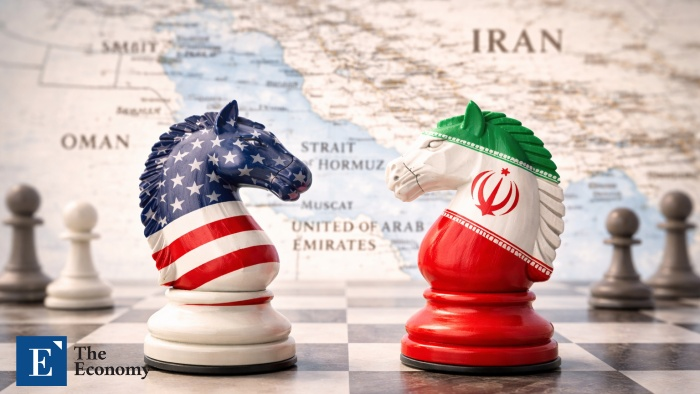
Iran has formally approved a plan to impose transit fees in the Strait of Hormuz, signaling a move to weaponize the strategic waterway and intensify economic pressure on adversaries including the United States and Israel. At the same time, Washington is shifting responsibility for the strait onto European allies that declined to support military operations against Iran, while reinforcing troop deployments in the Middle East and leaving open the possibility of military action in areas surrounding the strait.
Iran’s Continued Weaponization of the Strait of Hormuz
On March 30 (local time), Iran’s state-run Press TV reported that the Iranian parliament’s National Security Committee approved a new regulatory framework introducing transit fees for vessels passing through the Strait of Hormuz. Under the proposal, vessels from the United States and Israel would be barred from transiting the strait, while access would also be restricted for countries that have imposed unilateral economic sanctions on Iran. Additional measures include enhanced security protocols within the strait, the establishment of operational procedures to ensure the safe navigation of Iranian naval vessels, and an expanded role for Iranian military forces in managing the waterway. The initiative effectively seeks to transform the Strait of Hormuz—through which roughly 20% of global oil shipments pass—into a toll-controlled maritime chokepoint.
For the plan to become law, it must undergo a formal legislative process including a plenary vote in parliament, review by the Guardian Council, and presidential approval. However, given that Iran has already been informally collecting transit fees within the strait, formal legalization appears to be only a matter of time. Reports indicate that Iran has allowed passage for certain friendly vessels while charging approximately $2 million per transit. Iran’s Tasnim News Agency projected that maintaining such fees could generate annual revenue exceeding $100 billion, equivalent to more than 20% of Iran’s 2024 GDP.
Iran has also incorporated formal control over the Strait of Hormuz into the five conditions it has set for ceasefire negotiations with the United States. The international community, including Washington, has characterized these actions as a clear violation of international law. Although the narrowest parts of the strait fall within the territorial waters of Iran and Oman, it is internationally recognized as a vital waterway guaranteeing the right of passage for commercial shipping. U.S. Secretary of State Marco Rubio stated on March 30 that Iran’s attempt to levy transit fees is unacceptable, warning that it would set a precedent for individual nations to seize and claim international waters as their own.
Widening Rift in the U.S.-Europe Alliance
Questions are mounting over whether the United States will actively pursue reopening the Strait of Hormuz. President Donald Trump has begun shifting responsibility for restoring access onto European allies. Most European countries have refused to support Trump’s military campaign against Iran. The North Atlantic Treaty Organization (NATO) expressed reluctance over Trump’s request to deploy naval forces to the strait, while Spain denied U.S. military aircraft access to its airspace on March 30. Italy rejected the use of its Sicilian air bases for operations against Iran, and Poland declined Washington’s request to deploy its Patriot air defense systems to the Middle East. France also refused to allow Israeli aircraft transporting U.S.-supplied weapons for the Iran conflict to pass through its airspace.
In response, Trump sharply criticized European nations. In a phone interview with the New York Post on March 31, he stated, “We are completely devastating Iran right now, and there is more that needs to be done to eliminate their offensive capabilities,” while adding, “We will not be there for very long.” He further asserted, “I think it will open automatically,” referring to the Strait of Hormuz, and argued that countries reliant on the waterway, including those in Europe, should take responsibility for reopening it themselves given Iran’s diminished capacity. On the same day, Trump wrote on his social media platform Truth Social, “To all countries that cannot obtain jet fuel because of the Strait of Hormuz—such as the UK, which refused to participate in operations to remove Iran’s leadership—I have a proposal: buy American oil, or, even if it’s late, show courage and go to the strait to secure your own supply.”
There is also a growing possibility that the United States could declare an end to the war unilaterally, regardless of whether maritime traffic through the Strait of Hormuz is fully restored. On March 31, following a signing ceremony at the White House, Trump stated that troop withdrawal could occur within two to three weeks. Addressing concerns over oil prices, he remarked, “All I have to do is leave Iran, and prices will collapse,” emphasizing that a formal agreement with Iran is not necessary to end the war. He asserted that the war’s objectives—regime change in Iran and preventing the country from acquiring nuclear weapons—have already been achieved.
Primary Targets of U.S. Military Operations
Some analysts suggest that U.S. forces may maneuver in the vicinity of the Strait of Hormuz prior to any formal ceasefire declaration. On March 28, the United States deployed an additional 3,500 Marines and naval personnel to the Middle East theater. Combined with the already deployed elite 82nd Airborne Division, approximately 7,000 U.S. troops are now positioned and awaiting potential deployment orders. Initially, Kharg Island—responsible for 90% of Iran’s oil exports—was considered a primary target. Iran has since reinforced defenses on the island in anticipation of possible U.S. strikes. According to a CNN report on March 25, Iran has deployed additional troops and air defense assets to Kharg Island, along with anti-personnel and anti-tank mines.
More recently, however, attention has shifted toward seven islands controlling access to the Strait of Hormuz as more likely targets. These islands form an arc-shaped configuration along the strait, often referred to as the “arc defense line.” Specifically, Hormuz, Larak, Qeshm, and Hengam islands are located at the eastern entrance, while Abu Musa, Greater Tunb, and Lesser Tunb islands lie to the west. Iran has effectively militarized these islands, treating them as “unsinkable aircraft carriers” equipped with fast attack craft, naval mines, and drone capabilities to reinforce its control over the strait.
For U.S. forces to seize these islands, airborne operations or amphibious assaults would be required. Derek Layton, a CNN military analyst, noted that the four eastern islands—particularly Larak—could pose significant challenges during such operations. He assessed that Iran could use missiles and small attack vessels launched from Larak to disrupt “everything” transiting the strait. Even after a successful seizure, the risk of further casualties would remain high, as ground forces stationed on the islands would be exposed to drone, missile, and artillery attacks from the Iranian mainland. To date, U.S. casualties stand at 13 fatalities and approximately 300 wounded.
Despite these risks, the islands are viewed as offering greater strategic value than Kharg Island. Carl Schuster, former director of the Joint Intelligence Center at U.S. Pacific Command, told CNN that capturing the three western islands, including Abu Musa, would provide greater strategic advantage while minimizing damage to Iran’s future economic capacity envisioned by the Trump administration. Striking Kharg Island would directly destroy critical economic infrastructure, whereas securing the arc defense line would deliver military gains while preserving Iran’s economic base.
Aoife Brennan is a contributing writer for The Economy, with a focus on education, youth, and societal change. Based in Limerick, she holds a degree in political communication from Queen’s University Belfast. Aoife’s work draws connections between cultural narratives and public discourse in Europe and Asia.
- Previous [Ceasefire Negotiations] The Contours of Washington’s Endgame Come Into View, as a One-Sided U.S. “Exit” Begins Even With the Strait of Hormuz Still Blockaded
- Next "Even Retail Investors Were Tapped" OpenAI Moves to Raise Capital and Improve Profitability Ahead of IPO, Putting AI Investment Frenzy to the Test
Similar Post