"SNS Virality, Hallyu Boom Take Hold" K-Beauty Growth Axis Shifts to the U.S., Chinese Market Reorients Around Local Brands
Authored On
Modified
K-beauty gains traction in the U.S. on the back of SNS marketing success and the Hallyu wave
Government support accelerates, companies like Olive Young step up local expansion
“Value for money matters” — China turns away from K-beauty, embraces local brands
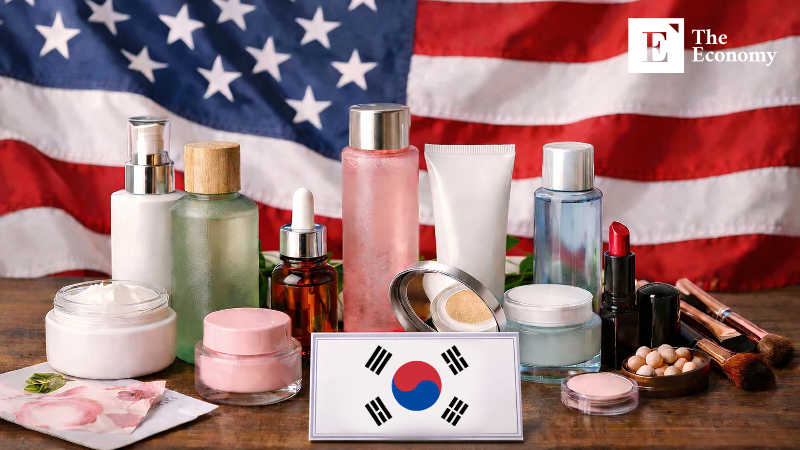
The United States has emerged as a new export stronghold for Korean cosmetics, or K-beauty. As local consumers’ perception of Korean culture improves markedly, demand is surging, fueled by the amplifying effect of social media (SNS) viral marketing. In contrast, China—once a core export destination for K-beauty—has seen a shift toward value-oriented consumption, reducing demand for foreign cosmetics while local brands increasingly dominate the market.
U.S. Emerges as Top Export Destination for K-Beauty
According to industry sources on April 1, K-beauty’s global market presence has expanded notably, with the United States at the center of this growth. Data from the Ministry of Food and Drug Safety show that Korea’s cosmetics exports reached a record $11.4 billion last year, up 12.3% year-on-year. The United States accounted for the largest share, with exports totaling $2.2 billion. As export destinations diversify rapidly, the U.S.—combining both scale and growth potential—has solidified its position as a core market.
A key driver behind K-beauty’s success in the U.S. is viral marketing via platforms such as TikTok. A CNBC report last year, citing data from global beauty outlet Personal Care Insights, noted that three-quarters of K-beauty consumers in the U.S. belong to the Millennial and Gen Z cohorts. These consumers primarily encounter K-beauty products through influencer reviews and promotional videos on TikTok. Korean-style skincare, which emphasizes natural skin health, has gained particular traction on social media.
Shifting perceptions of Korean culture have also played a pivotal role in driving the K-beauty boom in the U.S. While the popularity of Hallyu was previously concentrated in areas such as K-pop, its influence has broadened significantly in recent years to encompass K-beauty, K-food, and K-fashion. This trend intensified following the global success of Netflix’s animated series “K-pop Demon Hunters,” released in June last year. CNBC noted that the growing global popularity of K-pop groups such as BTS and Blackpink had already laid the groundwork, with the series elevating interest in Korean culture to unprecedented levels, a momentum clearly reflected in the expansion of K-beauty.
Acceleration of Local Market Penetration
Efforts to capture the U.S. beauty market are also gaining momentum from the Korean side. For instance, the Korea Trade-Investment Promotion Agency (KOTRA), in collaboration with the Korea Cosmetic Industry Institute, is advancing a “U.S.-focused K-beauty joint overseas logistics center support program” to facilitate successful market entry for Korean cosmetics firms. The initiative is designed to support logistics services and costs tailored to the beauty industry’s need for handling diverse product lines in small quantities.
Selected companies will receive local logistics services through KOTRA’s seven U.S.-based joint logistics centers until the end of October, along with up to $20,000 in logistics cost support (with companies covering 30–50%). The program includes nine support categories, such as local import customs clearance and storage, B2B and B2C fulfillment services for small-volume, multi-product orders, and delivery and returns processing. KOTRA stated that the initiative aims to alleviate logistics cost burdens and delivery delays faced by exporters, reduce initial infrastructure costs, shorten delivery times, and enhance supply reliability, thereby improving inventory efficiency and trust with buyers.
Companies are also accelerating the expansion of offline retail presence in the U.S. CJ Olive Young, a beauty subsidiary of CJ Group, plans to open its first overseas brick-and-mortar store in Pasadena, California, in May, followed by additional outlets across California, including in Los Angeles’ Westfield malls. The company has also established its first U.S. logistics hub, the “U.S. West Center,” in Bloomington, California. Spanning 3,600 square meters, the facility will serve as a logistics hub for K-beauty products distributed across the North American market via Olive Young.
Shifting Dynamics in the Chinese Market
While K-beauty secures new growth momentum in the U.S., the influence of China—once its primary export market—has weakened significantly. Exports of Korean cosmetics to China fell sharply from $4.8 billion in 2021 to $2.0 billion last year. This decline reflects a contraction in overall consumption amid a prolonged economic slowdown in China. In fact, China’s cosmetics market size in 2024 declined by 2.8% year-on-year to approximately $108 billion, marking its first negative growth since the COVID-19 pandemic. Cosmetic imports also dropped 8.3% to $16.28 billion, compared with $24.14 billion at their peak in 2021.
The vacuum left by foreign brands has been filled by domestic players, commonly referred to as “C-beauty.” As Chinese consumers increasingly prioritize value for money and product efficacy, local brands offering competitive pricing have absorbed demand. Platforms such as Douyin, powered by short-form video and algorithm-driven recommendations, have further strengthened the position of local brands. Visual, short-format beauty content—epitomized by the “Douyin makeup” trend—has gained popularity among younger consumers, enabling brands and products to achieve far more efficient exposure.
Amid these shifts, Korean companies that had heavily relied on the Chinese market are facing mounting pressure. A case in point is Aekyung Industrial, recently integrated into the Taekwang Group. The company’s cosmetics division had grown primarily through Chinese online and home shopping channels, led by brands such as AGE20’S, with overseas sales accounting for 58% of total revenue. However, as Chinese beauty trends shifted, demand for Korean cosmetics declined sharply. Revenue at its Chinese subsidiary, AK Shanghai Trading, fell from approximately $62 million in 2024 to $42 million last year, a 31.7% drop. Aekyung Industrial’s overall cosmetics revenue also declined 17.8% year-on-year to about $160 million, while exports dropped 28% to approximately $93 million. Going forward, the company plans to designate the United States, Europe, and Southeast Asia as “post-China” markets and accelerate its strategic pivot away from China to overcome the downturn.
- Previous "Even Retail Investors Were Tapped" OpenAI Moves to Raise Capital and Improve Profitability Ahead of IPO, Putting AI Investment Frenzy to the Test
- Next [U.S.-Iran War] Iranian Administration Signals Willingness to End War, Military Vows Fight to the Death; Curbing Military Backlash and Forging Compromise Seen as Key to Ceasefire
Similar Post