[Donroism] “Abandoning Hormuz, Signaling a NATO Exit” U.S.-Led Security Order Enters a Phase of Gradual Dismantling

Authored On
Modified
Trump pivots to a U.S.-centric strategy grounded in ‘Donroism’
Deepening fissures in the collective security system as allies refuse to join
Pressure for security self-reliance in Europe and Asia turns into reality
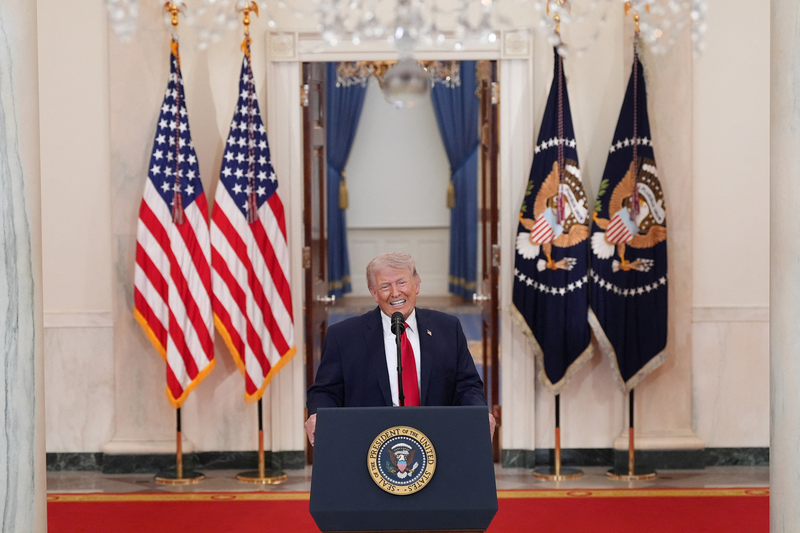
Washington’s approach to Middle East engagement has entered a phase of abrupt strategic reversal. President Donald Trump is openly shaking the foundations of the existing collective security framework by shifting full responsibility for defending the Strait of Hormuz onto allied countries. The strategic turn symbolized by pressure for withdrawal from the North Atlantic Treaty Organization (NATO) and by what he has termed “Donroism” is increasingly pointing beyond a mere redefinition of America’s role and toward a broader reordering of the global security architecture.
Trump Tells Allies to “Reopen Hormuz Yourselves”
On April 1 (all dates hereafter local time), ahead of his nationally televised address at the White House, Trump openly expressed frustration at an Easter luncheon with countries that had refused demands to dispatch warships to the Strait of Hormuz. He argued that the blockade of the Strait of Hormuz was “not America’s problem,” saying, “Let Europe handle it, let South Korea handle it.” He added in particular, “We have 45,000 troops stationed right next to rugged, nuclear-armed North Korea, and yet South Korea was of absolutely no help to us.”
After launching airstrikes on Israel and Iran on February 28, Trump had been pressing major allies, including South Korea, to intervene as part of a broader effort to pressure Tehran after Iran moved to threaten closure of the Strait of Hormuz, a critical artery for global oil supply. Seoul, however, declined to accept the request, weighing the burden of direct participation in the war and the broader repercussions such involvement could have on future South Korea-Iran ties and South Korea’s wider relations with the Middle East. European allies also drew a line against involvement. Spain barred U.S. military aircraft from crossing its airspace, Italy refused use of its air base in Sicily, and Poland rejected the deployment of its Patriot air defense system to the Middle East.
Trump subsequently intensified his criticism of Europe, accusing allies that had refused even the use of their military bases or airspace—much less troop deployments in the Iran war—of shirking responsibility. His grievance centered on the fact that allied countries suffering the most damage from the Strait of Hormuz blockade were refusing to cooperate with the war effort. He also directed criticism at British Prime Minister Keir Starmer, whose government had denied U.S. access to British military bases in the early stage of the war. Trump said of Britain, “You don’t even have a navy. You have an old aircraft carrier that doesn’t work.” After Britain rejected participation around Hormuz, Trump went on to mock the Royal Navy’s aircraft carrier as a “toy.”
In his nationally televised address that day, Trump again forcefully urged allies to assume responsibility for their own defense and hinted at the possibility of the United States stepping back from the collective security framework. On the Strait of Hormuz in particular, he repeated that countries using it should deal with the matter themselves. “To countries that cannot secure fuel, to the many countries that refused to join the operation to eliminate Iran’s leadership, I say: summon your ‘delayed courage’ even now,” Trump said. “Control it, protect it, and use the strait yourselves.” He went on to rebuke allies that had refused to participate in the operation to reopen the Strait of Hormuz, saying, “You should have shown courage much earlier. You should have been with us from the beginning,” before adding in a taunting tone, “We’ve already essentially smashed it, so the hard part is over. Reopening it should be easy.”
Trump also underscored America’s energy self-sufficiency and made explicit the “beneficiary pays” principle—that beneficiaries such as Europe should directly bear the manpower and financial burden of safeguarding the Strait of Hormuz. “Countries receiving oil through the Strait of Hormuz should take care of that route themselves,” he said. “Since it is a region they depend on so desperately, they should take the lead in protecting it.” He then added, “We do not need to be there. We do not need their oil or anything else,” and, “We are only there to help our allies,” effectively defining the alliance not as a reciprocal arrangement but as a one-sided act of American beneficence.
A Signal of Security Cost Realignment
Trump’s escalation in effectively treating a post-Iran-war U.S. withdrawal from NATO as a settled matter, thereby shaking the foundations of the transatlantic alliance, is rooted in the same logic. In an interview with the British daily The Telegraph on April 1, Trump said NATO had failed to take part in the Iran war and declared, “There is no room for reconsideration” regarding a U.S. withdrawal. He continued, “I’m not impressed by NATO. I always knew they were a paper tiger. Vladimir Putin knows that too.” On NATO members’ refusal to join the operation to reopen the Strait of Hormuz, Trump said, “Frankly, it was hard to believe. It’s not like I even pushed that hard. I just said, ‘Hey,’ and didn’t put enormous pressure on them,” adding, “I think they should have done it automatically.”
This is not the first time Trump has threatened to leave NATO. Even before beginning his first term in 2017, he called NATO a paper tiger and denounced it as imposing “massive costs” on the United States. During the 2024 presidential campaign, he sparked controversy by saying he would encourage Russia to attack NATO members that were not adequately meeting defense spending obligations. Former NATO Secretary General Jens Stoltenberg wrote in his memoir that “we saw clear signs that Trump was preparing to carry out his threat.” The White House at the time was reportedly said to have even prepared a speech announcing withdrawal from NATO. John Bolton, who served as national security adviser during Trump’s first administration, also said Trump “came very close to withdrawing from NATO” at the 2018 NATO summit.
Experts say Trump’s hard-line remarks amount to more than mere political rhetoric. In their view, they reflect a policy shift driven by the perception that the cost burden of America’s long-standing role in protecting Middle Eastern energy routes has reached its limit. Since the 1970s, the United States has rebuilt the global financial order around the petrodollar system, with Middle East stability functioning as one of its central pillars. In the process, Washington deployed vast military power to keep sea lanes and energy supply chains stable. That allowed major economies in Asia and Europe to secure energy at relatively low cost and sustain industrial growth. Yet the astronomical defense budget burden growing inside the United States has increasingly called into question the sustainability of such a security posture. The Trump administration has made unmistakably clear that it will no longer tolerate one-sided sacrifice in circumstances that undermine America’s economic interests. His call for beneficiary states to intervene directly in disputes arising in the Strait of Hormuz stands as a decisive indication that U.S. strategic priorities have shifted sharply.
EU Scrambles to Prepare Contingencies for a U.S. ‘NATO Exit’
Trump has described his foreign policy as a revival of the Monroe Doctrine—American isolationism—and has gone so far as to brand it “Donroism.” That view is widely interpreted as reflecting the sentiment among voters that the United States must return to an America-first posture. His broader political trajectory—the approach to the war in Ukraine, claims over control of the Panama Canal, pressure for regime change in Venezuela, demands over Greenland, and even remarks about incorporating Canada as the 51st state—reveals a clear common direction. Whatever the norms of international law or the customary rules of alliance diplomacy, the underlying intention has been consistently directed toward concentrating America’s strategic focus on the Western Hemisphere. This trajectory also dovetails with last year’s U.S. National Security Strategy (NSS), which designated the Western Hemisphere as Washington’s foremost strategic theater. In that sense, Donroism is aligned with the broader shift in America’s security and diplomatic axis away from global engagement and toward a strategy centered on U.S. national priorities.
Even so, a president cannot legally withdraw from NATO by unilateral fiat. During President Joe Biden’s administration in 2023, the U.S. Congress passed legislation barring any president from “suspending, terminating, or withdrawing” U.S. participation in NATO without congressional approval or a resolution passed by a two-thirds majority in the Senate, and the clause was incorporated into the National Defense Authorization Act (NDAA), which Biden signed into law. Moreover, with U.S. participation in NATO enjoying bipartisan support across both Republicans and Democrats, it would be difficult for Trump to successfully complete the legal procedures required for withdrawal. Even so, the prevailing view in Washington is that, judging from Trump’s past conduct, there is a strong possibility he could attempt to circumvent or violate the law and force through a declaration of withdrawal.
Should the United States actually leave NATO, the alliance would be significantly weakened and far more exposed to threats from Russia and others. As of last year, the United States accounted for 60% of total NATO defense spending, underscoring how indispensable America remains to the alliance. Faced with an urgent strategic shock, Europe is now scrambling to devise an independent security framework. According to European policy outlet Euractiv, the European External Action Service (EEAS) is planning to draft guidelines in the near future explaining procedures for invoking Article 42.7 of the Treaty on European Union. That clause stipulates that if an EU member state comes under armed attack on its own territory, the other member states must provide aid and assistance by all means in their power, including military support, in accordance with Article 51 of the United Nations (UN) Charter.
Europe has also begun work on assembling a multinational force to restore normal navigation through the Strait of Hormuz. On March 26, the French Defense Ministry said it had held a video conference chaired by Chief of the Defense Staff Fabien Mandon with the heads of the armed forces of 35 countries around the world. The meeting was convened to discuss a coordinated international response to secure navigational safety in the Strait of Hormuz, a critical maritime chokepoint in the Middle East. European countries have signaled that they could play a role in escorting vessels and ensuring maritime safety in the strait after a ceasefire. Foreign media have also recently reported that Britain and France are taking the lead in preparing a multinational maritime cooperation framework. While the multinational meeting does not immediately translate into military action, it is being assessed as a preliminary step toward establishing an international framework for reopening and securing navigation in the Strait of Hormuz once the situation in the Middle East stabilizes.
- Previous [U.S.-Iran War] Iranian Administration Signals Willingness to End War, Military Vows Fight to the Death; Curbing Military Backlash and Forging Compromise Seen as Key to Ceasefire
- Next [U.S.-Iran War] Energy Shock Triggered by the Strait of Hormuz Blockade Set to Fundamentally Reconfigure Asia’s Oil Dependence
Similar Post