[U.S.-Iran War] With the deadline looming, the brinkmanship is peaking. Will the Gulf states pull the trigger on entering the war?

Authored On
Modified
Iran fires back at Trump’s “hell” warning
Odds of a deal recede sharply as the negotiation deadline nears
Rising risk of a multilateral clash as Gulf states and pro-Iran forces weigh intervention
Concerns are mounting over a protracted war as ceasefire negotiations between the United States and Israel on one side and Iran on the other continue to falter. With both sides maintaining a hard-line posture and steadily ratcheting up pressure, the prospects for a negotiated settlement appear to be diminishing by the day. Against that backdrop, Washington’s review of military options and the Gulf states’ increasingly collective response are raising the possibility that the conflict could spill into a broader multilateral confrontation.
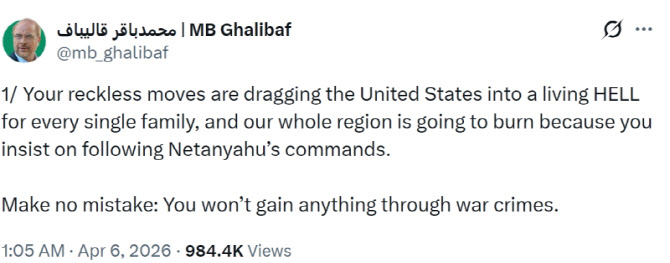
Iranian Parliament speaker: “Trump, by following Netanyahu, will set the Middle East ablaze”
On April 5 local time, Iranian Parliament Speaker Mohammad Bagher Ghalibaf wrote in English on his X account, “Your reckless moves are pushing every American family into a ‘living hell.’” He went on to say, “Your insistence on obeying Netanyahu’s orders will set our entire region on fire.” He also warned President Trump against miscalculating with respect to Iran, saying, “You will gain nothing through war crimes.” He further stressed that the only genuine path to resolving the current conflict lies in respecting the rights of the Iranian people and halting the “dangerous game.”
Ghalibaf’s remarks came immediately after President Trump referred to both military pressure on Iran and the possibility of a negotiated settlement. Trump had earlier taken to Truth Social to repeatedly press for the reopening of the Strait of Hormuz. “Tuesday (April 7) will be Power Plant Day and Bridge Day for Iran,” Trump wrote. “Open the Fxxxin’ Strait, you crazy bastards, or you’re going to live in hell.” The message amounted to a warning that, unless Iran reopened the Strait of Hormuz by 8 p.m. on April 7 Korea time 9 a.m. on April 8, Washington would destroy energy infrastructure across Iran.
Among Trump’s close allies, warnings are also circulating that, once the April 7 deadline passes, the president will move to “devastate Iran.” Senator Lindsey Graham, one of Trump’s closest confidants, wrote on X on April 5, “After talking with President Trump this morning, I am convinced that if the Iranian regime continues to obstruct passage through the Strait of Hormuz and refuses a diplomatic solution, the President will use overwhelming military force.” He added, “If Iran and other countries still do not understand that President Trump means what he says, I do not k
Negotiations deadlocked, prospects for a near-term deal fading
Yet with Iran refusing to back down and now signaling the possible closure of the Red Sea in addition to the Strait of Hormuz, the atmosphere is increasingly tilting toward a prolonged war. Ghalibaf had earlier written on X on April 4, “How much of the world’s oil, liquefied natural gas, wheat, rice, and fertilizer shipments pass through the Bab el-Mandeb Strait?” He added, “Which countries and companies rely most heavily on this passage?” Iranian media outlets including Press TV and Tasnim News interpreted the post as a signal that Ghalibaf was raising the possibility of additional pressure on the United States and Israel through a blockade of the Bab el-Mandeb Strait.
The Strait of Hormuz and the Bab el-Mandeb Strait account for roughly 20% and 12%, respectively, of global seaborne crude shipments, making them critical strategic chokepoints. Iran has controlled vessel traffic in the Strait of Hormuz since coming under U.S. and Israeli airstrikes on Feb. 28. On top of that, Yemen’s Iran-aligned Houthi rebels declared their entry into the war on March 28, heightening concern that any closure of the Bab el-Mandeb Strait, which links the Red Sea and the Gulf of Aden, would significantly deepen the global energy crisis.
Compounding matters, Iran is flatly denying that it has sought direct negotiations or a ceasefire request. The United States and Iran acknowledge only backchannel message exchanges through mediators including Pakistan and Oman. At present, Iran’s internal communications and military command structure have been effectively crippled after large numbers of senior officials were killed or replaced in U.S. and Israeli strikes. Since the outbreak of the war, dozens of core regime figures, including Supreme Leader Ali Khamenei and Ali Larijani, secretary of Iran’s Supreme National Security Council, have been killed, leaving the current leadership’s policymaking capacity substantially impaired. Most of the links connecting key military and civilian decision-makers have been severed, and surviving officials are reportedly avoiding phone calls and face-to-face meetings out of fear that they too could become targets of airstrikes.
Even so, the Iranian government has left open a limited possibility of talks with the United States. Iranian Foreign Minister Abbas Araghchi wrote on X on April 4, “The U.S. media are distorting Iran’s position,” adding, “We deeply appreciate Pakistan’s efforts, and there has never been a single instance in which we refused a visit to Islamabad.” Pakistan has been mediating between the two sides in an effort to convene U.S.-Iran ceasefire talks in Islamabad. Araghchi reaffirmed that “what matters to us are the conditions necessary to bring this illegal war imposed on us to a decisive and permanent end,” making clear once again that Iran would sit down at the negotiating table only if the United States guarantees that the war will not recur.
For now, however, discussions between the two sides remain deadlocked. In particular, the gap over the reopening of the Strait of Hormuz, a core point of contention, remains so wide that a comprehensive agreement in the near term is widely viewed as unlikely. Iran is holding to the hard-line position that the strait can be reopened only if it is guaranteed transit revenues sufficient to compensate for wartime damage, a demand Washington is unlikely to accept. Tehran is seeking to impose passage fees on the Strait of Hormuz in the manner of the Suez Canal, but unlike the Suez, which is man-made, a naturally formed strait cannot be subjected to toll collection under international law. More importantly, the Strait of Hormuz is a central artery for global oil shipments, meaning any Iranian push for a blockade or tighter control would inevitably send shockwaves through energy markets worldwide.
Saudi Arabia and the UAE weighing direct participation in anti-Iran operations
Military and diplomatic experts say that if no meaningful outcome emerges from negotiations with Iran by the evening of April 7, the war will enter a decisive escalation phase depending on what choice President Trump makes next. Trump’s stated plan is to destroy key infrastructure in succession and hurl Iran back into the Stone Age, but the situation may prove far more difficult to manage than anticipated. His exit strategy could revolve around crippling state functions through concentrated bombardment and then declaring victory. Yet analysts say that, should Washington fail to secure Iran’s stockpile of enriched uranium and fall short of achieving genuine regime change, it could face a domestic and international outcry that it merely reinforced Iran’s control over the Strait of Hormuz while plunging the world into an energy crisis.
There is also a considerable possibility that Gulf states allied with the United States will launch a high-intensity counteroffensive against Iran. The war is upending the recent years-long trend of rapprochement between Gulf states and Tehran. Saudi Arabia and the United Arab Emirates had sought to avoid direct confrontation through de-escalation, but those efforts are now widely seen as having been effectively nullified by the war. In late March, Bahrain, Kuwait, Saudi Arabia, and the UAE were reported to have intercepted successive waves of Iranian drones and missiles. Iran, for its part, considers these states legitimate military targets on the grounds that the United States is using their airspace and territory to attack Iran.
Another pivotal variable in the spread of the war is the Strait of Hormuz itself. With Iran blocking the waterway, anxiety is rising across the Gulf that the lifeline of their energy exports is under direct threat. In particular, if President Trump moves to seize Kharg Island, through which roughly 90% of Iran’s oil exports pass, there is growing concern that Iran could launch large-scale retaliation across the Gulf. Iranian officials have reportedly signaled that, should such a scenario materialize, they could directly strike the island and lay naval mines in the strait and across the Persian Gulf. As the war drags on, the intensity of Iranian attacks has also risen sharply. Since the outbreak of hostilities, about 5,000 missiles and drones have reportedly been launched toward Gulf states, with targets extending beyond oil and gas facilities, airports, and U.S. bases to include residential areas and diplomatic districts. In the process, at least 20 people are reported to have been killed across the Arab Gulf states.
Against that backdrop, member states of the Gulf Cooperation Council are said to have sharply intensified intelligence sharing and coordination of military responses. At a foreign ministers’ meeting held in Riyadh last month, joint military action against Iran was reportedly discussed as one of the collective response options. Following the meeting, Saudi Foreign Minister Prince فيصل bin Farhan warned at a press conference, “Our patience is not unlimited.” While Saudi Arabia officially favors a diplomatic solution and has not publicly endorsed regime change in Iran, some analysts say the kingdom stands ready to take military action if its power and water infrastructure comes under attack. The UAE is also cited as the country most strongly signaling the possibility of collective military action.
On the other side, pro-Iran forces are also weighing intervention. According to Iran’s Press TV, military units loyal to Chechen Republic leader Ramzan Kadyrov announced on March 31 that they were preparing to deploy in support of Iranian forces should the United States launch a ground invasion of Iran. Although the overwhelming majority of the Chechen Republic’s population is Sunni Muslim, setting it apart sectarianly from Shiite Iran, Chechen forces have defined the current crisis as a “religious war.” They claimed that their intervention would constitute a “jihad,” or holy war, to defend the Islamic Republic of Iran. Press TV underscored the significance of possible Chechen involvement by asserting that Ukrainian forces are openly supporting the United States and Israel in the current Middle East war.
Similar Post