“Taxing Jobless Growth Driven by AI” — Fiscal Overhaul Pressure Meets Capital Flight Dilemma

Matthew Reuter is a senior economic correspondent at The Economy, where he covers global financial markets, emerging technologies, and cross-border trade dynamics. With over a decade of experience reporting from major financial hubs—including London, New York, and Hong Kong—Matthew has developed a reputation for breaking complex economic stories into sharp, accessible narratives. Before joining The Economy, he worked at a leading European financial daily, where his investigative reporting on post-crisis banking reforms earned him recognition from the European Press Association. A graduate of the London School of Economics, Matthew holds dual degrees in economics and international relations. He is particularly interested in how data science and AI are reshaping market analysis and policymaking, often blending quantitative insights into his articles. Outside journalism, Matthew frequently moderates panels at global finance summits and guest lectures on financial journalism at top universities.
Authored On
Modified
Erosion of Labor Income Base Amid AI Expansion
Declining Tax Revenues Offset by Higher Capital Taxes
Rising Imperative for Redistribution Through Enhanced Taxation

Amid mounting concerns over job displacement driven by the proliferation of artificial intelligence (AI), a growing argument is emerging for restructuring the tax system toward eliminating income taxes. As AI—backed by vast capital investment—replaces human labor, proponents argue that individuals should be exempt from income taxes, while those benefiting from capital gains should bear a heavier tax burden. However, given the inherently mobile nature of capital across borders, stronger taxation risks triggering capital outflows, underscoring the need for a highly calibrated redesign of the tax framework.
Income Tax Exemption Proposal for Sub-$100,000 Earners
According to the Financial Times on the 5th (local time), Vinod Khosla, an early OpenAI investor and founder of Khosla Ventures, proposed eliminating income taxes for Americans earning less than $100,000 annually. He argued that the resulting shortfall in tax revenue could be offset by raising capital gains taxes on stock trading profits and similar income streams. Such a measure, he claimed, would leave overall government revenue intact while exempting approximately 125 million low-income Americans from federal income tax.
Currently, the U.S. federal income tax follows a progressive structure with rates reaching up to 37%, whereas capital gains taxes remain comparatively lower, capped at around 20% for assets held longer than one year. Khosla emphasized that AI is accelerating the transfer of wealth and power away from workers, necessitating a fundamental overhaul of the tax system. “In conversations with people, the biggest concern is that AI will take their jobs,” he said, adding that the issue is likely to emerge as a central theme in the 2028 presidential election.
As AI technologies rapidly advance to replace not only cognitive labor but also physical work, humanity faces unprecedented foundational questions. In a world where machines generate all economic value and human labor becomes redundant, how should individual livelihoods be secured? This debate is increasingly seen as pivotal to the future of both capitalism and democracy. Khosla’s advocacy for higher capital taxation reflects this sense of urgency.
At present, a substantial portion of global tax revenues is derived from income taxes on labor. As AI increasingly drives production in place of human workers, government revenues are likely to decline sharply. Speaking at the Hill & Valley Forum in Washington last month—a gathering of policymakers and Silicon Valley executives—Khosla warned that by 2030, up to 80% of jobs could fall within domains performable by AI, significantly heightening the risk of displacement. In a context where wealth generated by capital is outpacing the growth of labor income, he argued that strengthening capital taxation represents the only viable path to restoring the middle class and ensuring societal sustainability.
Rising Pressure for Tax Reform in the AI Era
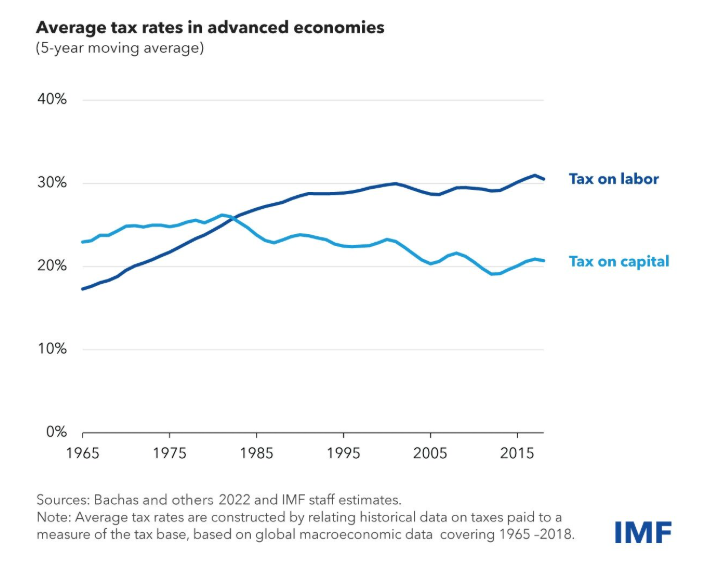
Khosla is not alone in advocating stronger capital taxation. The International Monetary Fund (IMF) has also warned that generative AI could exacerbate income inequality and wealth concentration, recommending higher capital and corporate taxes. According to the IMF, tax burdens on capital income in advanced economies have steadily declined since the 1980s, while those on labor income have increased. Strengthening taxation on capital income, therefore, is seen as essential to preserving the role of labor in income distribution and counteracting rising inequality. Moreover, expanding public investment in education and social spending to maximize AI-driven gains will require increased fiscal resources.
The Guardian has likewise proposed imposing taxes directly on AI systems or on the excess profits they generate. It also highlighted the concept of shared ownership of AI technologies as an alternative mechanism for wealth redistribution. The proposal aims to dismantle the current structure in which a small number of Big Tech firms monopolize AI capabilities and capture the entirety of resulting profits. The Guardian argued that the vast datasets underpinning AI development constitute a collective asset of humanity. It further cautioned against the transformation of companies like OpenAI from initially public-interest-oriented entities into profit-driven corporations, suggesting that a portion of corporate earnings be allocated to public funds and redistributed to citizens in the form of dividends.
United Nations Secretary-General António Guterres also warned that AI must not remain under the control of a handful of nations or billionaires. While current debates focus on whether AI systems function in accordance with human commands, he stressed that the more critical issue lies in whether the objectives of AI and its owners align with the broader interests of society. Economists Anton Korinek and Lee Lockwood similarly argued that as labor income declines, capital taxation will become central to fiscal policy. They further proposed using taxation to incentivize the development of technologies that complement rather than replace human labor. The revenue generated could serve as the foundation for a universal basic income, with a portion of cost savings achieved through labor substitution by corporations being socially reclaimed.
Capital Flight Risks Triggered by Tax Policy Shifts
Despite these arguments, the potential side effects of increased taxation remain significant. Citing analysis from asset management firm Rathbones, the Financial Times reported that approximately 6,000 business owners left the United Kingdom over the past two years, based on corporate disclosure data from January 2024 to January this year. During the same period, 3,182 business owners relocated to the UK, while 5,940 departed, resulting in a net outflow of 2,758 individuals. Among those leaving, technology sector entrepreneurs accounted for the largest share. The most popular destinations were the United Arab Emirates (UAE), followed by Spain and the United States.
The primary driver behind this exodus was rising tax rates. The UK implemented a series of tax reforms during this period, including increases in capital gains taxes and the abolition of remittance-based taxation for non-domiciled residents—measures that disproportionately affected high-net-worth individuals. In contrast, the UAE offers a tax-free environment with no personal income tax, capital gains tax, or inheritance and gift taxes. “International mobility among business owners and wealthy entrepreneurs has accelerated,” said Michelle White, head of private wealth at Rathbones. “There is a notable increase in younger entrepreneurs considering relocation in pursuit of better opportunities, favorable tax regimes, and stronger long-term growth prospects.” According to Rathbones, the UK saw a net decline of 16,500 millionaires last year, with their investable assets estimated at approximately $91.8 billion.
In this context, while strengthening taxation on AI-generated profits represents an unavoidable path toward fiscal stability, it also intensifies the pace of capital mobility as tax differentials widen. As a result, raising capital gains taxes may ultimately function less as a revenue-enhancing tool and more as a catalyst for tax base erosion. One international tax expert noted, “In the AI era, the core issue is no longer the tax rate itself but the institutional capacity to regulate capital mobility. The fundamental challenge lies in redesigning tax systems capable of effectively taxing borderless capital while sustaining welfare structures.”
Matthew Reuter is a senior economic correspondent at The Economy, where he covers global financial markets, emerging technologies, and cross-border trade dynamics. With over a decade of experience reporting from major financial hubs—including London, New York, and Hong Kong—Matthew has developed a reputation for breaking complex economic stories into sharp, accessible narratives. Before joining The Economy, he worked at a leading European financial daily, where his investigative reporting on post-crisis banking reforms earned him recognition from the European Press Association. A graduate of the London School of Economics, Matthew holds dual degrees in economics and international relations. He is particularly interested in how data science and AI are reshaping market analysis and policymaking, often blending quantitative insights into his articles. Outside journalism, Matthew frequently moderates panels at global finance summits and guest lectures on financial journalism at top universities.
Similar Post