[U.S.-Iran War] Trump Claims “Energy Gift” and Nuclear Deal Progress, but Middle East Tensions Persist

Niamh O’Sullivan is an Irish editor at The Economy, covering global policy and institutional reform. She studied sociology and European studies at Trinity College Dublin, and brings experience in translating academic and policy content for wider audiences. Her editorial work supports multilingual accessibility and contextual reporting.
Authored On
Modified
Trump highlights “regime change” narrative, underscores war gains
Europe takes lead in diplomatic push to avert full-scale conflict
Gulf states, including Saudi Arabia, harden stance toward Iran
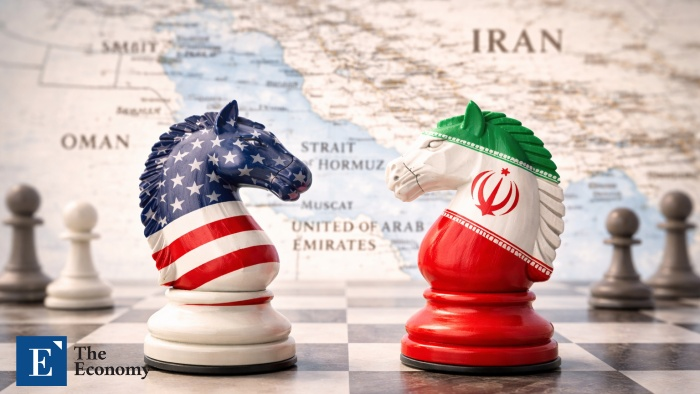
U.S. President Donald Trump declared a halt to attacks on Iranian energy facilities and claimed that the United States had received “a very large gift” from Iran, asserting progress in negotiations. He tied this to conditions requiring Iran to abandon its nuclear program, framing war achievements and prospects for ending the conflict as part of a single trajectory. Iran denied any such talks with the United States, dismissing Trump’s remarks as political rhetoric. With both sides offering sharply conflicting accounts of the same issue, uncertainty over negotiation channels, the scope of any agreement, and pathways to ending the war has intensified.
Uncertainty Over Endgame Scenario Persists
On March 24, speaking to reporters at the White House during the swearing-in ceremony of newly appointed Homeland Security Secretary Markwayne Mullin, Trump said, “A gift from Iran arrived today,” describing it as “a very large and valuable gift related to oil and gas.” This followed his statement the previous day that “all military attacks on Iranian power plants and energy infrastructure will be suspended for the next five days,” again suggesting progress in negotiations. However, he declined to elaborate on the nature of the gift, responding to reporters’ questions only with a smile.
Trump went on to say, “We killed all of their leadership,” adding, “We are dealing with one of Iran’s new groups, and it will soon be revealed.” Regarding the negotiations, he claimed, “They agreed that Iran should have no nuclear weapons and will not enrich uranium,” adding, “We are in the best possible position in negotiations.” He further asserted that “we have agreed on 15 points, including Iran’s nuclear abandonment,” emphasizing that “they have agreed never to possess nuclear weapons.” The remarks suggest an attempt to frame military outcomes and diplomatic progress as a unified narrative.
Iran immediately rejected these claims. Esmaeil Baghaei, spokesperson for Iran’s Foreign Ministry, stated, “There have been no negotiations or dialogue with the United States in the past 24 hours,” directly contradicting Trump’s remarks. While acknowledging that the U.S. had conveyed messages seeking talks to end the war, Iran made clear it does not consider these to constitute formal negotiations. Semi-official Mehr News Agency, citing Foreign Ministry sources, also reported that “no dialogue exists between the two countries,” describing Trump’s statements as “political rhetoric aimed at lowering surging energy prices and buying time to implement military plans.”
As both sides present opposing claims, uncertainty over the substance of any negotiations has deepened. Trump insisted, “I didn’t call them—they called me,” emphasizing that Iran initiated contact, and outlined post-agreement steps, including the U.S. directly retrieving Iran’s highly enriched uranium. When asked whether the U.S. would control the Strait of Hormuz after the war, he responded, “We can control whatever we want.” However, no formal negotiation framework or channel supporting these claims has been presented.
European Involvement in Military Operations and Negotiations
Diplomatic circles are increasingly focused on the possibility that European countries, which maintain relatively more balanced relations with Iran, could take a leading role in negotiations. Although Trump expressed frustration that major European powers were “not helping” U.S. military operations against Iran, developments on the ground indicate that Europe is simultaneously involved in both military and diplomatic dimensions. A March 23 report by The Wall Street Journal noted that “European countries are indirectly supporting the war by providing operational infrastructure while also facilitating negotiations through diplomatic channels,” suggesting an effort to contain escalation while calibrating their level of involvement.
In practice, European military infrastructure has become a critical backbone for U.S. operations against Iran. Approximately 80,000 U.S. troops are stationed across around 40 bases in Europe, and since the outbreak of war, large numbers of fighter jets and drone vessels have launched from bases in the United Kingdom, Germany, Portugal, Italy, France, and Greece after refueling and rearming. At Ramstein Air Base in Germany, roughly 9,000 U.S. personnel are reportedly directing drone operations, while B-1 strategic bombers have been observed loading munitions and fuel at RAF Fairford in the United Kingdom. These developments underscore Europe’s central role in supporting U.S. military operations.
The Wall Street Journal assessed that “European governments are reluctant to provide direct military support due to domestic opinion and energy concerns but are unable to refuse cooperation with their primary security partner, the United States.” With prolonged conflict threatening to exacerbate already high energy prices, Europe—still grappling with the economic fallout from the war in Ukraine—faces strong incentives to provide logistical backing while avoiding overt combat involvement. Publicly, however, most governments maintain that their role is limited to logistical support. France, for example, while permitting U.S. aerial refueling aircraft to operate from its territory, emphasized that “the refuelers function as gas stations.”
Rising Possibility of Gulf State Military Involvement
The shifting dynamics in the Middle East have also influenced these developments, as even Gulf states that previously favored diplomatic solutions have begun adopting a more confrontational stance toward Iran. Saudi Arabia’s de facto leader, Crown Prince Mohammed bin Salman, reportedly emphasized the need to remove Iran’s hardline regime during a recent phone call with Trump, urging continued military pressure. His support for airstrikes and potential ground operations—framed as a “historic opportunity to reshape the Middle East”—marks a notable shift from earlier caution.
Saudi Arabia has also moved to actively support U.S. air operations, reversing its prior position of refusing to allow its airspace and facilities to be used. It has permitted access to King Fahd Air Base and is reportedly considering further support. Saudi Foreign Minister Faisal bin Farhan Al Saud stated in an interview with The Wall Street Journal, “Our patience regarding Iran’s attacks is not unlimited,” adding, “It is a miscalculation to believe Gulf states lack the capability to respond.” Diplomatic sources have even begun suggesting that “Saudi participation in the war is only a matter of time.”
The United Arab Emirates (UAE) has likewise tightened enforcement against Iranian-owned assets within its territory and initiated discussions on potential troop deployment. The UAE is also lobbying against any ceasefire that would leave parts of Iran’s military capabilities intact. In Dubai, Iranian hospitals and clubs have been shut down. The UAE federal government explained that “certain entities directly linked to the Iranian regime and the Islamic Revolutionary Guard Corps (IRGC) were found to have violated UAE laws by being used for purposes not beneficial to Iranian citizens,” signaling the possibility of further sanctions. This has raised expectations that Iran’s access to foreign currency and global trade networks could become increasingly restricted.
Despite these pressures, Iran continues to signal its willingness to fight. Since the outbreak of war, it has carried out successive strikes on energy infrastructure in Ras Laffan, Qatar, as well as targets along Saudi Arabia’s Red Sea coast, Kuwait, and the UAE, including more than 2,000 attacks on the UAE alone. At the same time, Iran has tightened control over the Strait of Hormuz, selectively permitting vessel passage and reportedly informing neighboring states of potential post-war involvement in strait operations or the imposition of transit fees. For Gulf states, the prospect of disruption to a critical oil export route has become increasingly tangible, intensifying pressure to respond.
Niamh O’Sullivan is an Irish editor at The Economy, covering global policy and institutional reform. She studied sociology and European studies at Trinity College Dublin, and brings experience in translating academic and policy content for wider audiences. Her editorial work supports multilingual accessibility and contextual reporting.
Similar Post