[Donroism] “Has the Collective Security System Reached the End of Its Shelf Life?” As the United States Warns of a NATO Exit, the End of “80 Years of Peace” Looms

Anne-Marie Nicholson is a fearless reporter covering international markets and global economic shifts. With a background in international relations, she provides a nuanced perspective on trade policies, foreign investments, and macroeconomic developments. Quick-witted and always on the move, she delivers hard-hitting stories that connect the dots in an ever-changing global economy.
Authored On
Modified
U.S. signals possible NATO withdrawal amid the Iran war
Risk of accelerating Europe’s arms race
Mounting concern over global chain reactions
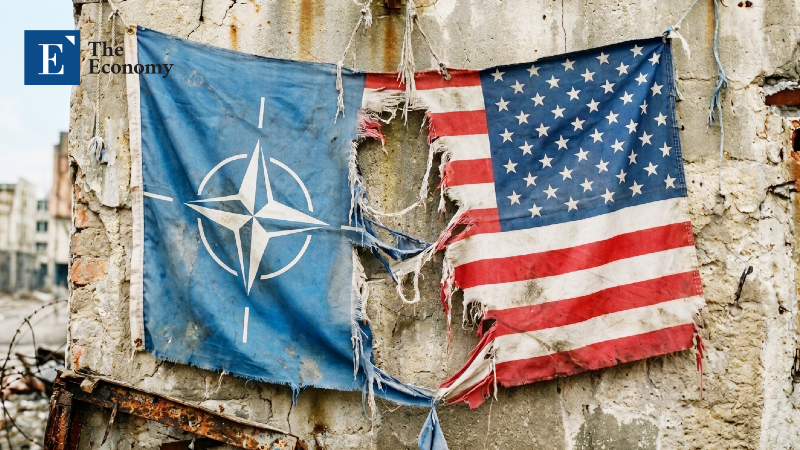
The administration of U.S. President Donald Trump is using the war with Iran as a catalyst to shake the North Atlantic Treaty Organization (NATO) framework to its core. Washington is increasingly signaling that Europe’s NATO allies, despite belonging to the world’s largest collective defense system, have stood idle at the very moment the United States needed them. Such fractures point to a weakening of the security architecture that has underpinned the international order. Analysts are now warning that the long peace the world has enjoyed for 80 years since World War II may be nearing its end.
Fracturing of the U.S.-Europe Security Alliance
According to the Associated Press and other outlets on the 31st, Secretary of State Marco Rubio said in an interview with Al Jazeera the previous day that he was “very disappointed” with NATO, which effectively refused to dispatch warships to the Strait of Hormuz during the Iran war, adding that “the United States should reexamine all of this after this operation is over.” Rubio said, “One of the reasons NATO is beneficial to the United States is that it gives us basing rights in contingencies,” adding that “this allows us to position troops, aircraft, and weapons in many parts of Europe and other regions of the world where we would not ordinarily maintain bases.”
He took particular aim at Spain, a NATO ally, for blocking U.S. military aircraft engaged in the war with Iran from entering its airspace. Rubio said, “Spain’s leftist leaders are bragging about closing their airspace.” Earlier, Spanish Defense Minister Margarita Robles stated on the 30th that the use of bases in Spain by U.S. forces would not be allowed, and that Spanish airspace would naturally not be made available for the war against Iran. She also made clear to Washington that Spain would not permit the use of the joint U.S. bases at Morón and Rota in Andalusia, southern Spain. Rubio responded, “If NATO is focused only on our defending Europe when Europe comes under attack, but denies us access to bases and other rights when we need them, that is not a very good system.” He added, “NATO is an alliance, and alliances must be mutually beneficial. They cannot be a one-way street.”
Rubio’s remarks are closely aligned with President Donald Trump’s own position. Speaking on the 27th at the Future Investment Initiative event hosted by Saudi Arabia’s sovereign wealth fund in Miami, Florida, Trump said, “We would always have been there for them, but looking at their conduct, it seems we do not need to be.” He continued, “I think it was a tremendous mistake that NATO did not help us,” adding, “We spend hundreds of billions of dollars on NATO every year. If they will not step up for us, why should we step up for them? They did not step up for us.”
In practice, a significant number of European countries have maintained an uncooperative posture toward Trump’s military operation. After NATO balked at Trump’s request to dispatch warships to the Strait of Hormuz, Italy also rejected a U.S. plan to use an air base in Sicily during the war with Iran. Poland likewise refused a U.S. proposal to send its Patriot air defense system to the Middle East, while France, like Spain, denied its airspace to Israel for the transport of U.S. weapons destined for use in the Iran war. This came as U.S. forces in the Middle East were already struggling with shortages in weapons inventories, further aggravating Trump.

Justification for the Reinforcement of the “Donroeism” Doctrine
At present, the Trump administration and the Republican Party are treating the conduct of European countries as an unmistakable betrayal, and appear poised to use it to justify the “Donroe Doctrine,” which prioritizes America’s own interests. This so-called “Donroeism,” named after Trump, is an expanded and revised version of the Monroe Doctrine, which in the 1800s advocated restraint in European conflicts and a concentration on national interests in the Western Hemisphere.
The foreign-policy line advanced by Trump marks a clear departure from the traditional strategy of sustaining the liberal international order. This posture is accompanied by a fundamental skepticism about NATO’s raison d’être. The collective defense system built after World War II to deter invasion by the former Soviet Union and contain the spread of communism during the Cold War played a central role in that geopolitical environment. Its core principle is the collective defense clause, Article 5, under which an attack on one member is treated as an attack on all.
Yet one of the gravest threats arising from the current international uncertainty is the extreme difficulty of discerning Trump’s true intentions. The closure of the Strait of Hormuz following the U.S.-Israel-Iran war is serious in its own right, but the larger risk lies in the near impossibility of forecasting the future direction of U.S. policy.
When the United States ousted Venezuelan President Nicolás Maduro earlier this year, Trump’s conduct could still be explained through the lens of the Donroe Doctrine. But the U.S. airstrikes on Iran serve as a warning that it may be a misreading to interpret Trump’s conduct simply as isolationism. The Iran war has taken on an interventionist character, with the United States overtly projecting hard power—military and economic coercive instruments alike—to achieve America-first objectives.
Moreover, while Trump has insisted that the economic burden on the United States is too great and pressed European countries to raise defense spending to 5% of gross domestic product, he has also shifted support for Ukraine’s resistance to Russian aggression into a European-mediated “weapons sales” model. Separate from the pressure on NATO members over defense contributions, European Union member states were also threatened with retaliatory tariffs after they opposed Trump’s attempt to annex Greenland, a Danish territory, following the imposition of steep tariffs.
Ultimately, Europe’s reluctance to engage in the Iran war may reflect both the argument that NATO’s core Article 5 is difficult to apply to this conflict and the backlash within Europe against the Trump administration’s harsh treatment of allies. Diplomatic circles also broadly agree that Europe’s cold response cannot be separated from the fact that, right up until the launch of the attack on Iran on Feb. 28, Washington made little effort to persuade NATO allies to participate in the operation. The Donroe Doctrine is, in effect, shaking the Atlantic alliance that once bound the United States and Europe together at its roots.
Countries Around the World Brace for a “Wartime System”
The problem is that the uncertainty surrounding NATO could drive the world back toward a phase governed by the logic of power. In a report released on the 30th, the British think tank Chatham House assessed that the current crisis could produce structural fractures in the international security system. The report identified the credibility of America’s extended nuclear deterrence as the key variable. In other words, allies that have long relied on the United States are increasingly questioning whether Washington would, in an emergency, move immediately to their defense.
This trend is being detected first and foremost in Europe. As Trump continues to hint at the possibility of withdrawing from NATO while demanding greater European defense burden-sharing, the prospect of “security without the United States” is being discussed as a realistic scenario. Europe has already been raising defense expenditures aggressively for several years. According to data from the Stockholm International Peace Research Institute (SIPRI), military spending across the European continent reached $693 billion in 2024. That was the highest level since the collapse of the Soviet Union and amounted to 113% of the $616 billion recorded in 1990, at the end of the Cold War.
During 2024 alone, nearly every country in Europe except the Mediterranean island nation of Malta increased defense spending. Poland, which borders both Russia and Ukraine, increased military expenditures by 31% from 2023 to $38 billion. That amounted to 4.2% of Poland’s GDP. Other European countries adjacent to Russia, including Sweden (34%), Norway (17%), and Finland (16%), also sharply increased defense spending.
Germany, which had restrained its emergence as a major military power since World War II, spent $88.5 billion on defense. That ranked fourth in the world behind the United States, China, and Russia. Just a year earlier, in 2023, Germany ranked seventh globally in defense spending, at roughly $60 billion to $70 billion. In the span of a single year, it climbed three places. Late last year, the budget committee of the German Bundestag also approved more than $57.5 billion in defense procurement contracts in one sweep, covering defense-industrial infrastructure such as logistics procurement, combat vehicles, and reconnaissance and surveillance satellite systems.
More recently, nuclear deterrence planning has also begun in earnest. Early last month, French President Emmanuel Macron unveiled a new nuclear strategy that included an increase in nuclear warheads and nuclear deterrence cooperation with European allies. The centerpiece of the plan is to increase France’s current stockpile of 290 warheads. Given that France had long adhered to a principle of “strict sufficiency,” maintaining only a minimal number of warheads, the move marks a dramatic policy shift. Beyond strengthening France’s nuclear posture, Macron also announced a new cooperative framework of “forward deterrence.” Seven European countries without nuclear weapons, including Germany, Greece, and Sweden, are participating in that initiative.
The intensifying arms race driven by rising military tensions is also affecting Asia. Late last year, Taiwanese President Lai Ching-te said, “Peace must rest on strength, not on consultation.” Earlier, Lai had written in an op-ed for The Washington Post that China’s military buildup and provocations were destabilizing regional peace, and said Taiwan would earmark an additional $40 billion in defense spending in 2026.
Japan, amid mounting tensions in Northeast Asia and buoyed by strong public support for strengthening defense capabilities, is accelerating efforts to repeal some of the rules that have long restricted weapons exports. Earlier this year, the Japanese government and ruling party moved to scrap within the year a rule that allows exports of completed defense equipment only when used for five purposes: rescue, transport, warning, surveillance, and minesweeping. Taiwan and Japan’s moves are widely seen as stemming from a broadening sense of insecurity across the region triggered by China’s military ascent.
As conflict and rearmament gather pace across the globe, analysts are warning that the era of peace humanity has long enjoyed is drawing to a close. Graham Allison, a Harvard University professor and former U.S. assistant secretary of defense during the Clinton administration, noted that the absence of war among major powers for roughly 80 years since the end of World War II was an exceptionally rare achievement in human history, but that its foundations are now being shaken in many places. In his view, it is increasingly difficult to guarantee that the “long peace” sustained by deterrence designed to avert mutually assured destruction (MAD) between the United States and the Soviet Union during the Cold War, along with the nuclear nonproliferation regime centered on the Treaty on the Non-Proliferation of Nuclear Weapons (NPT), will endure.
Anne-Marie Nicholson is a fearless reporter covering international markets and global economic shifts. With a background in international relations, she provides a nuanced perspective on trade policies, foreign investments, and macroeconomic developments. Quick-witted and always on the move, she delivers hard-hitting stories that connect the dots in an ever-changing global economy.
Similar Post