Education Policy in the Age of AI and the Falling Labour Share

Working across research, policy, and data-driven analysis, the Editorial Board ensures that published pieces reflect a consistent institutional perspective grounded in quantitative reasoning and long-term structural assessment.
Published
Modified
AI is changing how income is distributed between workers and capital
As automation expands, the labour share may fall, weakening tax bases and reshaping education systems
Education policy must adapt now to prepare societies for an AI-driven economic structure

For a considerable time, developed economies have seen a somewhat consistent division between labor and capital. About 40–60% of a country's income has typically gone to workers, with the remainder to those who own capital, through avenues such as profits and investment returns. This range has persisted due to its role in economic stability. When labor's share gets too high, companies tend to move production to other countries to lower expenses. Conversely, if it drops too low, workers tend to organize, protest, and push for higher wages. There's a change happening now. Companies used to cut labor costs by moving factories to places in Asia or Eastern Europe. Now, they're doing it more by replacing workers with artificial intelligence (AI). This shift accelerated around 2024 as generative AI began to be used for routine business tasks. The initial effects aren't too obvious. Job numbers appear stable in many countries. But the overall trend is clear: as AI takes over tasks that people used to do, the portion of income going to labor could decrease again. This has big implications for how we handle taxes, education, and the very idea of work.
The Relationship Between AI and the Declining Labor Share
Globalization was the main driver of changes in the labor share throughout much of the late 20th century. Businesses in the West moved their production to areas with lower wages. Manufacturing crossed borders, and supply chains spread across Asia and parts of Africa. According to a 2020 article in ScienceDirect, workers in wealthier countries lost factory jobs as technology advanced, yet the labor share of national income did not remain steady; instead, it has declined since the 1980s.
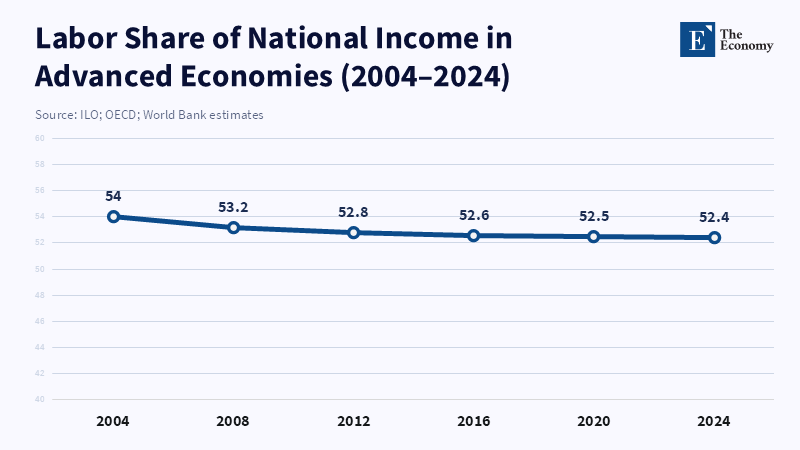
Artificial Intelligence introduces a new dynamic. Instead of moving work, businesses can use technology to automate tasks within their current operations. Software can now create reports, examine legal documents, write code, and manage customer service. Generative AI grew quickly after 2023, and it became cheaper as the technology improved and more people gained access through the cloud. Businesses now have a reason to replace workers with AI. It doesn't require moving factories or building new infrastructure overseas. It means using algorithms that run constantly at almost no additional cost.
History shows that replacing workers with technology can reduce labor's share of income. Studies of developed economies have noted a continuous decline in the labor share since the 1980s, partly due to information technology and the replacement of labor by capital. In several European countries and the United States, the labor share dropped by about eight percentage points between 1980 and 2007. This drop reflects the increasing use of technology to replace routine tasks. The rise of AI could worsen this trend because it can handle not just routine manual tasks but also tasks that require thinking.
Recent global estimates suggest that the labor income share has already decreased somewhat in the last two decades. According to the OECD, the share of income going to workers has fallen by about 6 percentage points in the United States and most developed countries between 1980 and 2022. If artificial intelligence continues to expand into more sectors, this downward trend could accelerate. Businesses become more productive while needing less labor for certain tasks. This change shifts income toward the owners of capital who control the algorithms, infrastructure, and intellectual property.
The initial signs in the job market are mixed. Employment in OECD countries remains high, and participation rates have reached new highs in many of these countries. Yet, job growth has started to slow. Between early 2024 and early 2025, employment rates across OECD countries increased by only 0.12 percentage points on average, about half the rate of the previous year. Although there has been concern about a slowdown in labor market growth due to automation, a report from the OECD finds no evidence to date that exposure to AI is linked to declining wage growth across OECD countries.
How the AI Labor Share Shift Affects Education Policy
According to the OECD, discussions about labor share rarely incorporate education policy, even as technological change continues to reshape job demands. But there's a clear connection. Schools and universities train workers for an economy where wages are the main source of income for most families. When the labor share decreases, the economic model supporting public education shifts. Public education systems rely heavily on labor-related taxes. Governments collect money through income taxes, payroll taxes, and taxes on what people spend. In many OECD countries, labor taxes account for a large share of public revenue. For example, the average tax on labor reached about 34.9% in OECD economies in 2024. This amount includes combined income taxes and social security contributions. This system works because workers earn taxable income that supports public services.
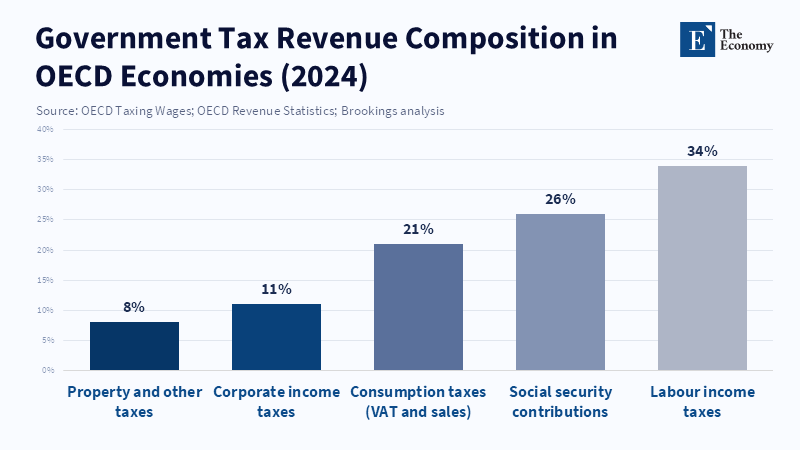
According to the OECD, as AI increases the share of income going to capital rather than labor, countries may see a shift in their tax base. With fewer people earning wages, income tax revenue could decrease. Less household spending also reduces consumption taxes. Even if total economic output increases, government revenue from labor may decline. This dynamic could put pressure on education budgets at a time when education systems need to expand training for new technological skills. This financial risk isn't often discussed in education discussions. Most of the conversation focuses on updating what is taught or introducing digital literacy. These changes are needed, but they aren't enough. The main issue is whether education systems can remain financially stable when the labor share decreases.
Education systems also have to prepare students for a job market shaped by AI. In the past, education expanded to meet industry demand for skilled workers. Universities grew along with knowledge industries. But AI changes the relationship between education and employment. A graduate entering the job market today might compete not only with other graduates but also with automated systems that can do parts of their job. This doesn't mean education is becoming less valuable. Advanced skills are still important. But the traditional idea that more education always leads to more job demand is becoming less certain. If AI handles a growing share of tasks that require thinking, the job market might reward fewer, highly specialized positions while reducing the need for middle-skill jobs. So, education policy must consider how to teach skills and prepare people for a more unstable income distribution.
Rethinking Education Systems in an Economy Shaped by AI and Labor Share
The challenge for education policy isn't just adapting to technology. It's redesigning institutions. When income from labor is no longer the main source of economic distribution, education systems must serve a wider range of social needs.
One way to respond is to focus on skills that support AI rather than compete with it. Research on technology adoption suggests that workers who combine analytical, social, and strategic skills are hard to automate. Tasks that involve negotiation, ethical reasoning, interdisciplinary thinking, and human interaction still rely on human abilities. Education systems need to strengthen these abilities across different subjects. This means moving away from teaching only narrow technical skills as the main purpose of higher education. AI can handle technical processes, such as coding or document review. Graduates who rely only on these skills might be quickly replaced. But people who know how to use technology in broader decision-making processes will still be valuable. Education systems should focus on critical thinking, knowledge of how institutions work, and learning across different fields.
Another change involves education throughout life. In an economy where technology quickly reshapes tasks, education can't be limited to the first two decades of life. Workers must return to training throughout their careers. Governments and universities should expand education programs that enable adults to acquire new skills without leaving the workforce. This shift is already happening in some OECD policy discussions. Because productivity growth remains low—around 1.4% across OECD countries in 2023, close to the long-term average—governments are looking to invest in people to achieve economic resilience. Education can help workers transition between jobs as automation reshapes job structures. But education alone can't solve the declining labor share problem. If automation continues to replace labor on a large scale, even well-trained workers might have less power to negotiate for better wages. Education policy must work with broader economic policies. Tax systems might need to place greater emphasis on capital income. Governments might also consider ways to more widely spread the gains from automation across the population.
Education systems also have a role to play here. Universities and research institutions create much of the innovation that drives AI development. Public money supports these. So, it is important for policymakers to ensure that the economic benefits of publicly funded innovation are shared broadly rather than concentrated only in private capital.
Education Policy as a Way to Stabilize the AI Labor Share
The stability of developed economies has always depended on a balance between labor and capital. When that balance shifts too much, social problems increase. The 20th century saw labor movements and policy changes aimed at restoring balance. AI is now threatening to disrupt that balance again, though in different ways.
Education policy can help stabilize this transition. First, it shapes the skills that support technological change. Second, it prepares people to participate in an economy where traditional job structures may change. Third, it supports the idea that technological advances are good by ensuring that their benefits are widely available. But education policy can't achieve these goals through small changes. The amount of change caused by AI requires a broader plan. Governments must see education not just as a way to prepare people for jobs but as a key institution for economic resilience. This means investing in courses that can adapt, expanding education systems for adults, and aligning financial structures with a future where income from labor might no longer be the main source of national earnings.
The initial signs of the AI age are still developing. Job markets are relatively stable, and employment levels remain high in many developed economies. But general trends already point toward a possible shift. The labor income share has decreased over the last two decades, and technological labor replacement continues to advance. If AI speeds up this trend, education systems will experience more demand for retraining and growing financial problems.
The main lesson is clear. Economic changes don't happen suddenly. They build up gradually until the institutions created for a previous era no longer fit. Education systems were designed for an economy in which labor accounted for most of the national income. AI might change that. Preparing for that now is easier than reacting after the change is deeply established.
The next 10 years will show whether AI becomes a tool to help us be more productive or a substitute for labor. Education policy must prepare for both. If societies act early—by aligning education, financial policy, and technology—they can ensure that AI creates opportunities rather than limits them. If they wait, the decline in labor share could harm economic equality and the financial underpinnings of public education. According to a report from the Penn Wharton Budget Model, advances in AI are expected to raise productivity and GDP by 1.5% by 2035, potentially influencing the long-standing labor share balance that has helped stabilize modern economies. Education policy is now central to our response. The institutions that prepare people for work must also prepare societies for a future where work itself is changing.
The views expressed in this article are those of the author(s) and do not necessarily reflect the official position of The Economy or its affiliates.
References
Acemoglu, D. and Restrepo, P., 2020. Robots and jobs: Evidence from US labor markets. Journal of Political Economy, 128(6), pp.2188–2244.
Arnon, A., 2025. The projected impact of generative AI on future productivity growth. Penn Wharton Budget Model, Philadelphia.
Autor, D., Dorn, D., Katz, L.F., Patterson, C. and Van Reenen, J., 2020. The fall of the labor share and the rise of superstar firms. Quarterly Journal of Economics, 135(2), pp.645–709.
Carbonero, F., Offermans, C. and Weber, E., 2023. The fall of the labor income share: The role of technological change and hiring frictions. Review of Economic Dynamics, 49, pp.251–268.
Drozd, L.A. and Tavares, M.M., 2024. Generative AI: A turning point for labour’s share? Economic Insights, Federal Reserve Bank of Philadelphia, Q1 2024.
Ergül, Ö. and Göksel, T., 2020. The effects of technological development on the labor share of national income. Economic Modelling, 87, pp.158–171.
Gulati, P., Marchetti, A., Puranam, P. and Sevcenko, V., 2025. Generative AI adoption and higher order skills. arXiv preprint.
International Labour Organization (ILO), 2024. Global labour income share declines putting upward pressure on inequality; SDG targets not on track. Geneva: ILO.
Korinek, A. and Lockwood, L.M., 2026. Public finance in the age of AI: A primer. NBER Working Paper / Brookings Working Paper.
Minniti, A., Prettner, K., Venturini, F. and Bloom, D., 2026. AI and the distribution of income between capital and labour. CEPR VoxEU Column.
OECD, 2023. OECD Employment Outlook 2023. Paris: OECD Publishing.
OECD, 2025a. OECD Employment Outlook 2025: Bouncing back, but on shaky ground: Wages continue to recover in uncertain labour markets. Paris: OECD Publishing.
OECD, 2025b. Taxing Wages 2025. Paris: OECD Publishing.
OECD, 2025c. OECD Economic Outlook, Volume 2025 Issue 2. Paris: OECD Publishing.
Penn Wharton Budget Model (Arnon, A.), 2025. The Projected Impact of Generative AI on Future Productivity Growth. Philadelphia: Penn Wharton Budget Model.
Productivity Institute, 2024. AI innovation and the labour share. Manchester: The Productivity Institute.
United Nations Economic Commission for Europe (UNECE), 2023. Labour share of GDP: Indicator methodology. Geneva: UNECE.
Working across research, policy, and data-driven analysis, the Editorial Board ensures that published pieces reflect a consistent institutional perspective grounded in quantitative reasoning and long-term structural assessment.













Comment