The Elite Lawyer Advantage: How money buys more than briefs

David O’Neill is a Professor of AI/Policy at the Gordon School of Business, SIAI, based in Switzerland. His work explores the intersection of AI, quantitative finance, and policy-oriented educational design, with particular attention to executive-level and institutional learning frameworks.
In addition to his academic role, he oversees the operational and financial administration of SIAI’s education programs in Europe, contributing to governance, compliance, and the integration of AI methodologies into policy and investment-oriented curricula.
Authored On
Modified
Elite lawyer advantage turns money into durable courtroom power
Networks and repeat experience, not just ideology, shape Supreme Court outcomes
Real reform must redesign the institutional ecosystem, not merely demand fairness

The fact that repeat Supreme Court litigators, a small group of highly experienced lawyers, appear before the high court far more often than those with only one appearance—between 20 to 70 times more— cannot be ignored. Experience alone increases a lawyer’s chance of winning by about fourteen percentage points. This difference is substantial and a key factor in modern litigation; money provides access to lawyers with knowledge, connections, and procedural advantages. When a select group of elite advocates handles high-stakes cases repeatedly, they influence the questions the Court considers, the factual arguments that strike a chord, and how the justices perceive credibility. As expected, wealthy parties who can afford top-tier counsel obtain more than just well-written briefs. They secure a range of advantages, such as specialized skills, ongoing relationships with court staff, and the ability to gather support from various groups, turning legal rules into practical power. This study indicates that the issue is not simply about money or judicial ideology but rather an entire system that transforms legal spending into a lasting institutional advantage. To create a fairer system, the goal should be to change this system, not just hope for fairer decisions.
The advantage starts with the market for legal talent. A small number of lawyers repeatedly argue the most important cases. Research that tracks appearances in recent times shows that a small group, roughly a dozen or a few dozen lawyers, appear much more often than others. About 15 superstar lawyers have appeared in private practice 20-69 times. This concentration is important because the Supreme Court is not only a forum for presenting legal arguments neutrally. It is a social setting where reputation, accuracy, and past successes influence what the justices consider important. Lawyers who have been in the courtroom many times understand the questioning styles, the arguments that gain attention, and the concrete facts that persuade the justices and their clerks. They also tend to manage large, well-funded teams that can gather support from outside groups, prepare data displays, and coordinate timing with the Court’s schedule. In other words, the advantage that elite lawyers have is a set of factors: experience builds skill, skill attracts high-profile clients, and clients reinvest in maintaining this advantage. This cycle is not simply a theory; it affects case outcomes. Studies that compare similar attorneys, including government solicitors, show that experienced repeat attorneys are much more likely to win. This is not solely about winning or losing; it shows that legal expertise translates directly into concrete benefits.
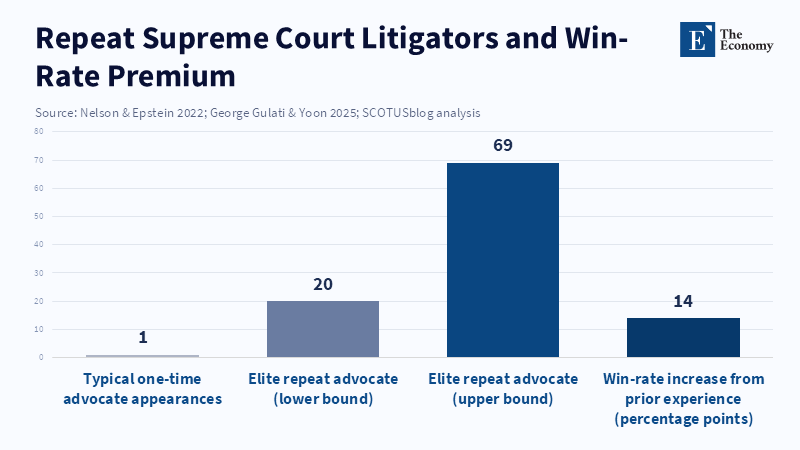
Networks and repeat experience, not just ideology, shape Supreme Court outcomes
Having money means more than just hiring a top lawyer. It provides access to networks that boost legal arguments beyond the written submissions. Elite lawyers often bring a support system that includes former clerks in key positions, established relationships with certain judges, and connections to influential outside groups. The modern market for amicus briefs shows this. Organizations, corporations, and undisclosed donors can fund friend-of-the-court briefs that indicate to the justices a sense of widespread agreement or factual support. According to a statement from Senator Sheldon Whitehouse, federal officials have debated strengthening disclosure requirements for amicus briefs because current rules do not sufficiently reveal who is funding them, eliciting concerns that outside funding could hide coordination between parties and groups that appear independent. When donors or trade groups support an amicus campaign, they are not just expressing opinions; they are creating the evidence and support that the Court considers. This increases the value of elite counsel, as a top lawyer can coordinate amicus briefs, verify factual claims, and present the appearance of broad support rather than just one client’s request. This leads to an information cascade where the Court sees not just one brief but a cohesive front of support. Network advantages, such as clerkships, law firm staff rotations into government roles, and post-clerkship hiring, further strengthen this cycle. Therefore, proposals that treat money and access as separate issues miss the point: paying for elite counsel buys access to networks that create legal advantage on a large scale.
Why simple fairness and better rules are insufficient
A common approach to reform is to expect government officials to act more fairly by upgrading public defenders, increasing funding for legal aid, and tightening campaign finance regulations. While these actions are important, they underestimate how firmly established the elite lawyer advantage is. The professional world of top-tier litigation is self-sustaining in three ways. First, experience creates trust: justices and clerks learn to rely on certain lawyers, and this trust cannot easily be transferred through funding. Second, high-level litigation often entails complex technical or economic arguments that large firms can support with teams of specialists, something smaller entities cannot quickly replicate. Third, the incentives for lawyers and judges are not aligned with a simple fairness solution. Once appointed, judges rarely return to the private sector at the same level of compensation. Instead, the legal elite continue to circulate through clerkships, conferences, and occasional lectures, preserving influence without direct commercial gain. This makes structural reform more challenging; simply removing money will not automatically equalize access because the advantage lies in lasting relationships and specialized expertise. Additionally, transparency efforts face political opposition, as business groups have repeatedly opposed stronger disclosure rules for amicus funding, citing First Amendment concerns. The hope that simply asking officials to be fairer will close the gap misunderstands how legal advantage is created. Real change requires interventions focused on the structure of influence.
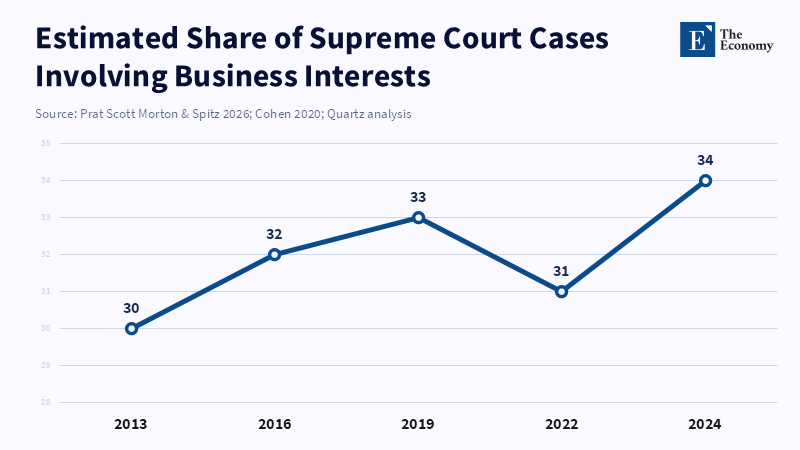
If the problem lies within the system, the solution must address the system itself. Three practical steps can begin to disrupt this cycle while allowing the Court to address difficult legal questions. First, require transparent funding disclosures for amicus briefs and for groups that coordinate filings with parties involved in the cases. While transparency is not a complete solution, it reveals hidden networks and reduces the power of coordinated donor groups that allow special interests to appear as independent consensus. Second, professionalize high-level public advocacy to match the resources of large firms. This can be achieved by creating a funded, rotating public-interest litigation office that can attract top appellate talent with competitive salaries and gather support from outside groups, data, and expert testimony. This reduces the experience gap by providing non-commercial parties with consistent counsel who can compete effectively. Third, revise the process for accepting and briefing cases to limit agenda control. This involves requiring clearer statements about the social impact of economic cases and mandating brief, standardized impact appendices that allow clerks to compare cases using common criteria. These proposals are measurable but can be tested. They do not require changing judicial philosophy and avoid the unrealistic goal of altering deep political alignments. Instead, they target channels such as disclosure, resources, and agenda control that turn money into permanent advantage.
The initial statistic serves as a warning: experience combined with extensive networks transforms law into a tool of advantage. We cannot ignore this by simply wishing for higher ethical standards among judges or with superficial gestures toward fairness. The problem is systemic, not merely individual. Reformers should shift from merely urging legal equity to actively designing it into the system. This requires insisting on disclosure that reveals coordinated funding, building public litigation resources capable of realistically challenging elite teams, and reforming practices that allow agenda control to concentrate power. These are tactical, political, and legal steps. They are also practical. If we want a Court that delivers law fairly, we must redesign the mechanisms by which money becomes influence. Otherwise, calls for fairness will remain civil requests to change a system designed to favor those who already have advantages.
The views expressed in this article are those of the author(s) and do not necessarily reflect the official position of The Economy or its affiliates.
References
Cohen, A., 2020. How the Supreme Court Favors the Rich and Powerful. Time, 3 March.
George, T.E., Gulati, M. & Yoon, A.H., 2025. The SCOTUS Tournament: Winning Isn't Everything (preprint).
Gulati, M., George, T.E. & Yoon, A.H., 2025. Professors’ Paper Explains How a Handful of Elite Lawyers Dominates Supreme Court Litigation. University of Virginia School of Law news release, 20 February.
Nelson, M.J. & Epstein, L., 2022. Human Capital in Court: The Role of Attorney Experience in U.S. Supreme Court Litigation. Journal of Law and Courts, 10(1), pp.61–85.
Prat, A., Scott Morton, F. & Spitz, J., 2026. Ruling for the rich: Evidence of a pro-wealthy bias on the US Supreme Court. Centre for Economic Policy Research (VoxEU), 23 February.
Reuters, Scarcella, M., 2025. Business groups oppose tighter financial disclosures in court amicus briefs. Reuters, 14 February.
SCOTUSblog, 2019. Academic highlight: Lawyers with more experience obtain better outcomes (summary of Nelson & Epstein findings).
Smith, D., 2023. Rightwing activist helps fund 'predatory payday lenders' in supreme court case. The Guardian, 2 October.
Quartz, Baab, C., 2026. The Supreme Court increasingly favors wealthy interests. Here's what that means for business. Quartz.
David O’Neill is a Professor of AI/Policy at the Gordon School of Business, SIAI, based in Switzerland. His work explores the intersection of AI, quantitative finance, and policy-oriented educational design, with particular attention to executive-level and institutional learning frameworks.
In addition to his academic role, he oversees the operational and financial administration of SIAI’s education programs in Europe, contributing to governance, compliance, and the integration of AI methodologies into policy and investment-oriented curricula.